
Black-necked Grebe
Podiceps nigricollis
The black-necked grebe or eared grebe (Podiceps nigricollis) is a member of the grebe family of water birds.
- Kingdom
- Animalia
- Phylum
- Chordata
- Class
- Aves
- Order
- Podicipediformes
- Family
- Podicipedidae
- Genus
- Podiceps
- Species
- Podiceps nigricollis
Description
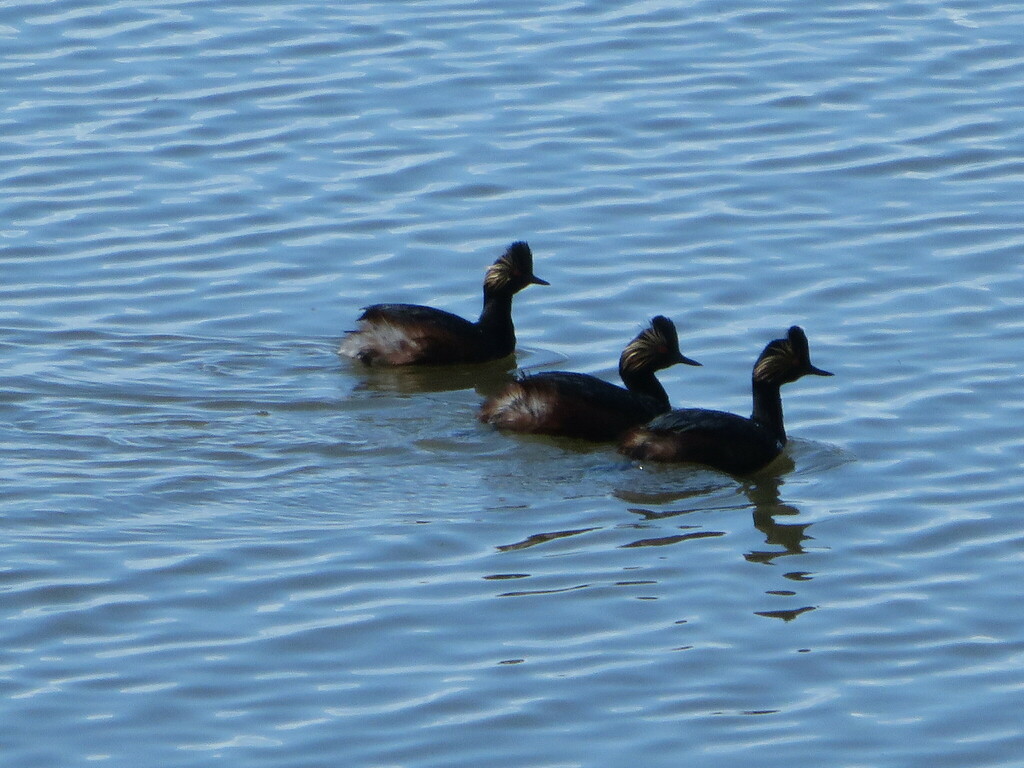
The black-necked grebe or eared grebe (Podiceps nigricollis) is a member of the grebe family of water birds. It was described in 1831 by Christian Ludwig Brehm. Its breeding plumage features distinctive ochre-coloured feathers which extend behind its eye and over its ear coverts. The rest of the upper parts, including the head, neck, and breast, are coloured black to blackish brown. The flanks are tawny rufous to maroon-chestnut, and the abdomen is white. In its non-breeding plumage, this bird has greyish-black upper parts, including the top of the head and a vertical stripe on the back of the neck. The flanks are also greyish-black. The rest of the body is a white or whitish colour. The juvenile has more brown in its darker areas. This species is present in parts of Africa, Eurasia, and the Americas. The black-necked grebe uses multiple foraging techniques. Insects, which make up the majority of this bird's diet, are caught either on the surface of the water or when they are in flight; this species occasionally practices foliage gleaning. This grebe dives to catch crustaceans, molluscs, tadpoles, and small frogs and fish. When moulting at saline lakes, this bird feeds mostly on brine shrimps (such as Artemia franciscana, and "Artemia parthenogenetica"). The black-necked grebe makes a floating cup nest on an open lake. The nest cup is covered with a disc. This nest is located both in colonies and by itself. During the breeding season, which varies depending on location, this species will lay one (sometimes two) clutch of three to four eggs. The number of eggs is sometimes larger due to conspecific brood parasitism. After a 21-day incubation period, the eggs hatch, and then the nest is deserted. After about 10 days, the parents split up the chicks between themselves. After this, the chicks become independent in about 10 days, and fledge in about three weeks. Although it generally avoids flight, the black-necked grebe travels as far as 6,000 kilometres (3,700 mi) during migration. In addition, it becomes flightless for at least a month after completing a migration to reach an area where it can moult safely. During this moult, the grebe can double in weight. The migration to reach these areas can be dangerous, sometimes with thousands of grebe deaths. In spite of this, it is classified as a least concern species by the International Union for Conservation of Nature (IUCN). It is likely that this is the most numerous grebe in the world. There are potential threats to it, such as oil spills, but these are not likely to present a major risk to the overall population.
Gallery
Ajouter des photos
Partagez vos photos de cette espèce (jusqu'à 20 à la fois) : elles sont vérifiées automatiquement, puis publiées.
Répartition
Occurrences observées (données GBIF). Les zones hors aire d'origine peuvent indiquer une présence introduite ou invasive.
Sources et crédits
Informations provenant de plusieurs sources vérifiées. Dernière mise à jour : .
Crédits photos (8)
- Photo : Denis H Knopp (@denis_k) · CC BY-NC 4.0 · via iNaturalist
- Photo : Cindy "Annie" Howland-Hodson (@hoboannie) · CC BY-NC 4.0 · via iNaturalist
- Photo : ayden (@aydenburd) · CC BY-NC 4.0 · via iNaturalist
- Photo : Jonathan (@jonathangarciab) · CC BY-NC 4.0 · via iNaturalist
- Photo : ren pedersen (@renjp) · CC BY-NC 4.0 · via iNaturalist
- Photo : Irina Bobyleva (@irinabobyleva) · CC BY-NC 4.0 · via iNaturalist
- Photo : @sbeep · CC BY-NC 4.0 · via iNaturalist
- Photo : Andréa Quattro. (@andrea_quattrociocchi) · CC BY-NC 4.0 · via iNaturalist
Mentions de licence
Texte disponible sous licence CC BY-SA 4.0. Il adapte notamment Wikipedia (CC BY-SA) : Black-necked grebe (Wikipédia, auteurs dans l’historique de l’article).
- Taxonomie : GBIF Backbone Taxonomy (CC BY 4.0)
- Carte : occurrences GBIF, fond © contributeurs OpenStreetMap (ODbL)
- Statut de conservation : Liste rouge de l'UICN, via Wikidata (CC0)
Détail : Sources et licences.
Discussion (0)
Aucun message pour l’instant. Lancez la discussion sur cette fiche (sources, précisions, débats éditoriaux).
Connectez-vous pour participer à la discussion.