
Great Horned Owl
Bubo virginianus
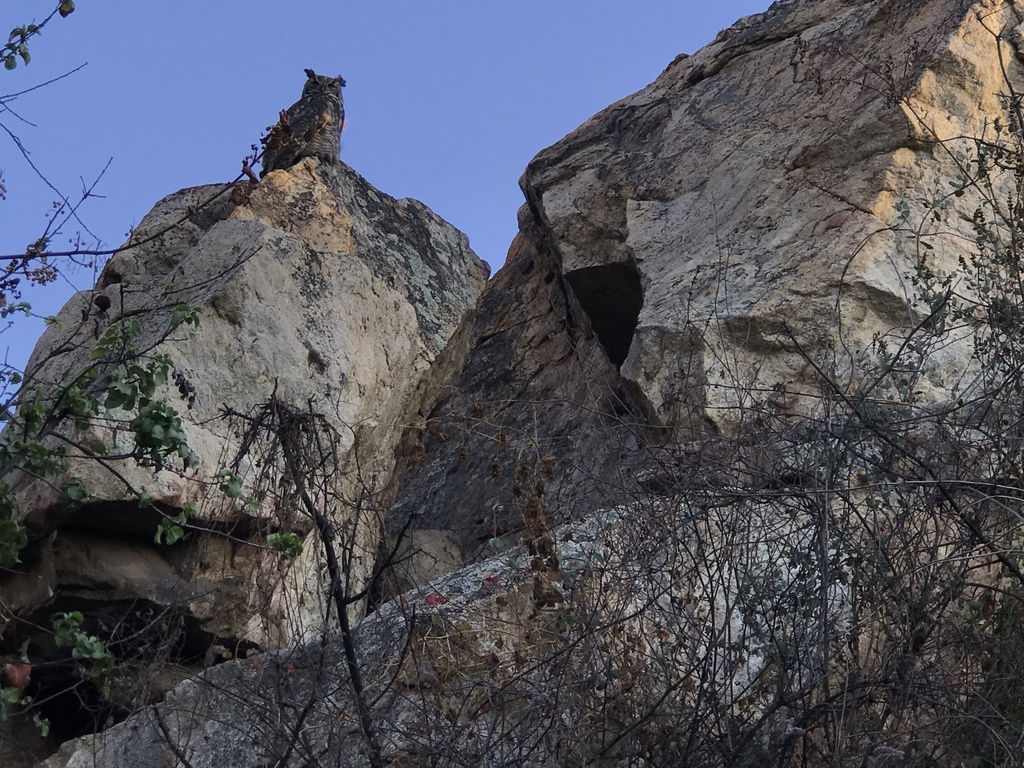
The great horned owl (Bubo virginianus), also known as the tiger owl (originally derived from early naturalists' description as the "winged tiger" or "tiger of the air") or the hoot owl, is a large owl native to the Americas.
- Kingdom
- Animalia
- Phylum
- Chordata
- Class
- Aves
- Order
- Strigiformes
- Family
- Strigidae
- Genus
- Bubo
- Species
- Bubo virginianus
Description
The great horned owl (Bubo virginianus), also known as the tiger owl (originally derived from early naturalists' description as the "winged tiger" or "tiger of the air") or the hoot owl, is a large owl native to the Americas. It is an extremely adaptable bird with a vast range and is the most widely distributed true owl in the Americas. Its diet consists primarily of rabbits and hares, rats and mice, and voles; it remains one of the few regular predators of skunk. Hunting also includes rodents, larger mid-sized mammals, birds, reptiles, amphibians, and invertebrates. In ornithological study, the great horned owl is often compared to the Eurasian eagle-owl (Bubo bubo), a closely related species, which occupies the same ecological niche in Eurasia despite its notably larger size. The great horned owl is also compared to the red-tailed hawk (Buteo jamaicensis), with which it often shares similar habitat, prey, and nesting habits by day; thus the red-tailed hawk is something of a diurnal ecological equivalent. The great horned owl is one of the earliest nesting birds in North America, often laying eggs weeks or even months before other raptorial birds.
Gallery
Ajouter des photos
Partagez vos photos de cette espèce (jusqu'à 20 à la fois) : elles sont vérifiées automatiquement, puis publiées.
Répartition
Occurrences observées (données GBIF). Les zones hors aire d'origine peuvent indiquer une présence introduite ou invasive.
Sources et crédits
Informations provenant de plusieurs sources vérifiées. Dernière mise à jour : .
Crédits photos (8)
- Photo : Becky Escalante (@spifferella) · CC BY-NC 4.0 · via iNaturalist
- Photo : Diego Tamayo (@diego4nature) · CC BY-NC 4.0 · via iNaturalist
- Photo : Brooke J. (@inkasaur) · CC BY 4.0 · via iNaturalist
- Photo : Philippe Hénault (@phil_crimson) · CC BY-NC 4.0 · via iNaturalist
- Photo : Gonzalo Diaz (@goncrisdi) · CC BY-NC 4.0 · via iNaturalist
- Photo : Karim Gharbi (@bugs_not_drugs) · CC BY-NC 4.0 · via iNaturalist
- Photo : Mary G (@mgessert) · CC BY 4.0 · via iNaturalist
- Photo : Katie and Ethan (@eisenbarths) · CC BY-NC 4.0 · via iNaturalist
Mentions de licence
Texte disponible sous licence CC BY-SA 4.0. Il adapte notamment Wikipedia (CC BY-SA) : Great horned owl (Wikipédia, auteurs dans l’historique de l’article).
- Taxonomie : GBIF Backbone Taxonomy (CC BY 4.0)
- Carte : occurrences GBIF, fond © contributeurs OpenStreetMap (ODbL)
- Statut de conservation : Liste rouge de l'UICN, via Wikidata (CC0)
Détail : Sources et licences.
Discussion (0)
Aucun message pour l’instant. Lancez la discussion sur cette fiche (sources, précisions, débats éditoriaux).
Connectez-vous pour participer à la discussion.