
Bluethroat
Luscinia svecica
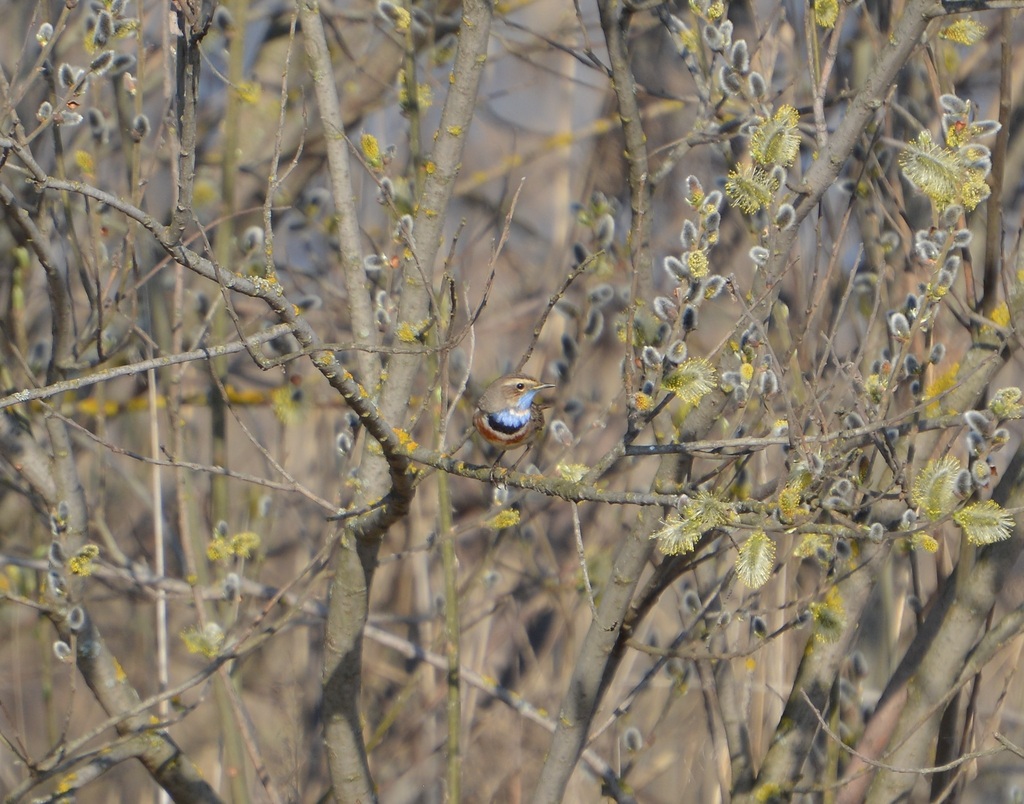
The bluethroat (Luscinia svecica) is a small passerine bird in the Old World flycatcher family.
- Kingdom
- Animalia
- Phylum
- Chordata
- Class
- Aves
- Order
- Passeriformes
- Family
- Muscicapidae
- Genus
- Luscinia
- Species
- Luscinia svecica
Description
The bluethroat (Luscinia svecica) is a small passerine bird in the Old World flycatcher family. It is a migratory insectivorous species breeding in wet birch wood or bushy swamp in Europe and across the Palearctic with a foothold in western Alaska. It nests in tussocks or low in dense bushes. It winters in the Iberian Peninsula, the northern half of Africa, and in southern Asia (among others including the Indian subcontinent). The bluethroat, and similar small European flycatchers, are often called chats. The bluethroat is similar in size to the European robin at 13–14 cm. It is plain brown above except for the distinctive tail, brown with black outer corners and red basal side patches. It has a strong white supercilium. The males have a striking throat pattern, with a vivid glossy blue throat bordered below with (usually) a narrow black band (but see subspecies, below), and a broad brick-red band below that; additionally there is often a central spot, either red or white, in the middle of the blue throat; see subspecies below for details. Despite the distinctive appearance of the males, recent genetic studies show only limited variation between the forms, and confirm that this is a single species. Moult begins in July after breeding and is completed in 40–45 days, before the birds migrate. The male has a varied and very imitative song. Its call is a typical chat chack noise.
Gallery
Ajouter des photos
Partagez vos photos de cette espèce (jusqu'à 20 à la fois) : elles sont vérifiées automatiquement, puis publiées.
Répartition
Occurrences observées (données GBIF). Les zones hors aire d'origine peuvent indiquer une présence introduite ou invasive.
Sources et crédits
Informations provenant de plusieurs sources vérifiées. Dernière mise à jour : .
Crédits photos (8)
- Photo : Galina Stolbova (@galinast) · CC BY-NC 4.0 · via iNaturalist
- Photo : Daniel Raposo (@draposo79) · CC BY-NC 4.0 · via iNaturalist
- Photo : Анастасия Яковлева (@anastasiazhemik) · CC BY-NC 4.0 · via iNaturalist
- Photo : Pavel Komkov (@pavelkomkov) · CC BY 4.0 · via iNaturalist
- Photo : Ivan Smorkalov (@sundry_divers) · CC BY-NC 4.0 · via iNaturalist
- Photo : Serych (@serycherny) · CC BY-NC 4.0 · via iNaturalist
- Photo : Yiyin Qi (@yiyin_qi) · CC BY-NC 4.0 · via iNaturalist
- Photo : @ekaterina_arkadevna · CC BY-NC 4.0 · via iNaturalist
Mentions de licence
Texte disponible sous licence CC BY-SA 4.0. Il adapte notamment Wikipedia (CC BY-SA) : Bluethroat (Wikipédia, auteurs dans l’historique de l’article).
- Taxonomie : GBIF Backbone Taxonomy (CC BY 4.0)
- Carte : occurrences GBIF, fond © contributeurs OpenStreetMap (ODbL)
- Statut de conservation : Liste rouge de l'UICN, via Wikidata (CC0)
Détail : Sources et licences.
Discussion (0)
Aucun message pour l’instant. Lancez la discussion sur cette fiche (sources, précisions, débats éditoriaux).
Connectez-vous pour participer à la discussion.