
Macaroni Penguin
Eudyptes chrysolophus
The macaroni penguin (Eudyptes chrysolophus) is a species of penguin found from the Subantarctic to the Antarctic Peninsula.
- Kingdom
- Animalia
- Phylum
- Chordata
- Class
- Aves
- Order
- Sphenisciformes
- Family
- Spheniscidae
- Genus
- Eudyptes
- Species
- Eudyptes chrysolophus
Description
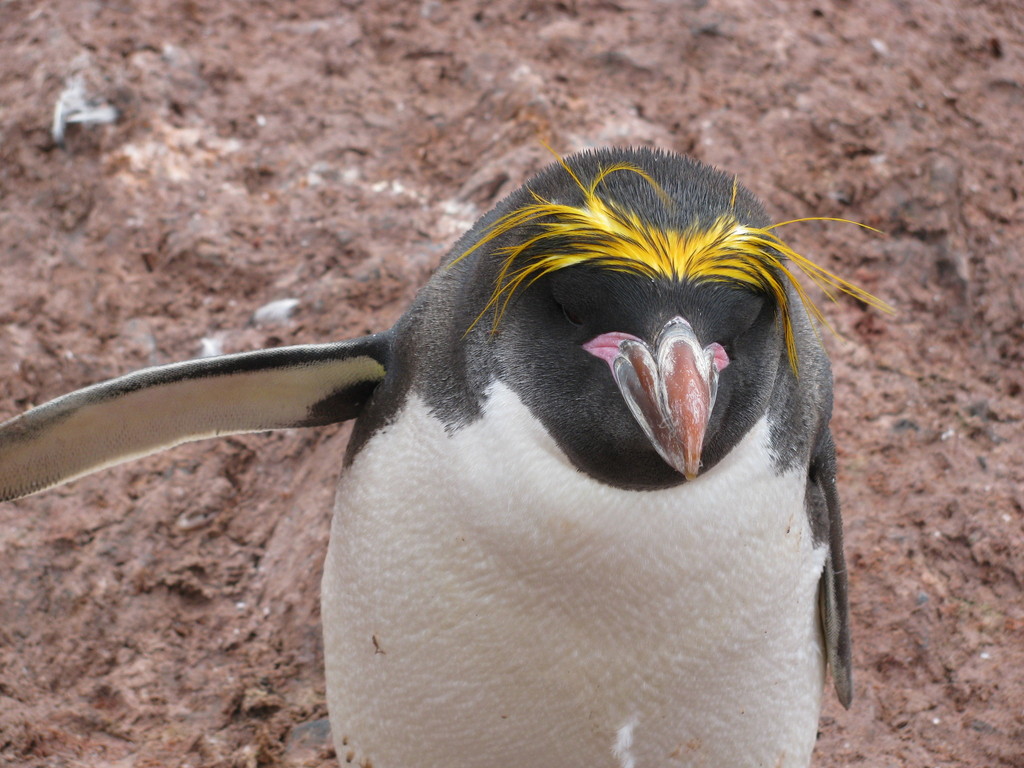
The macaroni penguin (Eudyptes chrysolophus) is a species of penguin found from the Subantarctic to the Antarctic Peninsula. One of eight species of crested penguin, it is very closely related to the royal penguin, and some authorities consider the two to be a single species. It bears a distinctive yellow crest on its forehead. Its face and upperparts are black and sharply delineated from the white underparts. Adults weigh on average 5.5 kg (12 lb) and are 70 cm (28 in) in length. The male and female are similar in appearance; the male is slightly larger and stronger with a larger bill. Like all penguins, it is flightless, with a streamlined body and wings stiffened and flattened into flippers for a marine life. Its diet consists of a variety of crustaceans, mainly krill, as well as small fish and cephalopods; the species consumes more marine life annually than any other species of seabird. These birds moult once a year, spending about three to four weeks ashore, before returning to the sea. Numbering up to 100,000 individuals, the breeding colonies of the macaroni penguin are among the largest and densest of all penguin species. After spending the summer breeding, penguins disperse into the oceans for six months; a 2009 study found that macaroni penguins from Kerguelen travelled over 10,000 km (6,200 mi) in the central Indian Ocean. With about 18 million individuals, the macaroni penguin is the most numerous penguin species. Widespread declines in populations have been recorded since the mid-1970s and their conservation status classification is vulnerable.
Gallery
Ajouter des photos
Partagez vos photos de cette espèce (jusqu'à 20 à la fois) : elles sont vérifiées automatiquement, puis publiées.
Répartition
Occurrences observées (données GBIF). Les zones hors aire d'origine peuvent indiquer une présence introduite ou invasive.
Sources et crédits
Informations provenant de plusieurs sources vérifiées. Dernière mise à jour : .
Crédits photos (8)
- Photo : @ecologyelise · CC BY-NC 4.0 · via iNaturalist
- Photo : Ray Duffy (@rduffy1172) · CC BY-NC 4.0 · via iNaturalist
- Photo : @nhaass · CC BY-NC 4.0 · via iNaturalist
- Photo : @alanvannorman · CC BY-NC 4.0 · via iNaturalist
- Photo : Nigel Forshaw (@nigelforshaw) · CC BY-NC 4.0 · via iNaturalist
- Photo : John Sterling (@jsterling60) · CC BY-NC 4.0 · via iNaturalist
- Photo : Ryan F. Mandelbaum (@ryanfm) · CC BY 4.0 · via iNaturalist
- Photo : Science and Education Coordinator MS FRAM (@scienceco_fr) · CC BY-NC 4.0 · via iNaturalist
Mentions de licence
Texte disponible sous licence CC BY-SA 4.0. Il adapte notamment Wikipedia (CC BY-SA) : Macaroni penguin (Wikipédia, auteurs dans l’historique de l’article).
- Taxonomie : GBIF Backbone Taxonomy (CC BY 4.0)
- Carte : occurrences GBIF, fond © contributeurs OpenStreetMap (ODbL)
- Statut de conservation : Liste rouge de l'UICN, via Wikidata (CC0)
Détail : Sources et licences.
Discussion (0)
Aucun message pour l’instant. Lancez la discussion sur cette fiche (sources, précisions, débats éditoriaux).
Connectez-vous pour participer à la discussion.