
Collared Flycatcher
Ficedula albicollis
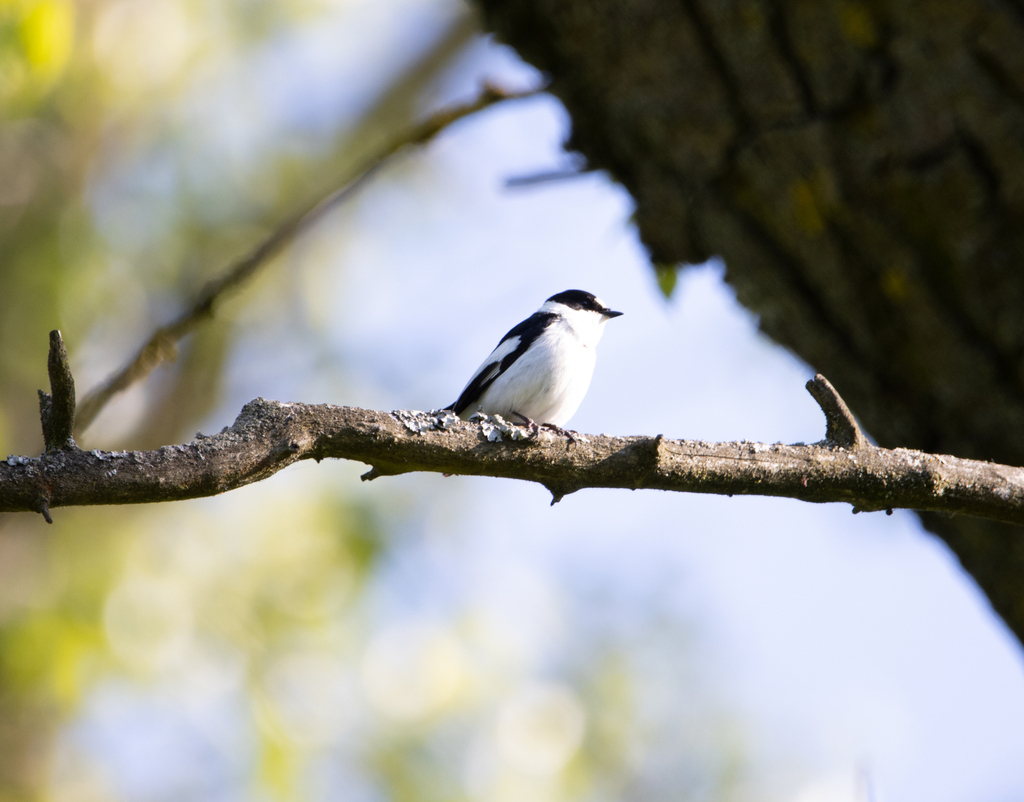
The collared flycatcher (Ficedula albicollis) is a small passerine bird in the Old World flycatcher family, one of the four species of Western Palearctic black-and-white flycatchers.
- Kingdom
- Animalia
- Phylum
- Chordata
- Class
- Aves
- Order
- Passeriformes
- Family
- Muscicapidae
- Genus
- Ficedula
- Species
- Ficedula albicollis
Description
The collared flycatcher (Ficedula albicollis) is a small passerine bird in the Old World flycatcher family, one of the four species of Western Palearctic black-and-white flycatchers. It breeds in southeast Europe (isolated populations are present in the islands of Gotland and Öland in the Baltic Sea, Sweden) and Eastern France to the Balkan Peninsula and Ukraine and is migratory, wintering in Sub-Saharan Africa. It is a rare vagrant in western Europe. This is a 12–13.5 cm long bird. The breeding male is mainly black above and white below, with a white collar, large white wing patch, black tail (although some males have white tail sides) and a large white forehead patch. It has a pale rump. The bill is black and has the broad but pointed shape typical of aerial insectivores. As well as taking insects in flight, this species hunts caterpillars amongst the oak foliage, and will take berries. Non-breeding males, females and juveniles have the black replaced by a pale brown, and may be very difficult to distinguish from other Ficedula flycatchers, particularly the European pied flycatcher (F. hypoleuca) and the semicollared flycatcher (F. semitorquata), with which this species hybridizes to a limited extent. F. albicollis vis-a-vis F. hypoleuca are speciating from each other by reinforcement, as evidenced by differences between colouration in sympatry versus allopatry. This is evidence for speciation by reinforcement. They are birds of deciduous woodlands, parks and gardens, with a preference for old trees with cavities in which it nests. They build an open nest in a tree hole, or man-made nest-boxes. Normally 5-7 eggs are laid. The song is slow strained whistles, quite unlike the pied flycatcher. Pied flycatchers can mimic the song of the collared flycatcher in sympatric populations. The genus name is from Latin and refers to a small fig-eating bird (ficus, "fig") supposed to change into the blackcap in winter. The specific albicollis is from Latin albus, white, and collum, "neck". The collared flycatcher is used as a model species in both ecology and genetics and it was one of the first birds that had its full genome sequenced. Repeated spectrometric data taken from male collared flycatchers has revealed that plumage reflectance should be measured during courtship, the primary period of sexual signalling, with spectral traits declining over the breeding season. In a natural population of F. albicollis inbreeding appeared to be rare, but when it did occur it had severe negative consequences for fitness characteristics such as hatching success rate.
Gallery
Ajouter des photos
Partagez vos photos de cette espèce (jusqu'à 20 à la fois) : elles sont vérifiées automatiquement, puis publiées.
Répartition
Occurrences observées (données GBIF). Les zones hors aire d'origine peuvent indiquer une présence introduite ou invasive.
Sources et crédits
Informations provenant de plusieurs sources vérifiées. Dernière mise à jour : .
Crédits photos (8)
- Photo : Denys Davydov (@davydovbotany) · CC BY-NC 4.0 · via iNaturalist
- Photo : Александр (@xander_knysh) · CC BY-NC 4.0 · via iNaturalist
- Photo : Kevin Merl (@merl) · CC BY-NC 4.0 · via iNaturalist
- Photo : African (@afr1can) · CC BY-NC 4.0 · via iNaturalist
- Photo : @belyaev · CC BY-NC 4.0 · via iNaturalist
- Photo : Богданович Светлана (@svetlana-bogdanovich) · CC BY-NC 4.0 · via iNaturalist
- Photo : Svatava Čoupková (@svatka) · CC BY-NC 4.0 · via iNaturalist
- Photo : Jim (@cherusker) · CC BY-NC 4.0 · via iNaturalist
Mentions de licence
Texte disponible sous licence CC BY-SA 4.0. Il adapte notamment Wikipedia (CC BY-SA) : Collared flycatcher (Wikipédia, auteurs dans l’historique de l’article).
- Taxonomie : GBIF Backbone Taxonomy (CC BY 4.0)
- Carte : occurrences GBIF, fond © contributeurs OpenStreetMap (ODbL)
- Statut de conservation : Liste rouge de l'UICN, via Wikidata (CC0)
Détail : Sources et licences.
Discussion (0)
Aucun message pour l’instant. Lancez la discussion sur cette fiche (sources, précisions, débats éditoriaux).
Connectez-vous pour participer à la discussion.