
Brown Gerygone
Gerygone mouki
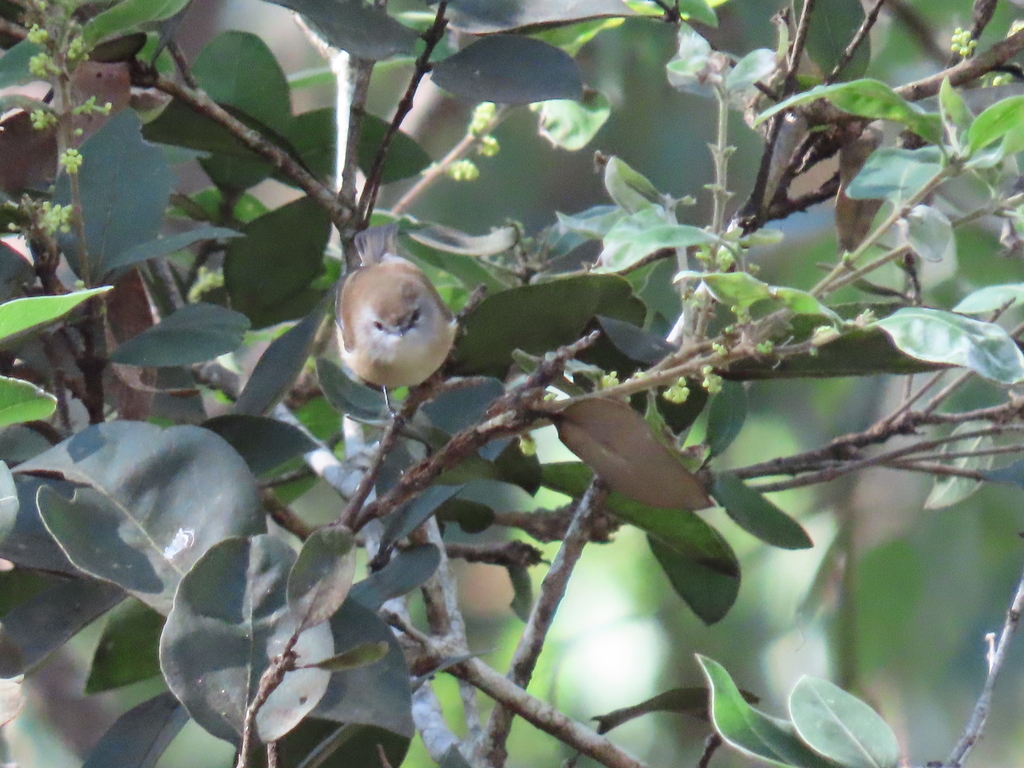
The brown gerygone (Gerygone mouki), previously known as the brown warbler, is a small passerine bird native to eastern coastal Australia.
- Kingdom
- Animalia
- Phylum
- Chordata
- Class
- Aves
- Order
- Passeriformes
- Family
- Acanthizidae
- Genus
- Gerygone
- Species
- Gerygone mouki
Description
The brown gerygone (Gerygone mouki), previously known as the brown warbler, is a small passerine bird native to eastern coastal Australia. The upper parts are olive-brown (or olive-grey for the nominate subspecies native to far-north Queensland), while its face and underparts are a much paler grey, cream, or washed-out brown. The tail feathers are dark and may be white-tipped. It is approximately 10 cm in length. The brown gerygone has a relatively large range. Although total population trends have not been quantified, it is considered of "least concern" by the IUCN. It may be sighted in coastal rainforest, singly or in small groups of two to four. It feeds on insects. The brown gerygone call is a soft what-is-it. It is not closely related to either true Old World Warblers or the New World Warblers, but belongs rather to the Corvida parvorder comprising many tropical and Australian passerines, as well as crows. The brown gerygone is similar to both the large-billed (G. magnirostris) and mangrove (G. levigaster) gerygones. It differs from the former by having a distinctive white eyebrow and a grey-tinged face. The mangrove gerygone, while having a white eyebrow, lacks the grey face, has more white on the flanks and has a redder eye.
Gallery
Ajouter des photos
Partagez vos photos de cette espèce (jusqu'à 20 à la fois) : elles sont vérifiées automatiquement, puis publiées.
Répartition
Occurrences observées (données GBIF). Les zones hors aire d'origine peuvent indiquer une présence introduite ou invasive.
Sources et crédits
Informations provenant de plusieurs sources vérifiées. Dernière mise à jour : .
Crédits photos (8)
- Photo : Marguerite B (@murramarg) · CC BY-NC 4.0 · via iNaturalist
- Photo : @andrewpavlov · CC BY-NC 4.0 · via iNaturalist
- Photo : @andrewpavlov · CC BY-NC 4.0 · via iNaturalist
- Photo : Alison (@alisonrharmer) · CC BY-NC 4.0 · via iNaturalist
- Photo : Liam Pentangelo (@liam_pentangelo) · CC BY-NC 4.0 · via iNaturalist
- Photo : @carategan · CC BY-NC 4.0 · via iNaturalist
- Photo : @lachlan_harriman · CC BY-NC 4.0 · via iNaturalist
- Photo : Casey M (@casey-em05) · CC BY-NC 4.0 · via iNaturalist
Mentions de licence
Texte disponible sous licence CC BY-SA 4.0. Il adapte notamment Gérygone brune, Wikipedia (CC BY-SA) : Brown gerygone (Wikipédia, auteurs dans l’historique de l’article).
- Taxonomie : GBIF Backbone Taxonomy (CC BY 4.0)
- Carte : occurrences GBIF, fond © contributeurs OpenStreetMap (ODbL)
- Statut de conservation : Liste rouge de l'UICN, via Wikidata (CC0)
Détail : Sources et licences.
Discussion (0)
Aucun message pour l’instant. Lancez la discussion sur cette fiche (sources, précisions, débats éditoriaux).
Connectez-vous pour participer à la discussion.