
Striped Cuckoo
Tapera naevia
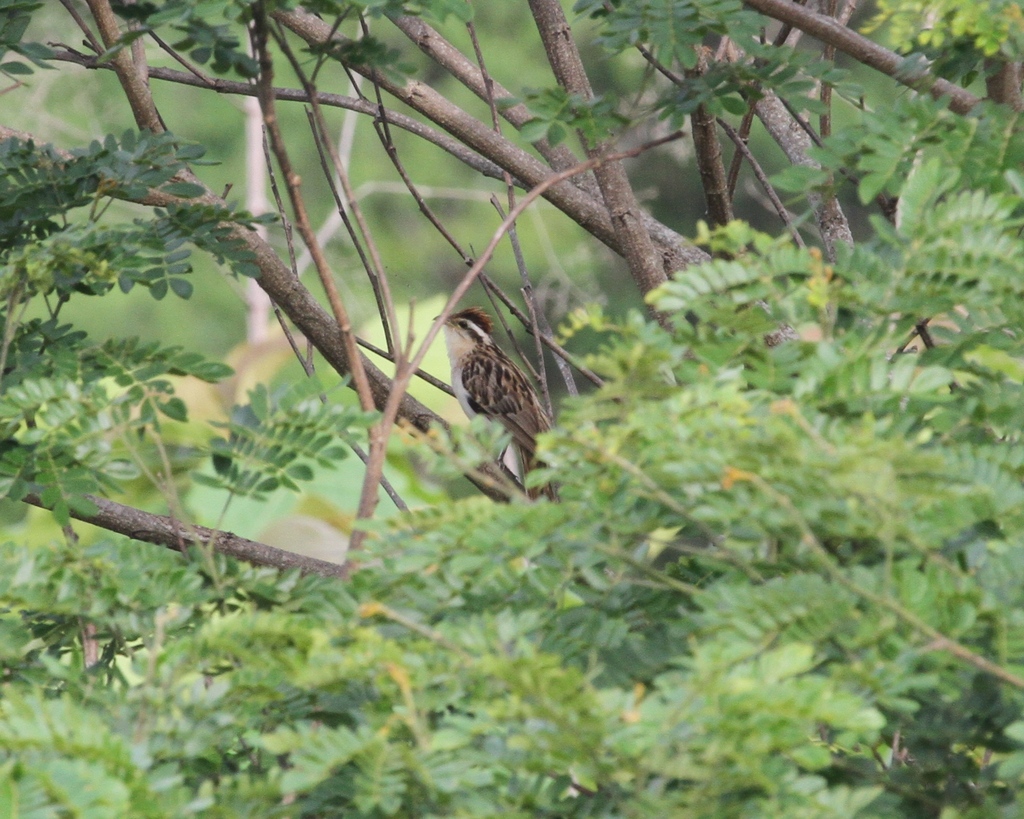
The striped cuckoo (Tapera naevia) is a near-passerine bird, the only member of the genus Tapera.
- Kingdom
- Animalia
- Phylum
- Chordata
- Class
- Aves
- Order
- Cuculiformes
- Family
- Cuculidae
- Genus
- Tapera
- Species
- Tapera naevia
Description
The striped cuckoo (Tapera naevia) is a near-passerine bird, the only member of the genus Tapera. This resident cuckoo is found from Mexico and Trinidad south to Bolivia and Argentina and Colombia. The striped cuckoo is found in open country with trees or shrubs, and the edges of mangrove forests. It is among the very few brood parasitic cuckoos of the Americas (only other are Dromococcyx), and typical hosts are spinetails, but often also wrens, and other species with domed nests. The female cuckoo lays one, sometimes two, white or bluish eggs in the host's large stick nest. The eggs hatch in 15 days, with a further 18 days until the cuckoo fledges. The young spinetails disappear. This species is about 27 cm (11 in) long and weighs 40 g (1.4 oz). The adult is mainly grey-brown above, streaked with black and buff. It has a pale supercilium and a chestnut and black crest which is raised as part of its display. The underparts are off-white and the tail is long and graduated. Immature birds are spotted with buff and are more rufous on the back and wings. The striped cuckoo eats large insects (primarily grasshoppers and caterpillars), often taken off the ground. This is a solitary and fairly shy species which tends to keep to the cover of bushes, although it will sing from more open perches. It has a whistled call usually of two or three notes, wu-weee or wu-wu-wee, and can be attracted by imitations of this.
Gallery
Ajouter des photos
Partagez vos photos de cette espèce (jusqu'à 20 à la fois) : elles sont vérifiées automatiquement, puis publiées.
Répartition
Occurrences observées (données GBIF). Les zones hors aire d'origine peuvent indiquer une présence introduite ou invasive.
Sources et crédits
Informations provenant de plusieurs sources vérifiées. Dernière mise à jour : .
Crédits photos (8)
- Photo : @jugbayjs · CC BY-NC 4.0 · via iNaturalist
- Photo : Santi MD (@smejiadu) · CC BY-NC 4.0 · via iNaturalist
- Photo : Alan Hentz (@alanhentz) · CC BY-NC 4.0 · via iNaturalist
- Photo : Nil Rodrigues (@nilrodrigues) · CC BY-NC 4.0 · via iNaturalist
- Photo : AJDeberdt (@ajdeberdt) · CC BY-NC 4.0 · via iNaturalist
- Photo : Ryan Steiner (@ryansteiner) · CC BY-NC 4.0 · via iNaturalist
- Photo : Michal Slaný (@michals) · CC BY-NC 4.0 · via iNaturalist
- Photo : Juan Zara (@entomofobia) · CC BY-NC 4.0 · via iNaturalist
Mentions de licence
Texte disponible sous licence CC BY-SA 4.0. Il adapte notamment Géocoucou tacheté, Wikipedia (CC BY-SA) : Striped cuckoo (Wikipédia, auteurs dans l’historique de l’article).
- Taxonomie : GBIF Backbone Taxonomy (CC BY 4.0)
- Carte : occurrences GBIF, fond © contributeurs OpenStreetMap (ODbL)
- Statut de conservation : Liste rouge de l'UICN, via Wikidata (CC0)
Détail : Sources et licences.
Discussion (0)
Aucun message pour l’instant. Lancez la discussion sur cette fiche (sources, précisions, débats éditoriaux).
Connectez-vous pour participer à la discussion.