
Tufted Jay
Cyanocorax dickeyi
The tufted jay (Cyanocorax dickeyi), also known as the painted jay and Dickey's jay, is a species of bird in the crow family Corvidae.
- Kingdom
- Animalia
- Phylum
- Chordata
- Class
- Aves
- Order
- Passeriformes
- Family
- Corvidae
- Genus
- Cyanocorax
- Species
- Cyanocorax dickeyi
Description
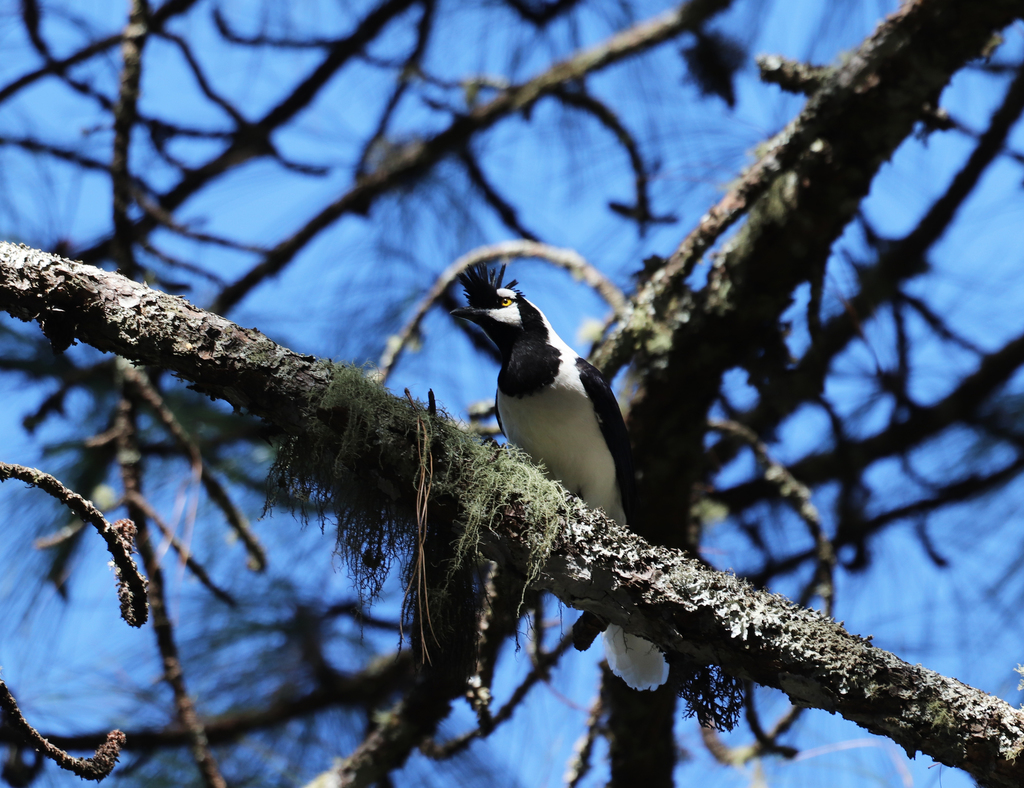
The tufted jay (Cyanocorax dickeyi), also known as the painted jay and Dickey's jay, is a species of bird in the crow family Corvidae. It is endemic to a small area of the Sierra Madre Occidental in the Mexican states of Sinaloa, Durango, and Nayarit. A distinctive large jay, it has a prominent dark crest on its head; purplish blue back, wings, and face; a white spot above the eye and on the cheek; white undersides; and a partially white tail. Its typical call is a quick, four-note vocalization. The relationship between the tufted jay and other members of the genus Cyanocorax has been a subject of interest since the species was first described in 1935. Because of the visual similarities between the tufted jay and the white-tailed jay, the two were thought by some to be closely related. A 2010 mitochondrial DNA study has shown that the tufted jay is most closely related to a group of South American jays, despite their ranges being separated by over 2,000 km (1,200 mi). They are likely descended from an ancestral jay which ranged throughout Central and South America. The tufted jay lives in pine-oak forests, often remaining high in the canopy. Its diet consists primarily of berries and fruit, and to a lesser extent insects such as katydids. It forms social flocks centred around a single breeding pair, with some flocks remaining together over several generations. The tufted jay's breeding season starts in late March, with a clutch of two to five eggs being laid in a nest that is cooperatively built by members of the flock. The tufted jay is considered near threatened by the International Union for Conservation of Nature (IUCN). Its population is decreasing, with an estimated 10,000–20,000 mature individuals in the wild. The primary threat to its survival is habitat destruction due to agricultural expansion and deforestation due to logging and narcotic cultivation.
Gallery
Ajouter des photos
Partagez vos photos de cette espèce (jusqu'à 20 à la fois) : elles sont vérifiées automatiquement, puis publiées.
Répartition
Occurrences observées (données GBIF). Les zones hors aire d'origine peuvent indiquer une présence introduite ou invasive.
Sources et crédits
Informations provenant de plusieurs sources vérifiées. Dernière mise à jour : .
Crédits photos (8)
- Photo : Eber Barraza (@eber_bh) · CC BY-NC 4.0 · via iNaturalist
- Photo : APFF Meseta de Cacaxtla (@apffmesetadecacaxtla) · CC BY-NC 4.0 · via iNaturalist
- Photo : M. C. Gerardo Eusebio Valdes (@gerardo_eusebio_valdes) · CC BY-NC 4.0 · via iNaturalist
- Photo : APFF Meseta de Cacaxtla (@apffmesetadecacaxtla) · CC BY-NC 4.0 · via iNaturalist
- Photo : Eduardo Quintero 🌵 (@xenarthro) · CC BY-NC 4.0 · via iNaturalist
- Photo : Brian Ahern (@brianahern) · CC BY-NC 4.0 · via iNaturalist
- Photo : Patricia Hernández (@patriciahernandez) · CC BY-NC 4.0 · via iNaturalist
- Photo : @datadan · CC BY 4.0 · via iNaturalist
Mentions de licence
Texte disponible sous licence CC BY-SA 4.0. Il adapte notamment Wikipedia (CC BY-SA) : Tufted jay (Wikipédia, auteurs dans l’historique de l’article).
- Taxonomie : GBIF Backbone Taxonomy (CC BY 4.0)
- Carte : occurrences GBIF, fond © contributeurs OpenStreetMap (ODbL)
- Statut de conservation : Liste rouge de l'UICN, via Wikidata (CC0)
Détail : Sources et licences.
Discussion (0)
Aucun message pour l’instant. Lancez la discussion sur cette fiche (sources, précisions, débats éditoriaux).
Connectez-vous pour participer à la discussion.