
Crested Jay
Platylophus galericulatus
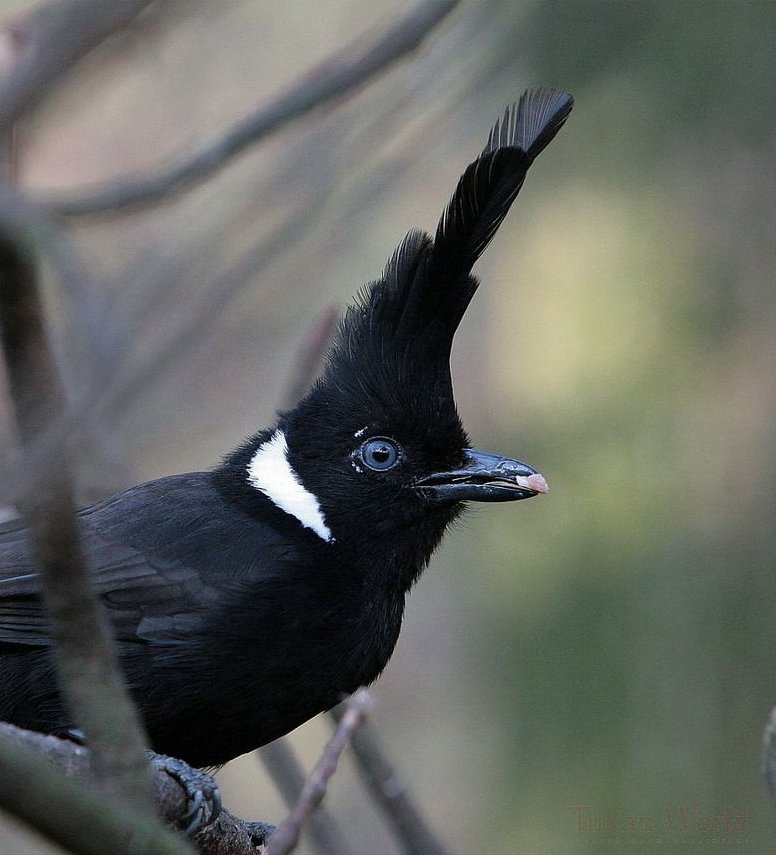
The crested jayshrike or crested shrikejay (Platylophus galericulatus), formerly known as the crested jay (despite not being a true jay), is a species of bird found in Brunei, Indonesia, Malaysia, Myanmar, and Thailand.
- Kingdom
- Animalia
- Phylum
- Chordata
- Class
- Aves
- Order
- Passeriformes
- Family
- Corvidae
- Genus
- Platylophus
- Species
- Platylophus galericulatus
Description
The crested jayshrike or crested shrikejay (Platylophus galericulatus), formerly known as the crested jay (despite not being a true jay), is a species of bird found in Brunei, Indonesia, Malaysia, Myanmar, and Thailand. It is the only member of the genus Platylophus and the family Platylophidae. Although traditionally placed in the family Corvidae, its taxonomy has been under contention since the 2000s, as phylogenetic analyses indicate that it is not a true corvid, but rather a basal member of the Corvoidea radiation. Some authorities have suggested that it may belong to the helmetshrikes. In 2019, eBird and the Clements Checklist renamed the species the crested shrikejay and placed it in its own family, the Platylophidae, which was undescribed at the time. In 2021, the family Platylophidae was officially described, and in 2022 the International Ornithological Congress reclassified the species into Platylophidae. However, the family name Lophocittidae, originally described as Lophocitteae in 1855 by Johann Jakob Kaup, may have referred to the crested shrikejay, and if so would take precedence over Platylophidae. Its natural habitats are subtropical or tropical moist lowland forest and subtropical or tropical moist montane forest of the Thai-Malay Peninsula, Sumatra, Java, and Borneo. It is threatened by habitat loss from illegal logging and land conversion for farming, as well as wildfires and capture for the wildlife trade. Research conducted by a team led by EcoVerde Global Consulting found that the crested jayshrike is used as a “master bird” to train other songbird species. Despite it receiving legal protection in Indonesia in 2018, the trade in the bird markets remained open and the number of individuals for the species remained unchanged over a 15 year period
Gallery
Ajouter des photos
Partagez vos photos de cette espèce (jusqu'à 20 à la fois) : elles sont vérifiées automatiquement, puis publiées.
Répartition
Occurrences observées (données GBIF). Les zones hors aire d'origine peuvent indiquer une présence introduite ou invasive.
Sources et crédits
Informations provenant de plusieurs sources vérifiées. Dernière mise à jour : .
Crédits photos (6)
- Photo : Roland Adam · CC BY-SA 3.0
- Photo : @richardchong0560 · CC BY-NC 4.0 · via iNaturalist
- Photo : Ian Dugdale (@ian_dugdale) · CC BY 4.0 · via iNaturalist
- Photo : Marc Thibault (@marcthibault) · CC BY-NC 4.0 · via iNaturalist
- Photo : @muangpaisuetrong · CC BY-NC 4.0 · via iNaturalist
- Photo : Erik Atwell (@erikatwell) · CC BY-NC 4.0 · via iNaturalist
Mentions de licence
Texte disponible sous licence CC BY-SA 4.0. Il adapte notamment Wikipedia (CC BY-SA) : Crested jayshrike (Wikipédia, auteurs dans l’historique de l’article).
- Taxonomie : GBIF Backbone Taxonomy (CC BY 4.0)
- Carte : occurrences GBIF, fond © contributeurs OpenStreetMap (ODbL)
- Statut de conservation : Liste rouge de l'UICN, via Wikidata (CC0)
Détail : Sources et licences.
Discussion (0)
Aucun message pour l’instant. Lancez la discussion sur cette fiche (sources, précisions, débats éditoriaux).
Connectez-vous pour participer à la discussion.