
Lidth's Jay
Garrulus lidthi
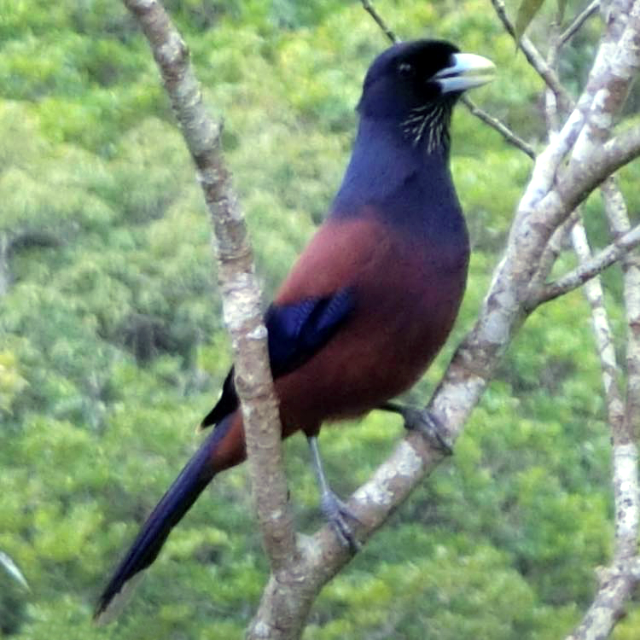
Lidth's jay (Garrulus lidthi), also known as the Amami jay, is a passerine bird in the family Corvidae native to the Ryukyu Islands, Japan.
- Kingdom
- Animalia
- Phylum
- Chordata
- Class
- Aves
- Order
- Passeriformes
- Family
- Corvidae
- Genus
- Garrulus
- Species
- Garrulus lidthi
Description
Lidth's jay (Garrulus lidthi), also known as the Amami jay, is a passerine bird in the family Corvidae native to the Ryukyu Islands, Japan. Measuring up to 38 cm (15 in) in total length, it is slightly larger than its close relative the Eurasian jay, with a proportionately stouter bill and also a longer tail. It has no discernible crest, with the head feathers a velvety black, the shoulders and back a deep purplish blue and all other parts a rich chestnut purple. This jay has a very restricted distribution occurring only on the southern Japanese islands of Amami Ōshima and Kakeromajima. It may have also been present on Tokunoshima. It occurs in subtropical evergreen broadleaf forests as well as in coniferous, deciduous, and mixed woodlands both in the lowlands and on the mountains. Food is largely made up of the nuts of the native chinkapin Castanopsis cuspidata but includes small reptiles and invertebrates of many types. The bird nests in large cavities in trees but otherwise the nest is the same as that of the other two Garrulus species with 3–4 eggs. The voice is similar to that of the Eurasian jay. The species was threatened in the past by hunting for its feathers, which were used for decorating ladies' hats. More recently it has been threatened by introduced small Indian mongooses, which were brought to its range to control the venomous Okinawa pit viper. The species is fully protected under Japanese law and is increasing in numbers thanks to control of the mongooses, which were finally eradicated in 2024. The species name commemorates the Dutch zoologist Theodoor Gerard van Lidth de Jeude. In 1965 it was chosen as the symbolic bird of Kagoshima Prefecture.
Gallery
Ajouter des photos
Partagez vos photos de cette espèce (jusqu'à 20 à la fois) : elles sont vérifiées automatiquement, puis publiées.
Répartition
Occurrences observées (données GBIF). Les zones hors aire d'origine peuvent indiquer une présence introduite ou invasive.
Sources et crédits
Informations provenant de plusieurs sources vérifiées. Dernière mise à jour : .
Crédits photos (6)
- Photo : Sugai3 · CC BY-SA 4.0
- Photo : かわう (@sskawau) · CC BY-NC 4.0 · via iNaturalist
- Photo : Nina (@ninaendlesseive) · CC BY-NC 4.0 · via iNaturalist
- Photo : @asimov0803 · CC BY-NC 4.0 · via iNaturalist
- Photo : @kenny_well · CC BY-NC 4.0 · via iNaturalist
- Photo : Annette (@annetteteng) · CC BY-NC 4.0 · via iNaturalist
Mentions de licence
Texte disponible sous licence CC BY-SA 4.0. Il adapte notamment Wikipédia (EN) : Lidth's jay, Geai de Lidth, Wikipedia (CC BY-SA) : Lidth's jay (Wikipédia, auteurs dans l’historique de l’article).
- Taxonomie : GBIF Backbone Taxonomy (CC BY 4.0)
- Carte : occurrences GBIF, fond © contributeurs OpenStreetMap (ODbL)
- Statut de conservation : Liste rouge de l'UICN, via Wikidata (CC0)
Détail : Sources et licences.
Discussion (0)
Aucun message pour l’instant. Lancez la discussion sur cette fiche (sources, précisions, débats éditoriaux).
Connectez-vous pour participer à la discussion.