
White-tailed Jay
Cyanocorax mystacalis
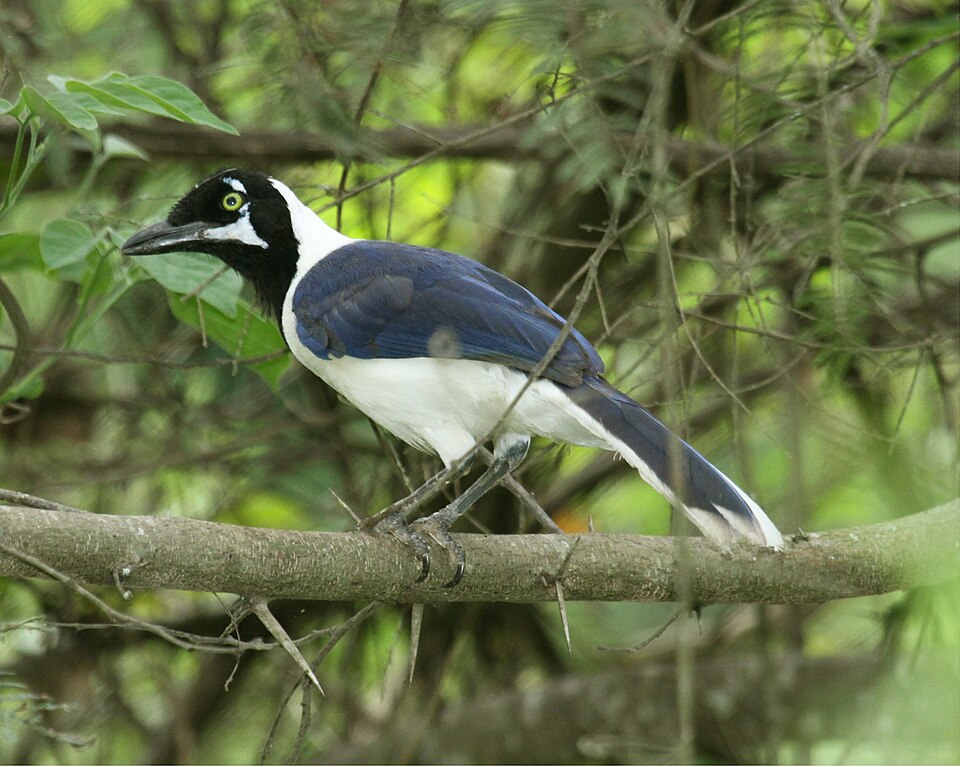
The white-tailed jay (Cyanocorax mystacalis), also known as the moustached jay, is a species of bird in the crow family Corvidae.
- Kingdom
- Animalia
- Phylum
- Chordata
- Class
- Aves
- Order
- Passeriformes
- Family
- Corvidae
- Genus
- Cyanocorax
- Species
- Cyanocorax mystacalis
Description
The white-tailed jay (Cyanocorax mystacalis), also known as the moustached jay, is a species of bird in the crow family Corvidae. It is found in Ecuador and Peru. It has a black face with white spots above and below the eyes, and a small white moustachial stripe. It has a white nape, belly, and underparts. Its back and wings are greyish-blue, extending most of the way down the tail. The rectrices and tail tip are white. It has several calls, the most common being described as "cha-cha-cha-cha". The white-tailed jay was first described by the French ornithologist Louis Ernest Gustave de Sparre in 1835 and was given the scientific name Pica mystacalis. It was later placed in the genus Cyanocorax. It is visually very similar to the tufted jay, which is found in Mexico over 4,800 km (3,000 mi) away, and the two species were incorrectly thought to be close relatives. The white-tailed jay's relationship to others in the genus Cyanocorax is still unclear. The white-tailed jay lives in semi-humid, semi-open woodlands, preferring to remain near thick vegetation close to rivers and streams. It eats mostly insects and seeds, but has also been known to steal eggs from the nests of other birds. It forages in flocks and can be found feeding on the ground more often than other members of the genus Cyanocorax. While little is known of its breeding and nesting habits, it is known to build nests through February and March and may nest close to villages. The white-tailed jay is considered a species of least concern by the International Union for Conservation of Nature, although its population has seen notable decreases in some regions. The largest threat to its survival is habitat destruction.
Gallery
Ajouter des photos
Partagez vos photos de cette espèce (jusqu'à 20 à la fois) : elles sont vérifiées automatiquement, puis publiées.
Répartition
Occurrences observées (données GBIF). Les zones hors aire d'origine peuvent indiquer une présence introduite ou invasive.
Sources et crédits
Informations provenant de plusieurs sources vérifiées. Dernière mise à jour : .
Crédits photos (6)
- Photo : TonyCastro · CC BY-SA 4.0
- Photo : @jose_luis_mena · CC BY-NC 4.0 · via iNaturalist
- Photo : Daniel Arias-Cruzatty (@urban_funga) · CC BY-NC 4.0 · via iNaturalist
- Photo : @humbertobonilla · CC BY-NC 4.0 · via iNaturalist
- Photo : Francisco Prieto Albuja (@panchoprieto) · CC BY-NC 4.0 · via iNaturalist
- Photo : Jaime Camacho (@jcamacho) · CC BY-NC 4.0 · via iNaturalist
Mentions de licence
Texte disponible sous licence CC BY-SA 4.0. Il adapte notamment Wikipedia (CC BY-SA) : White-tailed jay (Wikipédia, auteurs dans l’historique de l’article).
- Taxonomie : GBIF Backbone Taxonomy (CC BY 4.0)
- Carte : occurrences GBIF, fond © contributeurs OpenStreetMap (ODbL)
- Statut de conservation : Liste rouge de l'UICN, via Wikidata (CC0)
Détail : Sources et licences.
Discussion (0)
Aucun message pour l’instant. Lancez la discussion sur cette fiche (sources, précisions, débats éditoriaux).
Connectez-vous pour participer à la discussion.