
Sri Lanka Spurfowl
Galloperdix bicalcarata
The Sri Lanka spurfowl (Galloperdix bicalcarata) is a member of the pheasant family which is endemic to the dense rainforests of Sri Lanka.
- Kingdom
- Animalia
- Phylum
- Chordata
- Class
- Aves
- Order
- Galliformes
- Family
- Phasianidae
- Genus
- Galloperdix
- Species
- Galloperdix bicalcarata
Description
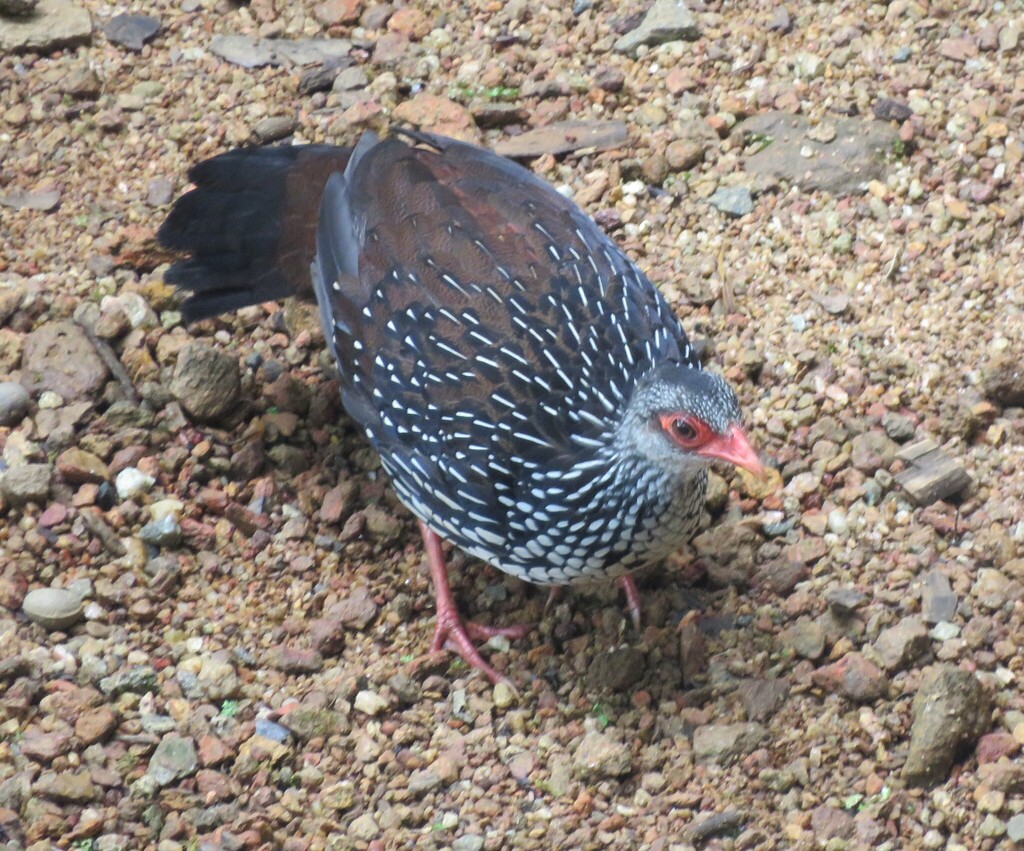
The Sri Lanka spurfowl (Galloperdix bicalcarata) is a member of the pheasant family which is endemic to the dense rainforests of Sri Lanka. In Sri Lanka, this bird is known as haban kukula - හබන් කුකුලා in Sinhala. It is a very secretive bird, and despite its size is difficult to see as it slips through dense undergrowth. Often the only indication of its presence is its distinctive ringing call, consisting of series of three-syllabled whistles. Kitulgala and Sinharaja are sites where there is a chance of seeing this bird. This spurfowl is one of three species of bird in the genus Galloperdix. It is a ground nesting bird, which lays 2-5 eggs in a scrape. Sri Lanka spurfowl is ~ 37 cm long bird. Both sexes have brown upperparts, wings and tail. The males exhibit vivid crimson red legs and bare facial skin and striking black and white dorsal plumage that extends to its head. There is also extensive white ocellation on the sepia wings and upperback. The legs of both sexes have multiple metatarsal spurs, which give rise to the specific name. The female has chestnut underparts and a plain brown back and wings. She is more prominently crested than the male. Sri Lanka spurfowl is a seasonally terrestrial species, like most of its near relatives. It scratches vigorously amongst the leaf litter of the forest floor for invertebrates, especially mollusks and insects. It will also take various seeds, fallen fruit and spiders.
Gallery
Ajouter des photos
Partagez vos photos de cette espèce (jusqu'à 20 à la fois) : elles sont vérifiées automatiquement, puis publiées.
Répartition
Occurrences observées (données GBIF). Les zones hors aire d'origine peuvent indiquer une présence introduite ou invasive.
Sources et crédits
Informations provenant de plusieurs sources vérifiées. Dernière mise à jour : .
Crédits photos (8)
- Photo : @emskakoon · CC BY-NC 4.0 · via iNaturalist
- Photo : John Turner Cambridge (@john_turner_cambridge) · CC BY-NC 4.0 · via iNaturalist
- Photo : @ngaunt · CC BY-NC 4.0 · via iNaturalist
- Photo : Albert Kang (@albertkang) · CC BY-NC 4.0 · via iNaturalist
- Photo : Pete Woodall (@nyoni-pete) · CC BY-NC 4.0 · via iNaturalist
- Photo : Ravisara Jayamanna (@ravisara_jayamanna) · CC BY-NC 4.0 · via iNaturalist
- Photo : @leekelai · CC BY-NC 4.0 · via iNaturalist
- Photo : Maryse (@rollier) · CC BY-NC 4.0 · via iNaturalist
Mentions de licence
Texte disponible sous licence CC BY-SA 4.0. Il adapte notamment Galloperdrix de Ceylan, Wikipedia (CC BY-SA) : Sri Lanka spurfowl (Wikipédia, auteurs dans l’historique de l’article).
- Taxonomie : GBIF Backbone Taxonomy (CC BY 4.0)
- Carte : occurrences GBIF, fond © contributeurs OpenStreetMap (ODbL)
- Statut de conservation : Liste rouge de l'UICN, via Wikidata (CC0)
Détail : Sources et licences.
Discussion (0)
Aucun message pour l’instant. Lancez la discussion sur cette fiche (sources, précisions, débats éditoriaux).
Connectez-vous pour participer à la discussion.