
Tristan Moorhen
Gallinula nesiotis
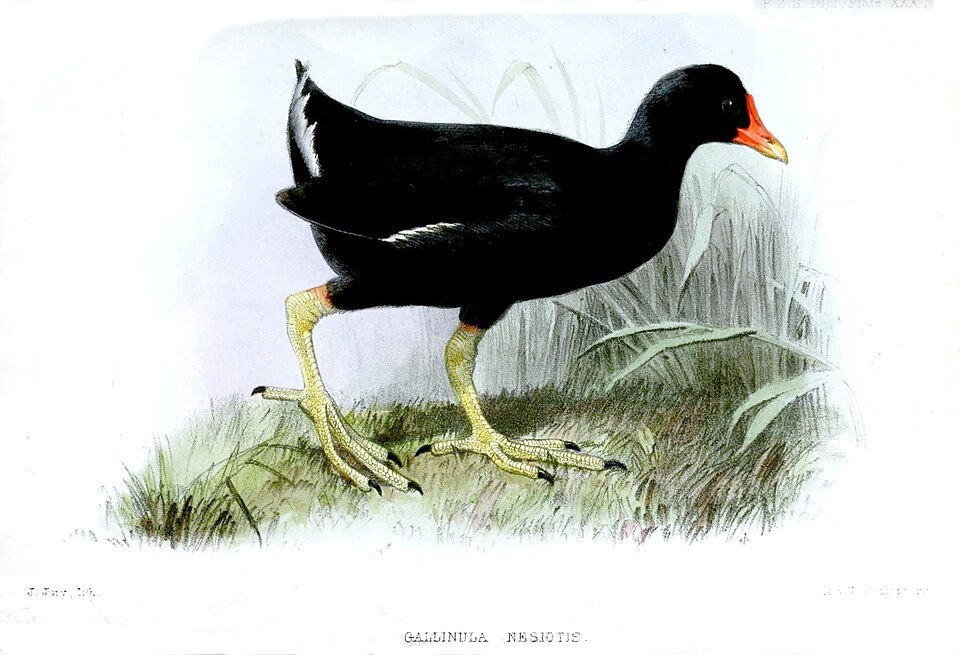
The Tristan moorhen or Tristan gallinule (Gallinula nesiotis) is an extinct species of flightless rail endemic to the South Atlantic island of Tristan da Cunha.
- Kingdom
- Animalia
- Phylum
- Chordata
- Class
- Aves
- Order
- Gruiformes
- Family
- Rallidae
- Genus
- Gallinula
- Species
- Gallinula nesiotis
Description
The Tristan moorhen or Tristan gallinule (Gallinula nesiotis) is an extinct species of flightless rail endemic to the South Atlantic island of Tristan da Cunha. It was very similar to the Gough moorhen of Gough Island, located 636 kilometres (395 mi) to the southeast. The once abundant Tristan moorhen had become rare by 1873, and by the end of 19th century it was extinct as a result of hunting, predation by introduced species (rats, cats and pigs) and habitat destruction by fire. A handful of taxidermied specimens of the Tristan moorhen have been preserved. In 1956 the closely related Gough moorhen G. comeri was introduced to Tristan da Cunha, under the then belief it was a reintroduction of the same species. On the basis of DNA sequencing of both recently collected and historical material from both species, Groenenberg et al (2008) concluded that the genetic distances between G. nesiotis and G. comeri are of at least the same size as those found between subspecies of G. chloropus in the literature. They propose that the extinct moorhen of Tristan (Gallinula nesiotis) and the moorhens that live on Gough and Tristan today (G. comeri) be regarded as subspecies: Gallinula nesiotis nesiotis and Gallinula nesiotis gomeri.
Ajouter des photos
Partagez vos photos de cette espèce (jusqu'à 20 à la fois) : elles sont vérifiées automatiquement, puis publiées.
Répartition
Occurrences observées (données GBIF). Les zones hors aire d'origine peuvent indiquer une présence introduite ou invasive.
Sources et crédits
Informations provenant de plusieurs sources vérifiées. Dernière mise à jour : .
Crédits photos (1)
- Photo : Philip Lutley Sclater (1829-1913) (text) - lithograph by J. Jury · Domaine public
Mentions de licence
Texte disponible sous licence CC BY-SA 4.0. Il adapte notamment Gallinule de Tristan da Cunha, Wikipedia (CC BY-SA) : Tristan moorhen (Wikipédia, auteurs dans l’historique de l’article).
- Taxonomie : GBIF Backbone Taxonomy (CC BY 4.0)
- Carte : occurrences GBIF, fond © contributeurs OpenStreetMap (ODbL)
- Statut de conservation : Liste rouge de l'UICN, via Wikidata (CC0)
Détail : Sources et licences.
Discussion (0)
Aucun message pour l’instant. Lancez la discussion sur cette fiche (sources, précisions, débats éditoriaux).
Connectez-vous pour participer à la discussion.