
Northern fulmar
Fulmarus glacialis
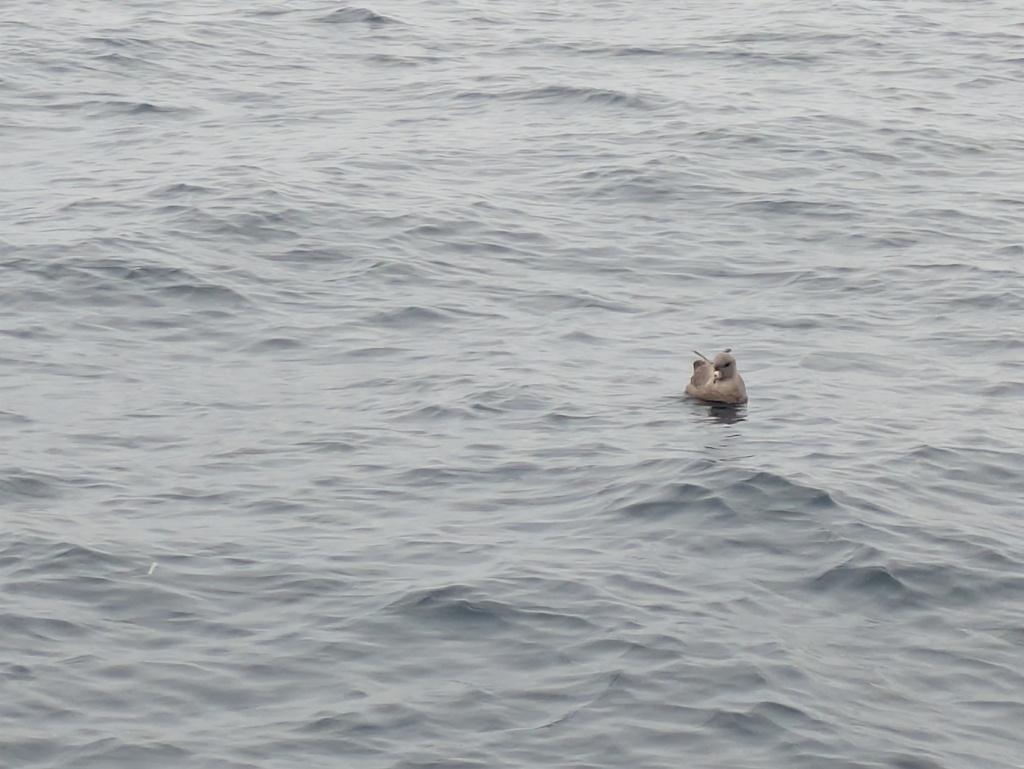
The northern fulmar, Arctic fulmar, or simply fulmar (Fulmarus glacialis) is an abundant seabird found primarily in subarctic regions of the North Atlantic and North Pacific oceans.
- Kingdom
- Animalia
- Phylum
- Chordata
- Class
- Aves
- Order
- Procellariiformes
- Family
- Procellariidae
- Genus
- Fulmarus
- Species
- Fulmarus glacialis
Description
The northern fulmar, Arctic fulmar, or simply fulmar (Fulmarus glacialis) is an abundant seabird found primarily in subarctic regions of the North Atlantic and North Pacific oceans. There has been one confirmed sighting in the Southern Hemisphere, with a single bird seen south of New Zealand. Fulmars come in one of two colour morphs; a light one in temperate populations, with white head and body and grey wings and tail, and a dark one in arctic populations, which is uniformly grey; intermediate birds are common. Though similar in appearance to gulls, fulmars are in fact members of the family Procellariidae, which includes petrels and shearwaters. The northern fulmar and its sister species, the southern fulmar (Fulmarus glacialoides), are the only extant members of the genus Fulmarus. The fulmars are in turn a member of the order Procellariiformes, and they all share certain identifying features. First, they have nasal passages that attach to the upper bill called naricorns; however, nostrils on albatrosses are on the sides of the bill, as opposed to the rest of the order, including fulmars, which have nostrils on top of the upper bill. The bills of Procellariiformes are also unique in that they are split into between seven and nine horny plates. One of these plates makes up the hooked portion of the upper bill, called the maxillary unguis. They produce a stomach oil made up of wax esters and triglycerides that is stored in the proventriculus. This can be sprayed out of their mouths as a defense against predators from a very early age, and as an energy rich food source for chicks and for the adults during their long flights. It will mat the plumage of avian predators, and can lead to their death. Finally, they also have a salt gland that is situated above the nasal passage that helps desalinate their bodies, due to the high amount of ocean water that they imbibe. This gland excretes a high saline solution from their nose. The northern fulmar was first described as Procellaria glacialis by Carl Linnaeus in 1761, based on a specimen from within the Arctic Circle, on Spitsbergen. The Mallemuk Mountain in Northeastern Greenland is named after the northern fulmar (Danish: Mallemuk).
Gallery
Ajouter des photos
Partagez vos photos de cette espèce (jusqu'à 20 à la fois) : elles sont vérifiées automatiquement, puis publiées.
Répartition
Occurrences observées (données GBIF). Les zones hors aire d'origine peuvent indiquer une présence introduite ou invasive.
Sources et crédits
Informations provenant de plusieurs sources vérifiées. Dernière mise à jour : .
Crédits photos (8)
- Photo : Wan-hsuan Kao (@wanhsuan) · CC BY-NC 4.0 · via iNaturalist
- Photo : Karen L. Johnson (@kljinsitka) · CC BY-NC 4.0 · via iNaturalist
- Photo : @timlar2 · CC BY-NC 4.0 · via iNaturalist
- Photo : Dragonfyre (@dragonfyre) · CC BY-NC 4.0 · via iNaturalist
- Photo : Masumi Palhof (@machi) · CC BY-NC 4.0 · via iNaturalist
- Photo : @cedarleaf · CC BY-NC 4.0 · via iNaturalist
- Photo : @currowar · CC BY-NC 4.0 · via iNaturalist
- Photo : @mickingles · CC BY-NC 4.0 · via iNaturalist
Mentions de licence
Texte disponible sous licence CC BY-SA 4.0. Il adapte notamment Wikipedia (CC BY-SA) : Northern fulmar (Wikipédia, auteurs dans l’historique de l’article).
- Taxonomie : GBIF Backbone Taxonomy (CC BY 4.0)
- Carte : occurrences GBIF, fond © contributeurs OpenStreetMap (ODbL)
- Statut de conservation : Liste rouge de l'UICN, via Wikidata (CC0)
Détail : Sources et licences.
Discussion (0)
Aucun message pour l’instant. Lancez la discussion sur cette fiche (sources, précisions, débats éditoriaux).
Connectez-vous pour participer à la discussion.