
Greater Scaup
Aythya marila
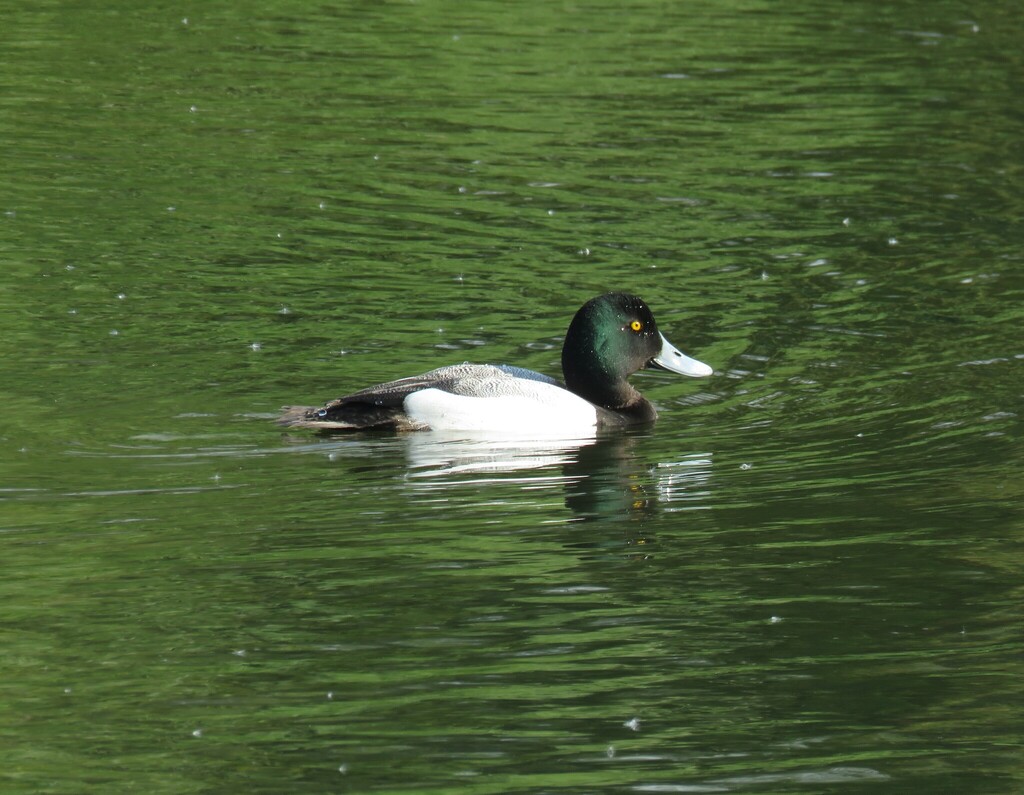
The greater scaup (Aythya marila), just scaup in Europe or, colloquially, "bluebill" in North America, is a mid-sized diving duck, larger than the closely related lesser scaup and tufted duck.
- Kingdom
- Animalia
- Phylum
- Chordata
- Class
- Aves
- Order
- Anseriformes
- Family
- Anatidae
- Genus
- Aythya
- Species
- Aythya marila
Description
The greater scaup (Aythya marila), just scaup in Europe or, colloquially, "bluebill" in North America, is a mid-sized diving duck, larger than the closely related lesser scaup and tufted duck. It spends the summer months breeding in Iceland, east across Scandinavia, northern Russia and Siberia, Alaska, and northern Canada. During the winter, it migrates south to the coasts of Europe, eastern Asia, and North America. Male greater scaup average slightly larger than the females but with much overlap; they have a light blue-grey bill and yellow eyes. Their heads are dark, with a green to purple (depending on light angle) gloss; the breast is black, the belly white, the upperparts pale grey, and the wing shows a strong white stripe. The females are mostly brown, again with white on the wing. They have dull blue bills and a white patch on the face. Greater scaup nest near water, typically on islands in northern lakes or on floating mats of vegetation. They begin breeding at age two, but start building nests in the first year. The drakes have a complex courtship, which takes place on the return migration to the summer breeding grounds and concludes with the formation of monogamous pairs. Females lay a clutch of six to nine olive-buff-coloured eggs. The eggs hatch in 24 to 28 days. The down-covered ducklings are able to follow their mother in her search for food immediately after hatching. Greater scaup eat aquatic molluscs, plants, and insects, which they obtain by diving underwater to depths of 0.5–6 m, exceptionally 10 m. They form large groups, called "rafts", that can number in the thousands. Their main threat is human development, although they are also preyed upon by owls, skunks, raccoons, foxes, coyotes, and humans. Greater scaup populations have been declining since the 1980s; however, they are still listed as a species of least concern on the IUCN Red List.
Gallery
Ajouter des photos
Partagez vos photos de cette espèce (jusqu'à 20 à la fois) : elles sont vérifiées automatiquement, puis publiées.
Répartition
Occurrences observées (données GBIF). Les zones hors aire d'origine peuvent indiquer une présence introduite ou invasive.
Sources et crédits
Informations provenant de plusieurs sources vérifiées. Dernière mise à jour : .
Crédits photos (8)
- Photo : @alfredoherrero · CC BY-NC 4.0 · via iNaturalist
- Photo : K.P. (@sarkany) · CC BY 4.0 · via iNaturalist
- Photo : Yulia Yelovska (@y_y) · CC BY-NC 4.0 · via iNaturalist
- Photo : @randyshonkwiler · CC BY-NC 4.0 · via iNaturalist
- Photo : Jen McIntyre (@jenmcintyre) · CC BY-NC 4.0 · via iNaturalist
- Photo : Gary James (@gary-james) · CC BY-NC 4.0 · via iNaturalist
- Photo : @ka-ra · CC BY-NC 4.0 · via iNaturalist
- Photo : Kai (@kaimigues) · CC BY-NC 4.0 · via iNaturalist
Mentions de licence
Texte disponible sous licence CC BY-SA 4.0. Il adapte notamment Wikipedia (CC BY-SA) : Greater scaup (Wikipédia, auteurs dans l’historique de l’article).
- Taxonomie : GBIF Backbone Taxonomy (CC BY 4.0)
- Carte : occurrences GBIF, fond © contributeurs OpenStreetMap (ODbL)
- Statut de conservation : Liste rouge de l'UICN, via Wikidata (CC0)
Détail : Sources et licences.
Discussion (0)
Aucun message pour l’instant. Lancez la discussion sur cette fiche (sources, précisions, débats éditoriaux).
Connectez-vous pour participer à la discussion.