
Baer's Pochard
Aythya baeri
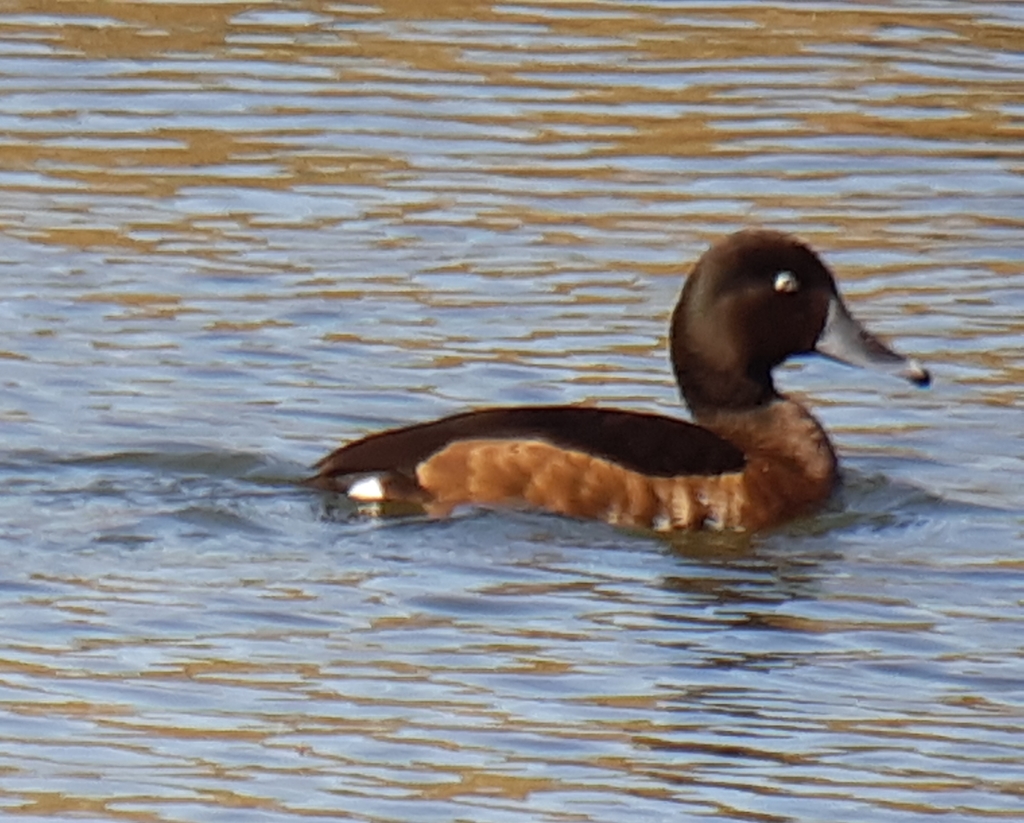
Baer's pochard (Aythya baeri) is a diving duck found in eastern Asia.
- Kingdom
- Animalia
- Phylum
- Chordata
- Class
- Aves
- Order
- Anseriformes
- Family
- Anatidae
- Genus
- Aythya
- Species
- Aythya baeri
Description
Baer's pochard (Aythya baeri) is a diving duck found in eastern Asia. It is a resident bird in North and Central China, and formerly bred in southeast Russia and Northeast China, migrating in winter to southern China, Vietnam, Japan, and India. Baer's pochard is a monotypic species. The holotype was collected in middle Amur. It has a distinctive black head and neck with green gloss. While in poor light, it is likely to look completely black. It is similar and closely related to the ferruginous duck, and they were previously considered to be a single species; Baer's pochard is differentiated by its white flanks when floating on the water, as well as its longer, more rounded head and larger size. Its breeding season varies by latitude and environment. The nest, built from sedges, reeds and other plants, is placed among emergent vegetation, usually in shallow water or on small islands or ridges. Its clutch size ranges from 5 to 14. Males usually take on sentry duty, and females take on the responsibility of incubating. Baer's pochard was once a common species in its range, but is now very rare. The number of mature individuals may be fewer than 1,000, and its population is still declining. Hunting and habitat loss are considered to be the main reasons. This species has been classified as critically endangered by the IUCN, and listed as a first-class protected animal in China.
Gallery
Ajouter des photos
Partagez vos photos de cette espèce (jusqu'à 20 à la fois) : elles sont vérifiées automatiquement, puis publiées.
Répartition
Occurrences observées (données GBIF). Les zones hors aire d'origine peuvent indiquer une présence introduite ou invasive.
Sources et crédits
Informations provenant de plusieurs sources vérifiées. Dernière mise à jour : .
Crédits photos (8)
- Photo : John Howes (@johnhowes) · CC BY-NC 4.0 · via iNaturalist
- Photo : @abujudy · CC BY-NC 4.0 · via iNaturalist
- Photo : 卢江离 (@lujiangli1997) · CC0 (domaine public) · via iNaturalist
- Photo : @p_concolor · CC BY-NC 4.0 · via iNaturalist
- Photo : 通通 (@tong-tong-) · CC BY-NC 4.0 · via iNaturalist
- Photo : Allen Lyu (@allenlyu) · CC BY-NC 4.0 · via iNaturalist
- Photo : Samuel Rion (@sambird09) · CC BY-NC 4.0 · via iNaturalist
- Photo : Hiroki Shudo (@hiroki_shudo) · CC BY-NC 4.0 · via iNaturalist
Mentions de licence
Texte disponible sous licence CC BY-SA 4.0. Il adapte notamment Wikipedia (CC BY-SA) : Baer's pochard (Wikipédia, auteurs dans l’historique de l’article).
- Taxonomie : GBIF Backbone Taxonomy (CC BY 4.0)
- Carte : occurrences GBIF, fond © contributeurs OpenStreetMap (ODbL)
- Statut de conservation : Liste rouge de l'UICN, via Wikidata (CC0)
Détail : Sources et licences.
Discussion (0)
Aucun message pour l’instant. Lancez la discussion sur cette fiche (sources, précisions, débats éditoriaux).
Connectez-vous pour participer à la discussion.