
Magnificent Frigatebird
Fregata magnificens
The magnificent frigatebird (Fregata magnificens), frigate petrel or man o' war is a seabird of the frigatebird family Fregatidae.
- Kingdom
- Animalia
- Phylum
- Chordata
- Class
- Aves
- Order
- Suliformes
- Family
- Fregatidae
- Genus
- Fregata
- Species
- Fregata magnificens
Description
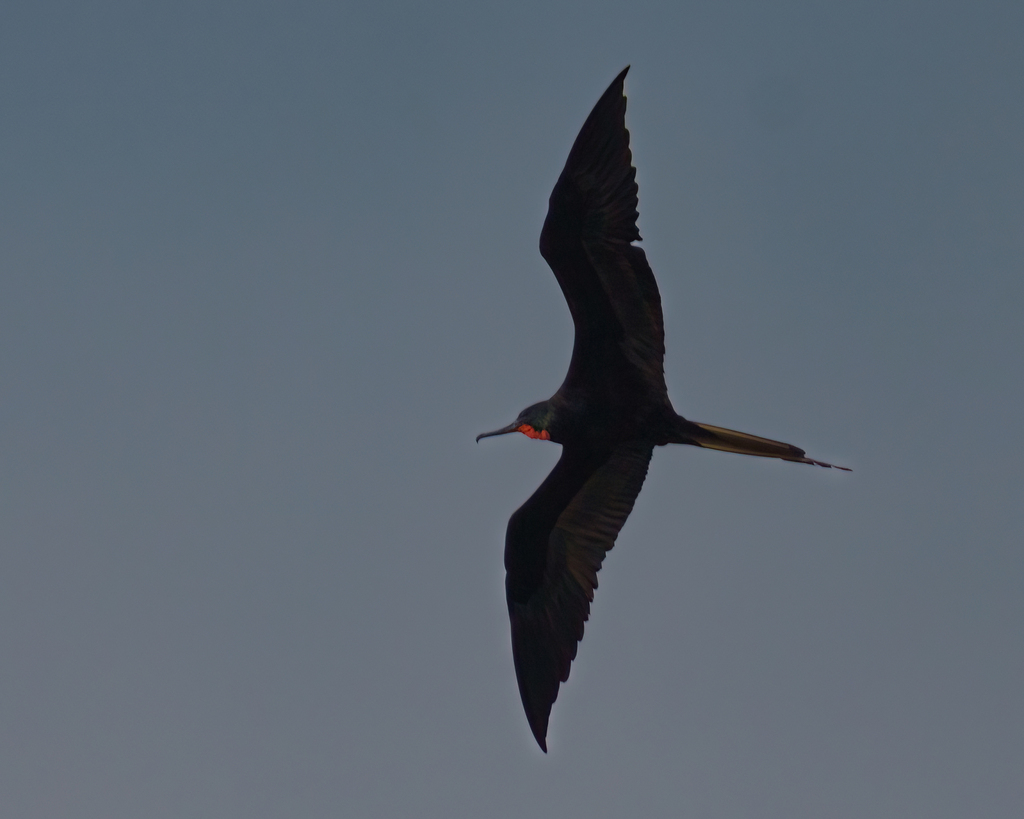
The magnificent frigatebird (Fregata magnificens), frigate petrel or man o' war is a seabird of the frigatebird family Fregatidae. With a length of 89–114 centimetres (2 ft 11 in – 3 ft 9 in) and wingspan of 2.17–2.44 m (7 ft 1 in – 8 ft 0 in), it is the largest species of frigatebird. It occurs over tropical and subtropical waters off America, between northern Mexico and Peru on the Pacific coast and between Florida and southern Brazil along the Atlantic coast. There are also populations on the Galápagos Islands in the Pacific and the Cape Verde islands in the Atlantic. It is one of the fastest birds in the world, flying at speeds of up to 153 kilometres (95 mi) per hour. The magnificent frigatebird is a large, lightly built seabird with brownish-black plumage, long narrow wings and a deeply forked tail. The male has a striking red gular sac which he inflates to attract a mate. The female is slightly larger than the male and has a white breast and belly. Frigatebirds feed on fish taken in flight from the ocean's surface (often flying fish), and sometimes indulge in kleptoparasitism, harassing other birds to force them to regurgitate their food.
Gallery
Ajouter des photos
Partagez vos photos de cette espèce (jusqu'à 20 à la fois) : elles sont vérifiées automatiquement, puis publiées.
Répartition
Occurrences observées (données GBIF). Les zones hors aire d'origine peuvent indiquer une présence introduite ou invasive.
Sources et crédits
Informations provenant de plusieurs sources vérifiées. Dernière mise à jour : .
Crédits photos (8)
- Photo : @gilmand1 · CC BY-NC 4.0 · via iNaturalist
- Photo : Harris McCutcheon (@harrisgrmln) · CC BY-NC 4.0 · via iNaturalist
- Photo : Guenther Eichhorn (@geichhorn) · CC BY-NC 4.0 · via iNaturalist
- Photo : @isabel_soria · CC BY-NC 4.0 · via iNaturalist
- Photo : Louis Beney (@louloubeney) · CC BY-NC 4.0 · via iNaturalist
- Photo : @ivan_popoca · CC BY-NC 4.0 · via iNaturalist
- Photo : Sonia Molino (@soniamolino) · CC BY-NC 4.0 · via iNaturalist
- Photo : Ethan Tripe (@ethan_tripe) · CC BY-NC 4.0 · via iNaturalist
Mentions de licence
Texte disponible sous licence CC BY-SA 4.0. Il adapte notamment Wikipedia (CC BY-SA) : Magnificent frigatebird (Wikipédia, auteurs dans l’historique de l’article).
- Taxonomie : GBIF Backbone Taxonomy (CC BY 4.0)
- Carte : occurrences GBIF, fond © contributeurs OpenStreetMap (ODbL)
- Statut de conservation : Liste rouge de l'UICN, via Wikidata (CC0)
Détail : Sources et licences.
Discussion (0)
Aucun message pour l’instant. Lancez la discussion sur cette fiche (sources, précisions, débats éditoriaux).
Connectez-vous pour participer à la discussion.