
American Coot
Fulica americana
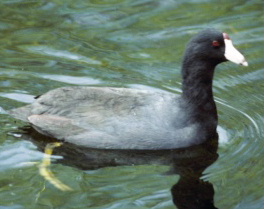
The American coot (Fulica americana), also known as a mud hen or pouldeau, is a bird of the family Rallidae.
- Kingdom
- Animalia
- Phylum
- Chordata
- Class
- Aves
- Order
- Gruiformes
- Family
- Rallidae
- Genus
- Fulica
- Species
- Fulica americana
Description
The American coot (Fulica americana), also known as a mud hen or pouldeau, is a bird of the family Rallidae. Though commonly mistaken for ducks, American coots are only distantly related to ducks, belonging to a separate order. Unlike the webbed feet of ducks, coots have broad, lobed scales on their lower legs and toes that fold back with each step to facilitate walking on dry land. Coots live near water, typically inhabiting wetlands and open water bodies in North America. Groups of coots are called covers or rafts. The oldest known coot lived to be 22 years old. The American coot is a migratory bird that occupies most of North America. It lives in the Pacific and southwestern United States and Mexico year-round and occupies more northeastern regions during the summer breeding season. In the winter they can be found as far south as Panama. Coots generally build floating nests and lay 8–12 eggs per clutch. Females and males have similar appearances, but they can be distinguished during aggressive displays by the larger ruff (head plumage) on the male. American coots eat primarily algae and other aquatic plants but also animals (both vertebrates and invertebrates) when available. The American coot is closely related to the Eurasian coot (Fulica atra), which occupies the same ecological niche in Eurasia and Australia as the American coot does in North America. Eurasian coots can be distinguished from this species by the absence of a red callus above the bird's frontal shield. The American coot is listed as "Least Concern" under the IUCN conservation ratings. Hunters generally avoid killing American coots because their meat is not as sought after as that of ducks. American coots display several interesting breeding habits; mothers will preferentially feed offspring with the brightest plume feathers, which has resulted in coot chicks having brightly ornamented plumage which becomes drabber as they age. American coots are also susceptible to conspecific brood parasitism and have evolved mechanisms to differentiate their offspring from those of parasitic females.
Gallery
Ajouter des photos
Partagez vos photos de cette espèce (jusqu'à 20 à la fois) : elles sont vérifiées automatiquement, puis publiées.
Répartition
Occurrences observées (données GBIF). Les zones hors aire d'origine peuvent indiquer une présence introduite ou invasive.
Sources et crédits
Informations provenant de plusieurs sources vérifiées. Dernière mise à jour : .
Crédits photos (6)
- Photo : The original uploader was Jimfbleak at English Wikipedia. · Domaine public · via Wikimedia Commons
- Photo : Greg Hume · CC BY-SA 3.0
- Photo : Krissa Klein (@graysquirrel) · CC BY-NC 4.0 · via iNaturalist
- Photo : @johnbargman · CC BY-NC 4.0 · via iNaturalist
- Photo : @efrenbiologia · CC BY-NC 4.0 · via iNaturalist
- Photo : S. Queen (@sylbird) · CC BY-NC 4.0 · via iNaturalist
Mentions de licence
Texte disponible sous licence CC BY-SA 4.0. Il adapte notamment Wikipedia (CC BY-SA) : American coot (Wikipédia, auteurs dans l’historique de l’article).
- Taxonomie : GBIF Backbone Taxonomy (CC BY 4.0)
- Carte : occurrences GBIF, fond © contributeurs OpenStreetMap (ODbL)
- Statut de conservation : Liste rouge de l'UICN, via Wikidata (CC0)
Détail : Sources et licences.
Discussion (0)
Aucun message pour l’instant. Lancez la discussion sur cette fiche (sources, précisions, débats éditoriaux).
Connectez-vous pour participer à la discussion.