
Masked Booby
Sula dactylatra
The masked booby (Sula dactylatra), also called the masked gannet or the blue-faced booby, is a large seabird of the booby and gannet family, Sulidae.
- Kingdom
- Animalia
- Phylum
- Chordata
- Class
- Aves
- Order
- Suliformes
- Family
- Sulidae
- Genus
- Sula
- Species
- Sula dactylatra
Description
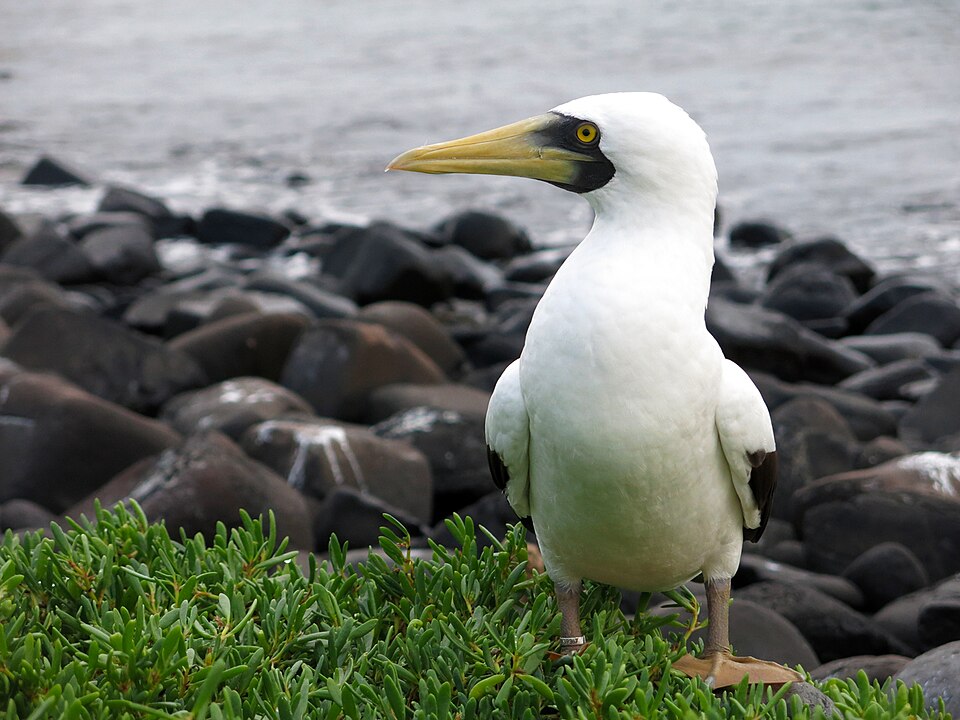
The masked booby (Sula dactylatra), also called the masked gannet or the blue-faced booby, is a large seabird of the booby and gannet family, Sulidae. First described by the French naturalist René-Primevère Lesson in 1831, the masked booby is one of six species of booby in the genus Sula. It has a typical sulid body shape, with a long pointed yellowish bill, long neck, aerodynamic body, long slender wings and pointed tail. The adult is bright white with black wings, a black tail and a dark face mask; at 75–85 cm (30–33 in) long, it is the largest species of booby. The sexes have similar plumage. This species ranges across tropical oceans, except in the eastern Atlantic and eastern Pacific. In the latter, it is replaced by the Nazca booby (Sula granti), which was formerly regarded as a subspecies of masked booby. Nesting takes place in colonies, generally on islands and atolls far from the mainland and close to deep water required for foraging. Territorial when breeding, the masked booby performs agonistic displays to defend its nest. Potential and mated pairs engage in courtship and greeting displays. The female lays two chalky white eggs in a shallow depression on flat ground away from vegetation. The chicks are born featherless, but are soon covered in white down. The second chick born generally does not survive and is killed by its elder sibling. These birds are spectacular plunge divers, plunging into the ocean at high speed in search of prey-mainly flying fish. The species faces few threats; although its population is declining, it is considered to be a least-concern species by the International Union for Conservation of Nature (IUCN). The masked booby primarily feeds on flying fish and squid, which it captures through high-speed plunge diving. Breeding Colonies are typically located on remote islands, where reduced predation allows for successful nesting.
Gallery
Ajouter des photos
Partagez vos photos de cette espèce (jusqu'à 20 à la fois) : elles sont vérifiées automatiquement, puis publiées.
Répartition
Occurrences observées (données GBIF). Les zones hors aire d'origine peuvent indiquer une présence introduite ou invasive.
Sources et crédits
Informations provenant de plusieurs sources vérifiées. Dernière mise à jour : .
Crédits photos (7)
- Photo : Salmeidas · CC BY-SA 3.0
- Photo : Rubens de Camargo Vianna Filho · CC BY-SA 4.0
- Photo : @cesar999_ · CC BY-NC 4.0 · via iNaturalist
- Photo : Donald Marotte (@don_marotte) · CC BY-NC 4.0 · via iNaturalist
- Photo : Bernardo Zorrilla (@bernardo0) · CC BY-NC 4.0 · via iNaturalist
- Photo : @helmal · CC BY-NC 4.0 · via iNaturalist
- Photo : Susan Aide (@susanfibio) · CC BY 4.0 · via iNaturalist
Mentions de licence
Texte disponible sous licence CC BY-SA 4.0. Il adapte notamment Wikipedia (CC BY-SA) : Masked booby (Wikipédia, auteurs dans l’historique de l’article).
- Taxonomie : GBIF Backbone Taxonomy (CC BY 4.0)
- Carte : occurrences GBIF, fond © contributeurs OpenStreetMap (ODbL)
- Statut de conservation : Liste rouge de l'UICN, via Wikidata (CC0)
Détail : Sources et licences.
Discussion (0)
Aucun message pour l’instant. Lancez la discussion sur cette fiche (sources, précisions, débats éditoriaux).
Connectez-vous pour participer à la discussion.