
Northern gannet
Morus bassanus
The northern gannet (Morus bassanus) is a seabird, the largest species of the gannet family, Sulidae.
- Kingdom
- Animalia
- Phylum
- Chordata
- Class
- Aves
- Order
- Suliformes
- Family
- Sulidae
- Genus
- Morus
- Species
- Morus bassanus
Description
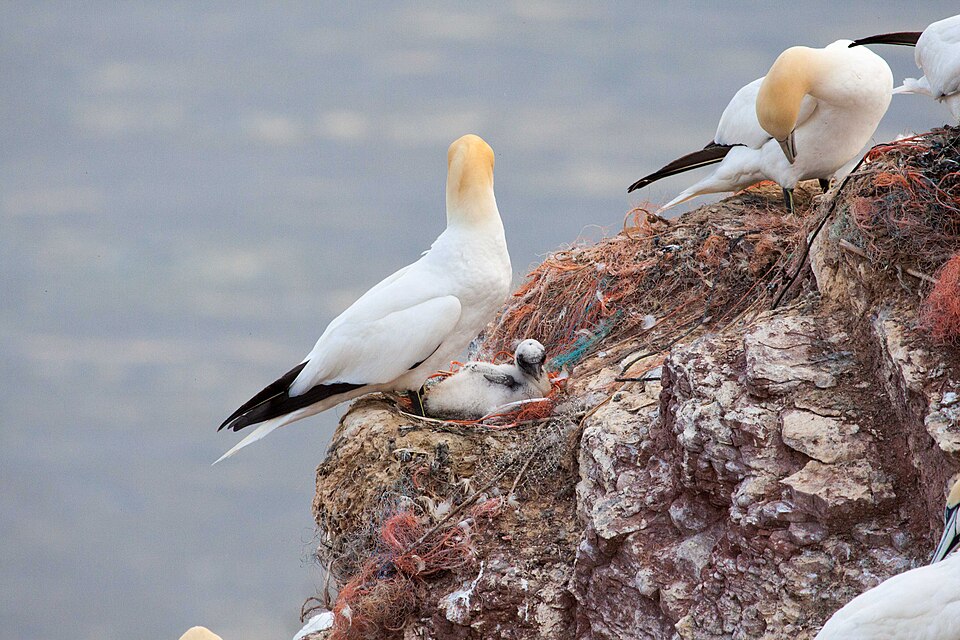
The northern gannet (Morus bassanus) is a seabird, the largest species of the gannet family, Sulidae. It is native to the coasts of the North Atlantic Ocean, breeding in Western Europe and Northeastern North America. It is the largest seabird in the northern Atlantic. The sexes are similar in appearance. The adult northern gannet has a mainly white streamlined body with a long neck, and long and slender wings. It is 87–100 cm (34+1⁄2–39+1⁄2 in) long with a 170–180 cm (67–71 in) wingspan. The head and nape have a buff tinge that is more prominent in breeding season, and the wings are edged with dark brown-black feathers. The long, pointed bill is blue-grey, contrasting with black, bare skin around the mouth and eyes. Juveniles are mostly grey-brown, becoming increasingly white in the five years it takes them to reach maturity. Nesting takes place in colonies on both sides of the North Atlantic, the largest of which are at the Bass Rock (75,000 pairs as of 2014), St. Kilda (60,000 pairs as of 2013) and Ailsa Craig (33,000 pairs as of 2014) in Scotland, in Ireland (Sceilg Bheag; little Skellig, 35,000 pairs in 2011), Grassholm in Wales, and Bonaventure Island (60,000 pairs in 2009) off the coast of Quebec. Its breeding range has extended northward and eastward, with colonies being established on Russia's Kola Peninsula in 1995 and Bear Island (the southernmost island of Svalbard), in 2011. Colonies are mostly located on offshore islands with cliffs, from which the birds can more easily launch into the air. The northern gannet undertakes seasonal migrations and catches fish (which are the mainstay of its diet) by making high-speed dives into the sea up to 60 mph. The northern gannet was previously hunted for food in certain parts of its range, and although that practice still continues in the Outer Hebrides of Scotland and the Faroe Islands, the bird faces few other natural or man-made threats. Since its population is growing, the International Union for Conservation of Nature considers it a least-concern species. Because it is both a conspicuous and a common bird, it is referred to in several ancient myths and legends.
Gallery
Ajouter des photos
Partagez vos photos de cette espèce (jusqu'à 20 à la fois) : elles sont vérifiées automatiquement, puis publiées.
Répartition
Occurrences observées (données GBIF). Les zones hors aire d'origine peuvent indiquer une présence introduite ou invasive.
Sources et crédits
Informations provenant de plusieurs sources vérifiées. Dernière mise à jour : .
Crédits photos (6)
- Photo : Kathrin Voss · CC BY-SA 4.0
- Photo : Forest Botial-Jarvis (@tiluchi) · CC BY 4.0 · via iNaturalist
- Photo : Ed Siarkowicz (@dredshark) · CC BY-NC 4.0 · via iNaturalist
- Photo : Carol McDougall (@salmonskyview) · CC BY-NC 4.0 · via iNaturalist
- Photo : Salty Pete (@saltypete) · CC BY-NC 4.0 · via iNaturalist
- Photo : @meuhmo · CC BY-NC 4.0 · via iNaturalist
Mentions de licence
Texte disponible sous licence CC BY-SA 4.0. Il adapte notamment Wikipedia (CC BY-SA) : Northern gannet (Wikipédia, auteurs dans l’historique de l’article).
- Taxonomie : GBIF Backbone Taxonomy (CC BY 4.0)
- Carte : occurrences GBIF, fond © contributeurs OpenStreetMap (ODbL)
- Statut de conservation : Liste rouge de l'UICN, via Wikidata (CC0)
Détail : Sources et licences.
Discussion (0)
Aucun message pour l’instant. Lancez la discussion sur cette fiche (sources, précisions, débats éditoriaux).
Connectez-vous pour participer à la discussion.