
Australasian Gannet
Morus serrator
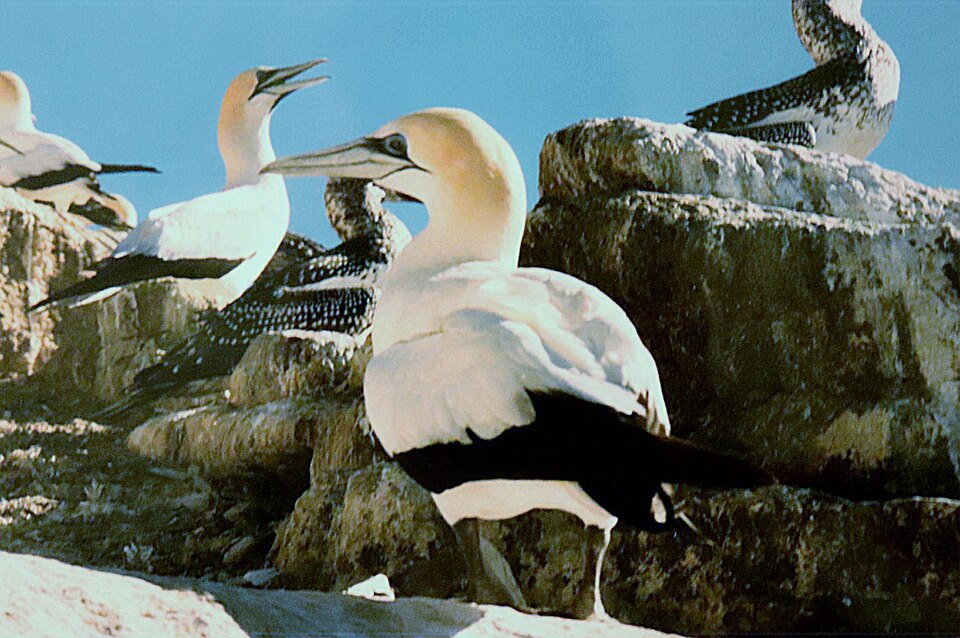
The Australasian gannet (Morus serrator), also known as the Australian gannet or tākapu, is a large seabird of the booby and gannet family, Sulidae.
- Kingdom
- Animalia
- Phylum
- Chordata
- Class
- Aves
- Order
- Suliformes
- Family
- Sulidae
- Genus
- Morus
- Species
- Morus serrator
Description
The Australasian gannet (Morus serrator), also known as the Australian gannet or tākapu, is a large seabird of the booby and gannet family, Sulidae. Adults are mostly white, with black flight feathers at the wingtips and lining the trailing edge of the wing. The central tail feathers are also black. The head is tinged buff-yellow, with a pearly grey bill edged in dark grey or black, and blue-rimmed eyes. Young birds have mottled plumage in their first year, dark above and light below. The head is an intermediate mottled grey, with a dark bill. The birds gradually acquire more white in subsequent seasons until they reach maturity after five years. The species range over water above the continental shelf along the southern and eastern Australian coastline, from Steep Point in Western Australia to Rockhampton, Queensland, as well as the North and South Islands of New Zealand, Lord Howe and Norfolk Islands. Nesting takes place in colonies along the coastlines of New Zealand, Victoria and Tasmania-mostly on offshore islands, although there are several mainland colonies in both countries. Highly territorial when breeding, the Australasian gannet performs agonistic displays to defend its nest. Potential and mated pairs engage in courtship and greeting displays. The nest is a cup-shaped mound composed of seaweed, earth, and other debris, built by the female from material mainly gathered by the male. A single pale blue egg is laid yearly, though lost eggs may be replaced. The chick is born featherless but is soon covered in white down. Fed regurgitated fish by its parents, it grows rapidly and outweighs the average adult when it fledges. These birds are plunge divers and spectacular fishers, plunging into the ocean at high speed. They eat mainly squid and forage fish that school near the surface. The species faces few natural or man-made threats, and since its population is growing it is considered to be a least-concern species by the International Union for Conservation of Nature (IUCN).
Gallery
Ajouter des photos
Partagez vos photos de cette espèce (jusqu'à 20 à la fois) : elles sont vérifiées automatiquement, puis publiées.
Répartition
Occurrences observées (données GBIF). Les zones hors aire d'origine peuvent indiquer une présence introduite ou invasive.
Sources et crédits
Informations provenant de plusieurs sources vérifiées. Dernière mise à jour : .
Crédits photos (6)
- Photo : Hueni · CC BY-SA 3.0
- Photo : Mononymous (@mononymous) · CC BY-NC 4.0 · via iNaturalist
- Photo : Dave Holland (@dave_holland) · CC BY-NC 4.0 · via iNaturalist
- Photo : Ben Zerante (@benzerante) · CC BY-NC 4.0 · via iNaturalist
- Photo : John Bromilow (@jb2602) · CC BY-NC 4.0 · via iNaturalist
- Photo : @gracieburger · CC BY-NC 4.0 · via iNaturalist
Mentions de licence
Texte disponible sous licence CC BY-SA 4.0. Il adapte notamment Wikipedia (CC BY-SA) : Australasian gannet (Wikipédia, auteurs dans l’historique de l’article).
- Taxonomie : GBIF Backbone Taxonomy (CC BY 4.0)
- Carte : occurrences GBIF, fond © contributeurs OpenStreetMap (ODbL)
- Statut de conservation : Liste rouge de l'UICN, via Wikidata (CC0)
Détail : Sources et licences.
Discussion (0)
Aucun message pour l’instant. Lancez la discussion sur cette fiche (sources, précisions, débats éditoriaux).
Connectez-vous pour participer à la discussion.