
Garden Warbler
Sylvia borin
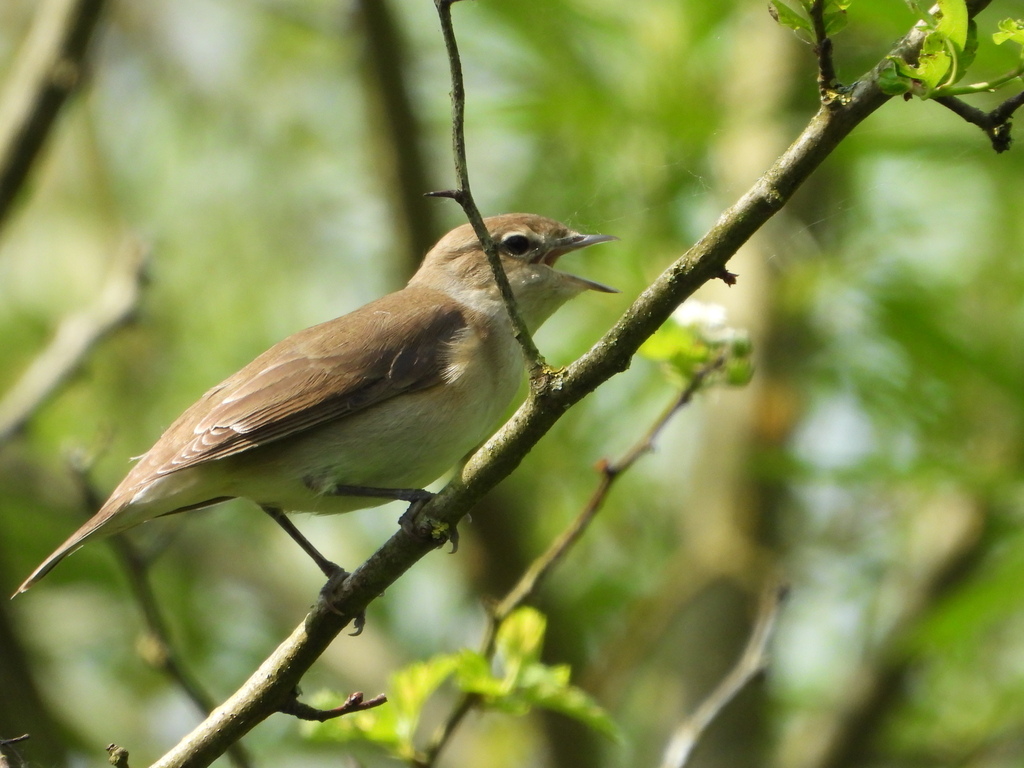
The garden warbler (Sylvia borin) is a common and widespread small bird that breeds in most of Europe and in the Palearctic to western Siberia.
- Kingdom
- Animalia
- Phylum
- Chordata
- Class
- Aves
- Order
- Passeriformes
- Family
- Sylviidae
- Genus
- Sylvia
- Species
- Sylvia borin
Description
The garden warbler (Sylvia borin) is a common and widespread small bird that breeds in most of Europe and in the Palearctic to western Siberia. It is a plain, long-winged and long-tailed warbler with brown upperparts and dull white underparts; the sexes are similar and juveniles resemble the adults. Its two subspecies differ only slightly and interbreed where their ranges overlap. Due to its lack of distinguishing features, this species can be confused with a number of other unstreaked warblers. The garden warbler's rich melodic song is similar to that of the blackcap, its closest relative, which competes with it for territory when nesting in the same woodland. The preferred breeding habitat in Eurasia is open woodland with dense low cover for nesting; despite its name, gardens are rarely occupied by this small passerine bird. The clutch of four or five blotched cream or white eggs is laid in a robust cup-shaped nest built near the ground and concealed by dense vegetation. The eggs are incubated for 11–12 days. The chicks are altricial, hatching naked and with closed eyes, and are fed by both parents. They fledge about 10 days after hatching. Only about a quarter of young birds survive their first year. The garden warbler is strongly migratory, wintering in sub-Saharan Africa. A wide range of habitats are used in Africa, but closed forest and treeless Sahel are both shunned. Insects are the main food in the breeding season, although fruit predominates when birds are fattening prior to migration, figs being a particular favourite where available. These warblers have a mixed diet of insects and fruit in their African wintering grounds. The garden warbler is hunted by Eurasian sparrowhawks and domestic cats, and its eggs and nestlings are taken by a variety of mammalian and avian predators. It may be host to various fleas, mites and internal parasites, and it is a host of the common cuckoo, a brood parasite. The large and fairly stable numbers and huge range of the garden warbler mean that it is classed as least concern by the International Union for Conservation of Nature. Despite a small population decline in much of its European range, the bird's breeding distribution is expanding northwards in Scandinavia.
Gallery
Ajouter des photos
Partagez vos photos de cette espèce (jusqu'à 20 à la fois) : elles sont vérifiées automatiquement, puis publiées.
Répartition
Occurrences observées (données GBIF). Les zones hors aire d'origine peuvent indiquer une présence introduite ou invasive.
Sources et crédits
Informations provenant de plusieurs sources vérifiées. Dernière mise à jour : .
Crédits photos (8)
- Photo : Stephen Matthews (@stephenmatthews) · CC0 (domaine public) · via iNaturalist
- Photo : Landry Gaël (@myorochy) · CC BY-NC 4.0 · via iNaturalist
- Photo : Jeremy Barker (@jeremybarker) · CC BY-NC 4.0 · via iNaturalist
- Photo : @elena_garipova · CC BY-NC 4.0 · via iNaturalist
- Photo : Franck Curk (@franckcurk) · CC BY-NC 4.0 · via iNaturalist
- Photo : @alex_pol_64 · CC BY-NC 4.0 · via iNaturalist
- Photo : @allagrigoreva175 · CC BY-NC 4.0 · via iNaturalist
- Photo : Денис Воронов (@vorden) · CC BY-NC 4.0 · via iNaturalist
Mentions de licence
Texte disponible sous licence CC BY-SA 4.0. Il adapte notamment Wikipedia (CC BY-SA) : Garden warbler (Wikipédia, auteurs dans l’historique de l’article).
- Taxonomie : GBIF Backbone Taxonomy (CC BY 4.0)
- Carte : occurrences GBIF, fond © contributeurs OpenStreetMap (ODbL)
- Statut de conservation : Liste rouge de l'UICN, via Wikidata (CC0)
Détail : Sources et licences.
Discussion (0)
Aucun message pour l’instant. Lancez la discussion sur cette fiche (sources, précisions, débats éditoriaux).
Connectez-vous pour participer à la discussion.