
Saker Falcon
Falco cherrug
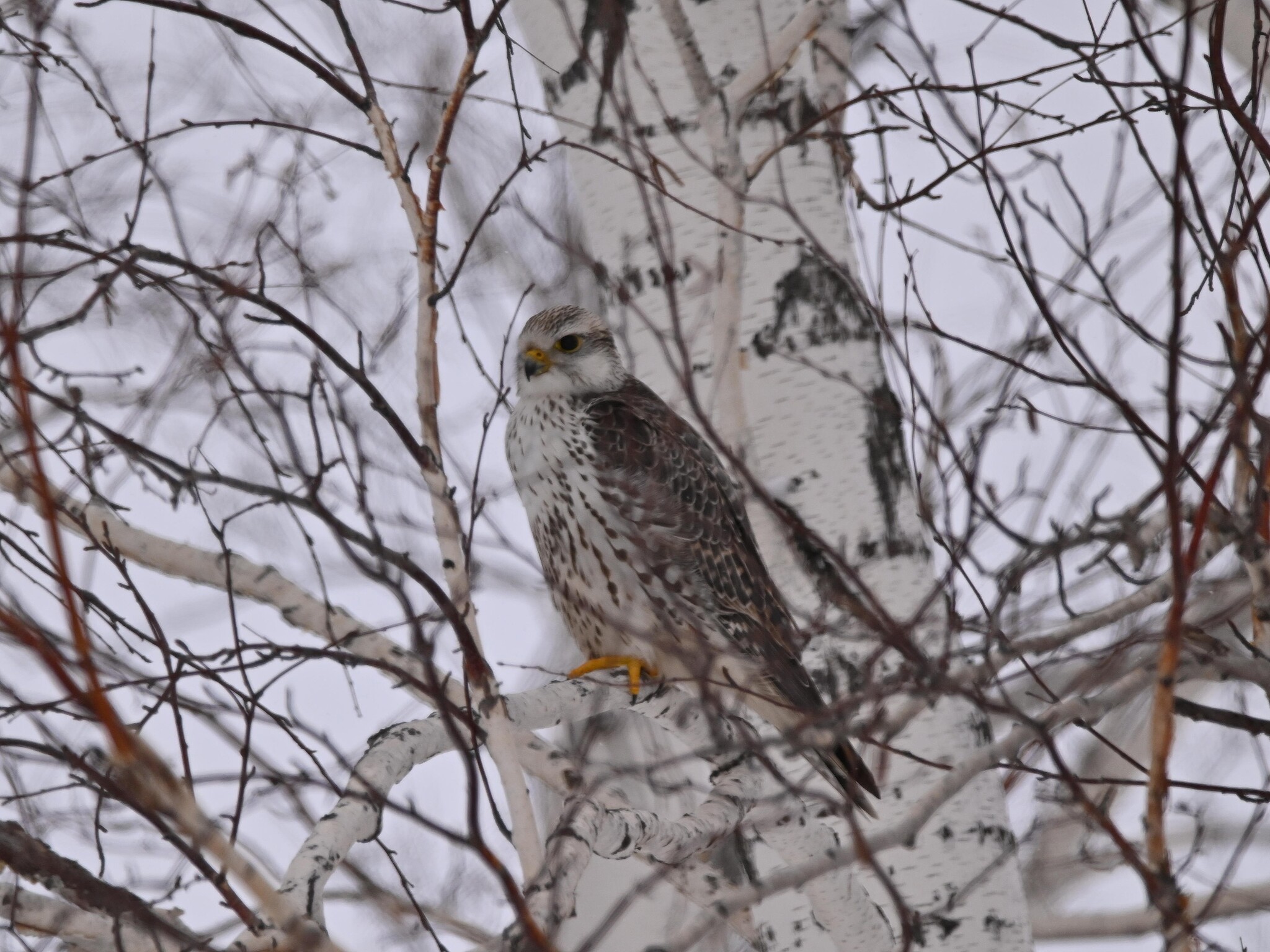
The saker falcon (Falco cherrug) is a large falcon species.
- Kingdom
- Animalia
- Phylum
- Chordata
- Class
- Aves
- Order
- Falconiformes
- Family
- Falconidae
- Genus
- Falco
- Species
- Falco cherrug
Description
The saker falcon (Falco cherrug) is a large falcon species. It breeds from Central Europe eastwards across the Palearctic to Manchuria. It is a partial migrant, which means that some part of the population is migratory, some part is not. In Europe, for example, a part of the juveniles are migrating, while adults are mostly resident. The European and West Asian migratory sakers spend the winter in the Sahel region. On migration, they cross the Middle East, the Arabian Peninsula, and Pakistan, where they are exposed to illegal trapping. The migratory birds to the east from Altai Mountains spend the winter in the Qinghai-Tibet Plateau. The saker falcon is the second fastest bird in level flight after the white-throated needletail swift (unconfirmed), capable of reaching 150 km/h (93 mph). It is also the third fastest animal in the world overall after the peregrine falcon and the golden eagle, with all three species capable of executing high speed dives known as "stooping", approaching 300 km/h (190 mph). The saker falcon is the national bird of Hungary, the United Arab Emirates, and Mongolia. It is called by Arabs Hur, i.e., "Free-bird", and it has been used in falconry in the Arabian Peninsula since ancient times. Saker falcons are the national bird of the United Arab Emirates, Saudi Arabia, Kuwait, Qatar, Oman and Yemen and have been integral to Arab heritage and culture for over 9,000 years. They are the national emblem of many Arab countries.
Gallery
Ajouter des photos
Partagez vos photos de cette espèce (jusqu'à 20 à la fois) : elles sont vérifiées automatiquement, puis publiées.
Répartition
Occurrences observées (données GBIF). Les zones hors aire d'origine peuvent indiquer une présence introduite ou invasive.
Sources et crédits
Informations provenant de plusieurs sources vérifiées. Dernière mise à jour : .
Crédits photos (6)
- Photo : Irina Krug · CC BY-NC 4.0 · via GBIF
- Photo : @lina_golovneva · CC BY-NC 4.0 · via iNaturalist
- Photo : @cnarraway · CC BY-NC 4.0 · via iNaturalist
- Photo : Сергей Неклюдов (@sneckl) · CC BY 4.0 · via iNaturalist
- Photo : @observe-syz · CC BY-NC 4.0 · via iNaturalist
- Photo : Tom Field (@tomfeild) · CC BY 4.0 · via iNaturalist
Mentions de licence
Texte disponible sous licence CC BY-SA 4.0. Il adapte notamment Wikipedia (CC BY-SA) : Saker falcon (Wikipédia, auteurs dans l’historique de l’article).
- Taxonomie : GBIF Backbone Taxonomy (CC BY 4.0)
- Carte : occurrences GBIF, fond © contributeurs OpenStreetMap (ODbL)
Détail : Sources et licences.
Discussion (0)
Aucun message pour l’instant. Lancez la discussion sur cette fiche (sources, précisions, débats éditoriaux).
Connectez-vous pour participer à la discussion.