
Laggar Falcon
Falco jugger
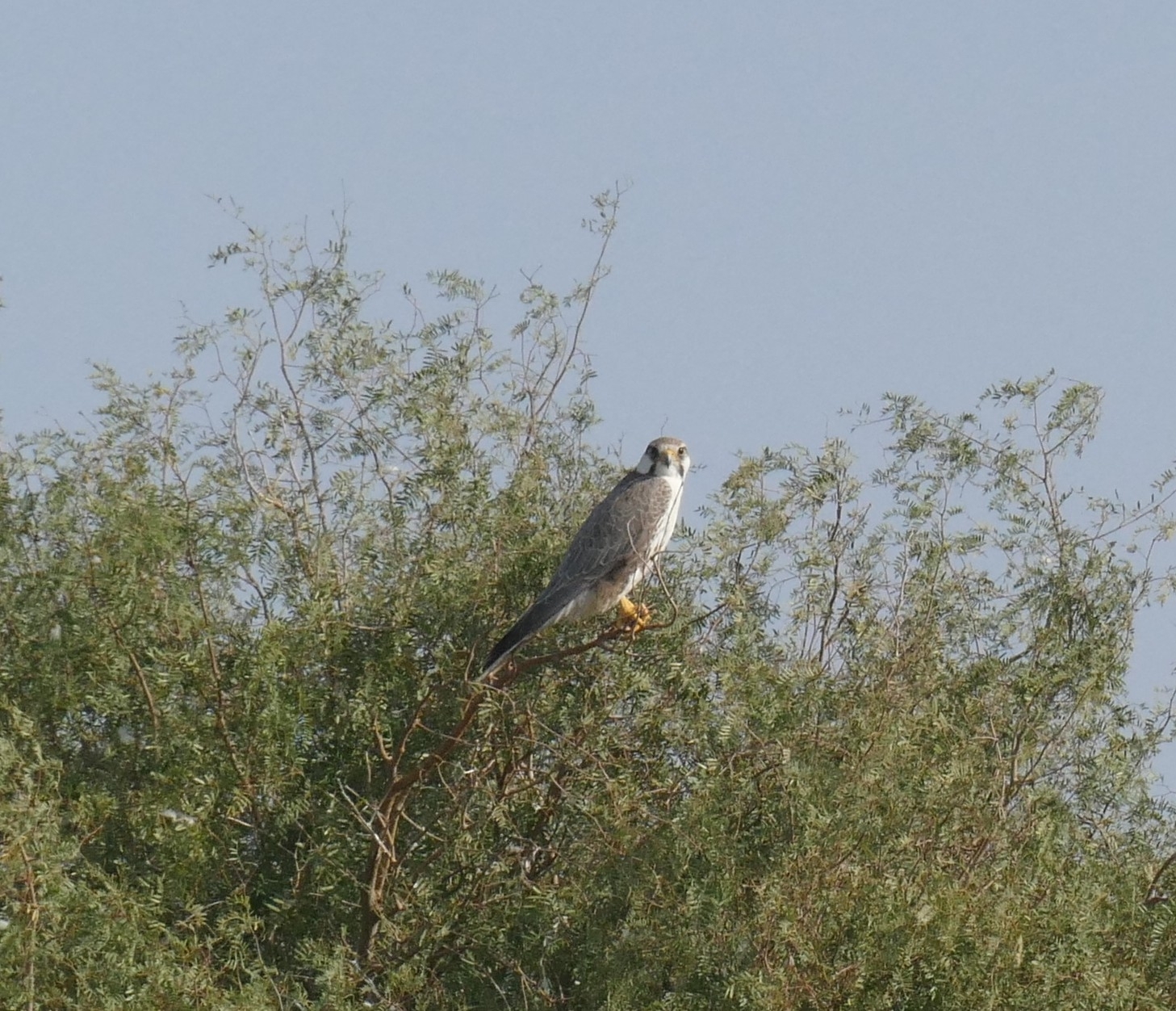
The laggar falcon (Falco jugger) is a mid-sized bird of prey occurring in the Indian subcontinent from southeastern Iran, southeastern Afghanistan, Pakistan, through India, Nepal, Bhutan, Bangladesh and northwestern Myanmar.
- Kingdom
- Animalia
- Phylum
- Chordata
- Class
- Aves
- Order
- Falconiformes
- Family
- Falconidae
- Genus
- Falco
- Species
- Falco jugger
Description
The laggar falcon (Falco jugger) is a mid-sized bird of prey occurring in the Indian subcontinent from southeastern Iran, southeastern Afghanistan, Pakistan, through India, Nepal, Bhutan, Bangladesh and northwestern Myanmar. It used to be one of the most common falcons in the region, but numbers have declined so that is probably nowhere a common species anymore. The main threats are the intensification of pesticide use and use as a decoy to trap large falcons. Fledglings have an almost entirely dark underside, and first-year subadult birds still retain much dark on the belly. Adults are dark overall and have blackish tibiotarsus feathers. The laggar falcon belongs to a close-knit complex of falcons known as hierofalcons. This group exhibits evidence for rampant hybridization and incomplete lineage sorting which confounds analyses of DNA sequence. The radiation of the hierofalcons has likely taken place in the Eemian interglacial at the start of the Late Pleistocene about 130,000–115,000 years ago. The laggar falcon represents a lineage that arrived at its present range out of eastern Africa by way of the Arabian Peninsula which during that time had a more humid climate than today.
Gallery
Ajouter des photos
Partagez vos photos de cette espèce (jusqu'à 20 à la fois) : elles sont vérifiées automatiquement, puis publiées.
Répartition
Occurrences observées (données GBIF). Les zones hors aire d'origine peuvent indiquer une présence introduite ou invasive.
Sources et crédits
Informations provenant de plusieurs sources vérifiées. Dernière mise à jour : .
Crédits photos (6)
- Photo : Kabir Singh Waraich · CC BY-NC 4.0 · via GBIF
- Photo : Rujuta Vinod (@rujutavinod) · CC BY-NC 4.0 · via iNaturalist
- Photo : Ravindr bhadarwal tal chhapar Ravindar (@ravindr_bhadarwal) · CC BY-NC 4.0 · via iNaturalist
- Photo : Suhas Fuladi (@suhasfuladi) · CC BY-NC 4.0 · via iNaturalist
- Photo : Avinash Bhagat (@avinashbhagat2) · CC BY-NC 4.0 · via iNaturalist
- Photo : Remco Hofland (@remco) · CC BY-NC 4.0 · via iNaturalist
Mentions de licence
Texte disponible sous licence CC BY-SA 4.0. Il adapte notamment Wikipedia (CC BY-SA) : Laggar falcon (Wikipédia, auteurs dans l’historique de l’article).
- Taxonomie : GBIF Backbone Taxonomy (CC BY 4.0)
- Carte : occurrences GBIF, fond © contributeurs OpenStreetMap (ODbL)
- Statut de conservation : Liste rouge de l'UICN, via Wikidata (CC0)
Détail : Sources et licences.
Discussion (0)
Aucun message pour l’instant. Lancez la discussion sur cette fiche (sources, précisions, débats éditoriaux).
Connectez-vous pour participer à la discussion.