
Common Pheasant
Phasianus colchicus
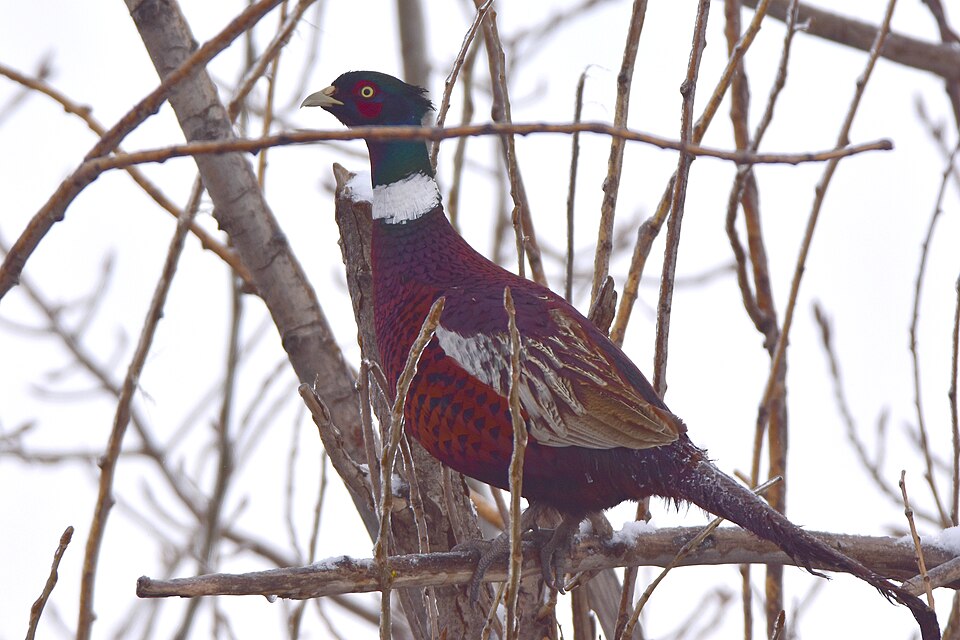
The common pheasant (Phasianus colchicus), ring-necked pheasant, or blue-headed pheasant, is a bird in the pheasant family (Phasianidae).
- Kingdom
- Animalia
- Phylum
- Chordata
- Class
- Aves
- Order
- Galliformes
- Family
- Phasianidae
- Genus
- Phasianus
- Species
- Phasianus colchicus
Description
The common pheasant (Phasianus colchicus), ring-necked pheasant, or blue-headed pheasant, is a bird in the pheasant family (Phasianidae). The genus name comes from Latin phasianus 'pheasant'. The species name colchicus is Latin for 'of Colchis' (modern day Georgia), a country on the Black Sea where pheasants became known to Europeans. Although Phasianus was previously thought to be closely related to the genus Gallus, the genus of junglefowl and domesticated chickens, recent studies show that they are in different subfamilies, having diverged over 20 million years ago. It is native to Asia, where it is widespread, and also to the extreme southeast of Europe in the northern foothills of the Caucasus Mountains. It has been widely introduced elsewhere as a game bird. In parts of its range, mainly in places where none of its relatives occurs such as in Europe, where it is naturalised, it is simply known as the pheasant. Ring-necked pheasant is both the collective name for a number of subspecies and their intergrades that have white neck rings and the name used for the species as a whole in North America. It is a well-known gamebird, among those of more than regional importance perhaps the most widespread and ancient one in the whole world. The common pheasant is one of the world's most hunted birds; it has been introduced for that purpose to many regions and is also common on game farms, where it is commercially bred. The ring-necked subspecies group in particular are commonly bred and were introduced to many parts of the world; the game farm stock, though no distinct breeds have been developed yet, can be considered semi-domesticated. The ring-necked pheasant is the state bird of South Dakota, one of only two US state birds that is not a species native to the United States. The green pheasant (P. versicolor) of Japan is sometimes considered a subspecies of the common pheasant. Though the species produce fertile hybrids wherever they coexist, this is simply a typical feature among fowl (Galloanseres), in which postzygotic isolating mechanisms are slight compared to most other birds. The species apparently have somewhat different ecological requirements and at least in its typical habitat, the green pheasant outcompetes the common pheasant. The introduction of the latter to Japan has therefore largely failed.
Gallery
Ajouter des photos
Partagez vos photos de cette espèce (jusqu'à 20 à la fois) : elles sont vérifiées automatiquement, puis publiées.
Répartition
Occurrences observées (données GBIF). Les zones hors aire d'origine peuvent indiquer une présence introduite ou invasive.
Sources et crédits
Informations provenant de plusieurs sources vérifiées. Dernière mise à jour : .
Crédits photos (10)
- Photo : © Kudaibergen Amirekul (iNaturalist) · CC BY-SA 4.0 · via iNaturalist
- Photo : © Михаил Голомысов (iNaturalist) · CC BY 4.0 · via iNaturalist
- Photo : © Антон Лабачоў (iNaturalist) · CC BY 4.0 · via iNaturalist
- Photo : © Griha Hasanov (iNaturalist) · CC BY 4.0 · via iNaturalist
- Photo : © Griha Hasanov (iNaturalist) · CC BY 4.0 · via iNaturalist
- Photo : © Donsky (iNaturalist) · CC BY 4.0 · via iNaturalist
- Photo : Phil Miller (@fiwfyfiw) · CC BY-NC 4.0 · via iNaturalist
- Photo : Alex Heffernan (@alexheffernan) · CC BY-NC 4.0 · via iNaturalist
- Photo : @sololegions · CC BY-NC 4.0 · via iNaturalist
- Photo : Do (@doornitho) · CC BY-NC 4.0 · via iNaturalist
Mentions de licence
Texte disponible sous licence CC BY-SA 4.0. Il adapte notamment Wikipedia (CC BY-SA) : Common pheasant (Wikipédia, auteurs dans l’historique de l’article).
- Taxonomie : GBIF Backbone Taxonomy (CC BY 4.0)
- Carte : occurrences GBIF, fond © contributeurs OpenStreetMap (ODbL)
- Statut de conservation : Liste rouge de l'UICN, via Wikidata (CC0)
Détail : Sources et licences.
Discussion (0)
Aucun message pour l’instant. Lancez la discussion sur cette fiche (sources, précisions, débats éditoriaux).
Connectez-vous pour participer à la discussion.