
Black-and-red Broadbill
Cymbirhynchus macrorhynchos
The black-and-red broadbill (Cymbirhynchus macrorhynchos) is a species of bird in the typical broadbill family, Eurylaimidae.
- Kingdom
- Animalia
- Phylum
- Chordata
- Class
- Aves
- Order
- Passeriformes
- Family
- Eurylaimidae
- Genus
- Cymbirhynchus
- Species
- Cymbirhynchus macrorhynchos
Description
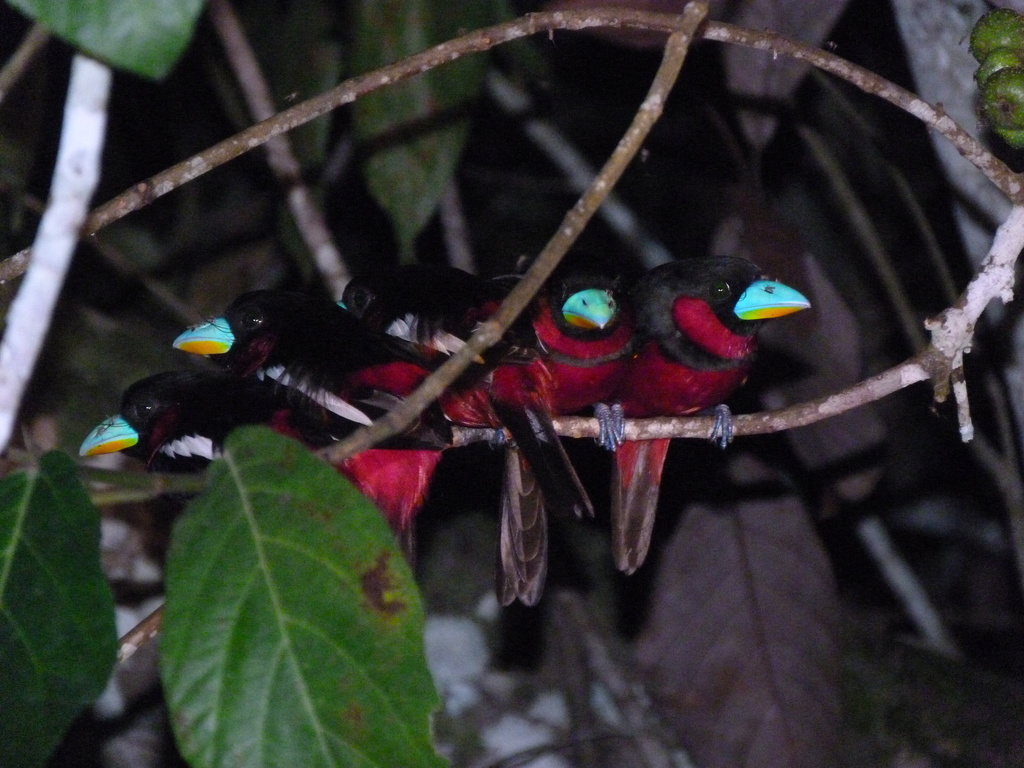
The black-and-red broadbill (Cymbirhynchus macrorhynchos) is a species of bird in the typical broadbill family, Eurylaimidae. It is the only species in the genus Cymbirhynchus. A large, distinctive bird, it has maroon underparts, black upperparts, a maroon neck-band, and white bars on the wings. It also has a large, two-colored, blue-and-yellow bill. The species shows slight sexual dimorphism, with females being smaller than males. No other bird in its range resembles it, though the black-and-yellow broadbill has a similar call. The species is found in Brunei, Cambodia, Indonesia, Laos, Malaysia, Myanmar, Singapore, Thailand, and Vietnam. Inhabiting lowland riparian forest throughout its range, it can also adapt quite well to disturbed habitat, such as secondary forest growth and degraded habitat near rivers. The black-and-red broadbill is mainly insectivorous, supplementing its diet with aquatic creatures such as mollusks, snails, fish, and crustaceans. It also takes leaves and seeds incidentally. Breeding takes place during the dry season throughout its range, with the nest being a large, conspicuous structure that usually hangs over water. Nests are built by both sexes, out of creepers, fungal hyphae, moss, and other plant matter. Eggs are laid in clutches of two or three, occasionally with a fourth runt egg, and incubated by both parents. The black-and-red broadbill is evaluated as a least-concern species by the International Union for Conservation of Nature due to its large range and the lack of a severe decrease in its global population. However, the species has experienced declines in several parts of its range, and may face threats due to deforestation, trapping for the songbird trade, and hunting.
Gallery
Ajouter des photos
Partagez vos photos de cette espèce (jusqu'à 20 à la fois) : elles sont vérifiées automatiquement, puis publiées.
Répartition
Occurrences observées (données GBIF). Les zones hors aire d'origine peuvent indiquer une présence introduite ou invasive.
Sources et crédits
Informations provenant de plusieurs sources vérifiées. Dernière mise à jour : .
Crédits photos (8)
- Photo : @bronyaur · CC BY-NC 4.0 · via iNaturalist
- Photo : Sergey Yeliseev (@sergeyyeliseev) · CC BY-NC 4.0 · via iNaturalist
- Photo : Ian Dugdale (@ian_dugdale) · CC BY 4.0 · via iNaturalist
- Photo : Shalahuddin Averroes Supartha (@saverroes) · CC BY-NC 4.0 · via iNaturalist
- Photo : @mitradaneshvar · CC BY-NC 4.0 · via iNaturalist
- Photo : Tero Linjama (@terolinjama) · CC0 (domaine public) · via iNaturalist
- Photo : @thebladedbird · CC BY-NC 4.0 · via iNaturalist
- Photo : @lunarjade · CC BY-NC 4.0 · via iNaturalist
Mentions de licence
Texte disponible sous licence CC BY-SA 4.0. Il adapte notamment Wikipedia (CC BY-SA) : Black-and-red broadbill (Wikipédia, auteurs dans l’historique de l’article).
- Taxonomie : GBIF Backbone Taxonomy (CC BY 4.0)
- Carte : occurrences GBIF, fond © contributeurs OpenStreetMap (ODbL)
- Statut de conservation : Liste rouge de l'UICN, via Wikidata (CC0)
Détail : Sources et licences.
Discussion (0)
Aucun message pour l’instant. Lancez la discussion sur cette fiche (sources, précisions, débats éditoriaux).
Connectez-vous pour participer à la discussion.