
Whitehead's Broadbill
Calyptomena whiteheadi
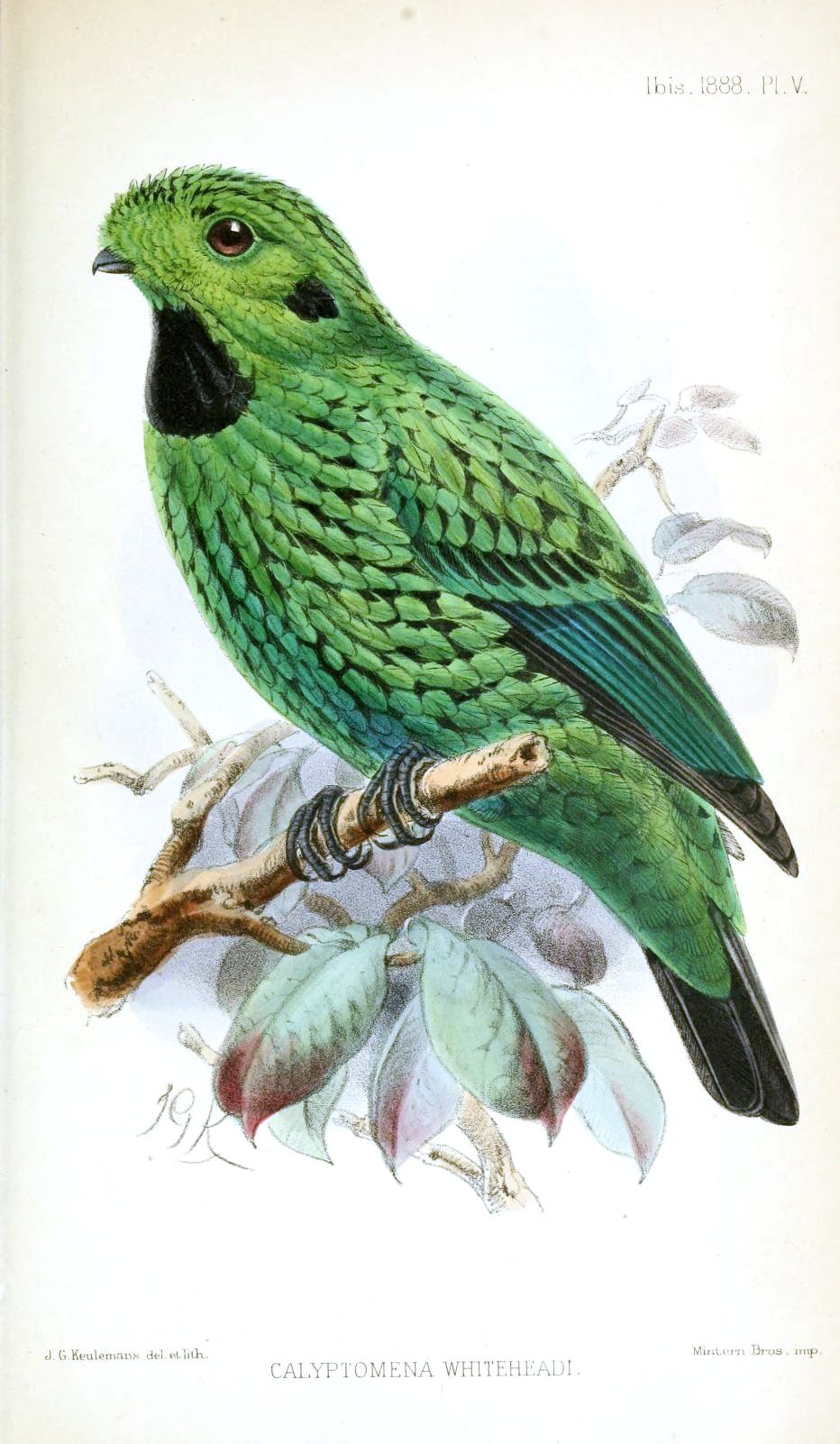
Whitehead's broadbill (Calyptomena whiteheadi) is a species of bird in the family Calyptomenidae.
- Kingdom
- Animalia
- Phylum
- Chordata
- Class
- Aves
- Order
- Passeriformes
- Family
- Eurylaimidae
- Genus
- Calyptomena
- Species
- Calyptomena whiteheadi
Description
Whitehead's broadbill (Calyptomena whiteheadi) is a species of bird in the family Calyptomenidae. It is endemic to the mountain ranges of north-central Borneo, where it mainly inhabits montane forests and forest edges at elevations of 900–1,700 m (3,000–5,600 ft). It is 24–27 cm (9.4–10.6 in) long, with males weighing 142–171 g (5.0–6.0 oz) and females weighing 150–163 g (5.3–5.7 oz). Males are vivid green and have a black throat patch, black spots on the ear-coverts and back of the neck, and black markings and streaking all over the body. The tails and flight feathers are also blackish. Females are smaller and lack the black markings on the head and underparts. Juveniles look similar to adults but have fewer black markings. Described by the British ornithologist Richard Bowdler Sharpe in 1887, Whitehead's broadbill is named after the British explorer John Whitehead. It mainly feeds on fruit and supplements its diet with insects. Breeding probably occurs from March to June, with clutches containing one or two eggs. Although it is classified as being of least concern by the International Union for Conservation of Nature, it is threatened by habitat destruction and its population is thought to be decreasing.
Gallery
Ajouter des photos
Partagez vos photos de cette espèce (jusqu'à 20 à la fois) : elles sont vérifiées automatiquement, puis publiées.
Répartition
Occurrences observées (données GBIF). Les zones hors aire d'origine peuvent indiquer une présence introduite ou invasive.
Sources et crédits
Informations provenant de plusieurs sources vérifiées. Dernière mise à jour : .
Crédits photos (6)
- Photo : John Gerrard Keulemans · Domaine public
- Photo : Tim Forrester (@tim_forrester) · CC BY-NC 4.0 · via iNaturalist
- Photo : John Sterling (@jsterling60) · CC BY-NC 4.0 · via iNaturalist
- Photo : @johnharshman · CC BY-NC 4.0 · via iNaturalist
- Photo : Natalia Rojas-Estevez (@nat_rojasestevez) · CC BY-NC 4.0 · via iNaturalist
- Photo : @emskakoon · CC BY-NC 4.0 · via iNaturalist
Mentions de licence
Texte disponible sous licence CC BY-SA 4.0. Il adapte notamment Wikipedia (CC BY-SA) : Whitehead's broadbill (Wikipédia, auteurs dans l’historique de l’article).
- Taxonomie : GBIF Backbone Taxonomy (CC BY 4.0)
- Carte : occurrences GBIF, fond © contributeurs OpenStreetMap (ODbL)
- Statut de conservation : Liste rouge de l'UICN, via Wikidata (CC0)
Détail : Sources et licences.
Discussion (0)
Aucun message pour l’instant. Lancez la discussion sur cette fiche (sources, précisions, débats éditoriaux).
Connectez-vous pour participer à la discussion.