
Banded Broadbill
Eurylaimus javanicus
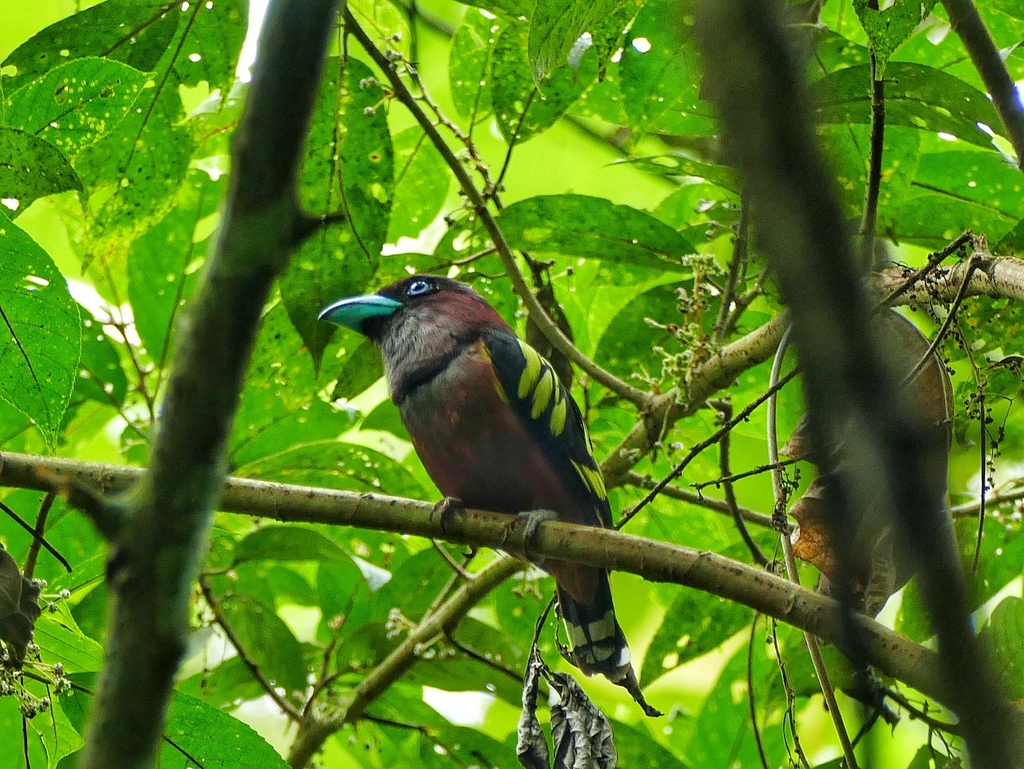
The banded broadbill (Eurylaimus javanicus) is a species of bird in the typical broadbill family Eurylaimidae found in Mainland Southeast Asia and the Greater Sunda Islands.
- Kingdom
- Animalia
- Phylum
- Chordata
- Class
- Aves
- Order
- Passeriformes
- Family
- Eurylaimidae
- Genus
- Eurylaimus
- Species
- Eurylaimus javanicus
Description
The banded broadbill (Eurylaimus javanicus) is a species of bird in the typical broadbill family Eurylaimidae found in Mainland Southeast Asia and the Greater Sunda Islands. It is sometimes split into two species, one including only the nominate subspecies, E. j. javanicus, and one including all the remaining subspecies. It inhabits a variety of forests, along with forest edge, rubber plantations and Falcataria falcata groves, mainly in lowland areas. A striking, large-bodied bird with a length of 21.5–23.0 cm (8.5–9.1 in), it is unlikely to be mistaken for another species. The broadbill is mostly purplish-red, with yellow-streaked black wings, a bright blue beak, a blackish face and greyish chin and upper breast. Females can be told apart from males by their lack of a black neckband, although these are indistinct in Bornean and Javan males. Despite its conspicuous appearance, the bird is usually hard to see due to its sluggishness and is usually only noticed when it vocalises. The species mainly eats arthropods such as orthopterans (grasshoppers, katydids and crickets), true bugs and beetles, but has also been recorded feeding on snails, lizards, frogs and figs. On the mainland, breeding generally occurs during the dry season; populations in the Greater Sundas have a longer breeding season lasting from March to November. On Java, the broadbill is thought to breed year-round. Their large, raggedy nests are hung from trees at a height of 6–21 m (20–69 ft) over clearings or water bodies. Clutches have two or three eggs. The eggs are usually dull white with dark purple or reddish-brown flecks, but those from West Java are dirty white with dense rusty-brown to lavender-grey markings. The International Union for Conservation of Nature, which splits the banded broadbill into two species, classifies javanicus as being near-threatened and the other subspecies as being of least concern.
Gallery
Ajouter des photos
Partagez vos photos de cette espèce (jusqu'à 20 à la fois) : elles sont vérifiées automatiquement, puis publiées.
Répartition
Occurrences observées (données GBIF). Les zones hors aire d'origine peuvent indiquer une présence introduite ou invasive.
Sources et crédits
Informations provenant de plusieurs sources vérifiées. Dernière mise à jour : .
Crédits photos (8)
- Photo : @andraescholz · CC BY-NC 4.0 · via iNaturalist
- Photo : Diane Bricmont (@steelbirder) · CC BY-NC 4.0 · via iNaturalist
- Photo : @benjamynweil · CC BY-NC 4.0 · via iNaturalist
- Photo : Yingyod Lapwong (@charliev) · CC BY-NC 4.0 · via iNaturalist
- Photo : Eric Carpenter (@ecarpe) · CC BY-NC 4.0 · via iNaturalist
- Photo : Kyle Winney (@kyle_winney) · CC BY-NC 4.0 · via iNaturalist
- Photo : Leslie Flint (@leslie_flint) · CC BY-NC 4.0 · via iNaturalist
- Photo : @lunarjade · CC BY-NC 4.0 · via iNaturalist
Mentions de licence
Texte disponible sous licence CC BY-SA 4.0. Il adapte notamment Wikipedia (CC BY-SA) : Banded broadbill (Wikipédia, auteurs dans l’historique de l’article).
- Taxonomie : GBIF Backbone Taxonomy (CC BY 4.0)
- Carte : occurrences GBIF, fond © contributeurs OpenStreetMap (ODbL)
- Statut de conservation : Liste rouge de l'UICN, via Wikidata (CC0)
Détail : Sources et licences.
Discussion (0)
Aucun message pour l’instant. Lancez la discussion sur cette fiche (sources, précisions, débats éditoriaux).
Connectez-vous pour participer à la discussion.