
Long-tailed Widowbird
Euplectes progne
The long-tailed widowbird (Euplectes progne) is a species of bird in the weaver family Ploceidae.
- Kingdom
- Animalia
- Phylum
- Chordata
- Class
- Aves
- Order
- Passeriformes
- Family
- Ploceidae
- Genus
- Euplectes
- Species
- Euplectes progne
Description
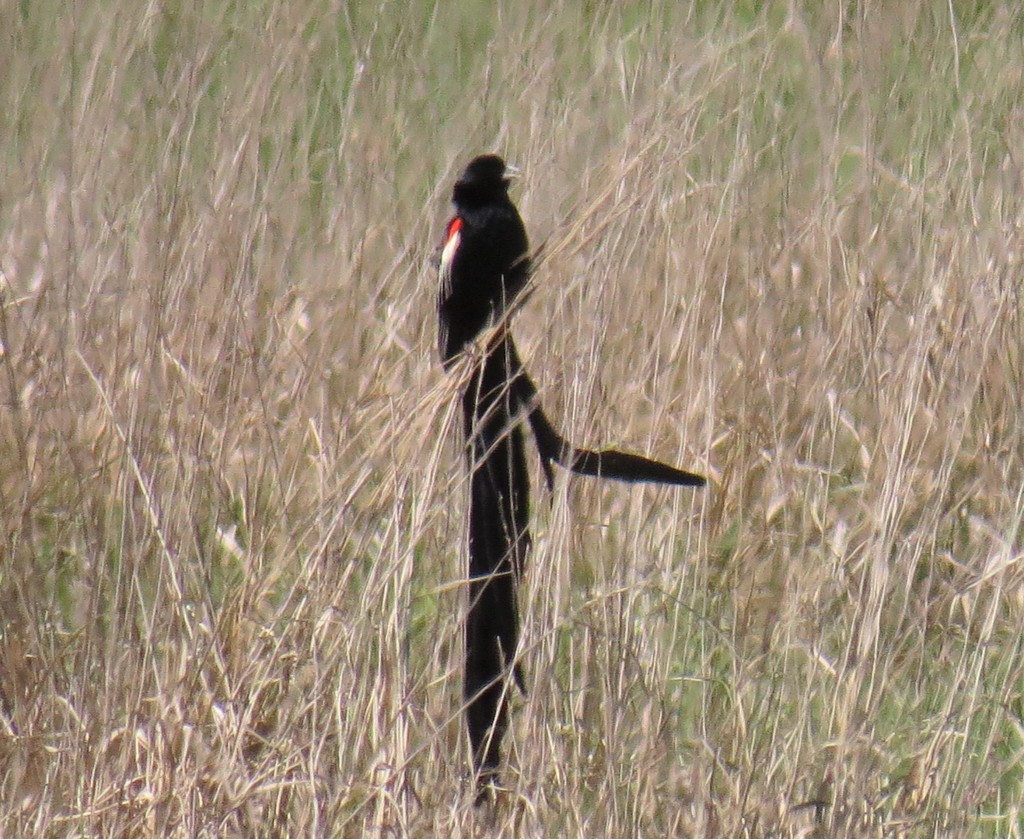
The long-tailed widowbird (Euplectes progne) is a species of bird in the weaver family Ploceidae. The species is found in Angola, Botswana, the Democratic Republic of the Congo, Kenya, Lesotho, South Africa, Eswatini, and Zambia. The long-tailed widowbird is a medium-sized bird and one of the most common in the territories it inhabits. Adult breeding males are almost entirely black with orange and white shoulders ("epaulets"), long, wide tails, and a bluish white bill. Females are rather inconspicuous, their feathers streaked tawny and black with pale patches on the chest, breast and back, narrow tail feathers, and horn-coloured bills. When flying, male long-tailed widowbirds are readily visible due to their extremely long tails. Between six and eight of their twelve tail feathers are approximately half a metre (approximately 20 inches) long. The tail during flight display is expanded vertically into a deep, long keel below the male as he flies with slow wingbeats 0.5 to 2 metres (20 to 78 inches) above his territory. Because of the seemingly large cost to such male ornaments, the long-tailed widowbird has been the subject of extensive research into the function and evolution of sexually selected traits. This research has demonstrated the existence of female choice in sexual selection and indicates the trade-offs between sexual appeal and physical constraints with regard to the evolution of sexual ornaments.
Gallery
Ajouter des photos
Partagez vos photos de cette espèce (jusqu'à 20 à la fois) : elles sont vérifiées automatiquement, puis publiées.
Répartition
Occurrences observées (données GBIF). Les zones hors aire d'origine peuvent indiquer une présence introduite ou invasive.
Sources et crédits
Informations provenant de plusieurs sources vérifiées. Dernière mise à jour : .
Crédits photos (8)
- Photo : @pam_ellenberger_kleiman · CC BY-NC 4.0 · via iNaturalist
- Photo : Innes Buchner (@oerknal) · CC0 (domaine public) · via iNaturalist
- Photo : Paul Tavares (@paultavares) · CC BY-NC 4.0 · via iNaturalist
- Photo : c (@sylvc) · CC BY-NC 4.0 · via iNaturalist
- Photo : @wetlandwanderer · CC BY-NC 4.0 · via iNaturalist
- Photo : Deon van der Hoven (@deonbirds) · CC BY-NC 4.0 · via iNaturalist
- Photo : Timothy Hedges (@t_hedges) · CC BY-NC 4.0 · via iNaturalist
- Photo : @cressgil · CC BY-NC 4.0 · via iNaturalist
Mentions de licence
Texte disponible sous licence CC BY-SA 4.0. Il adapte notamment Wikipedia (CC BY-SA) : Long-tailed widowbird (Wikipédia, auteurs dans l’historique de l’article).
- Taxonomie : GBIF Backbone Taxonomy (CC BY 4.0)
- Carte : occurrences GBIF, fond © contributeurs OpenStreetMap (ODbL)
- Statut de conservation : Liste rouge de l'UICN, via Wikidata (CC0)
Détail : Sources et licences.
Discussion (0)
Aucun message pour l’instant. Lancez la discussion sur cette fiche (sources, précisions, débats éditoriaux).
Connectez-vous pour participer à la discussion.