
Little Hermit
Phaethornis longuemareus
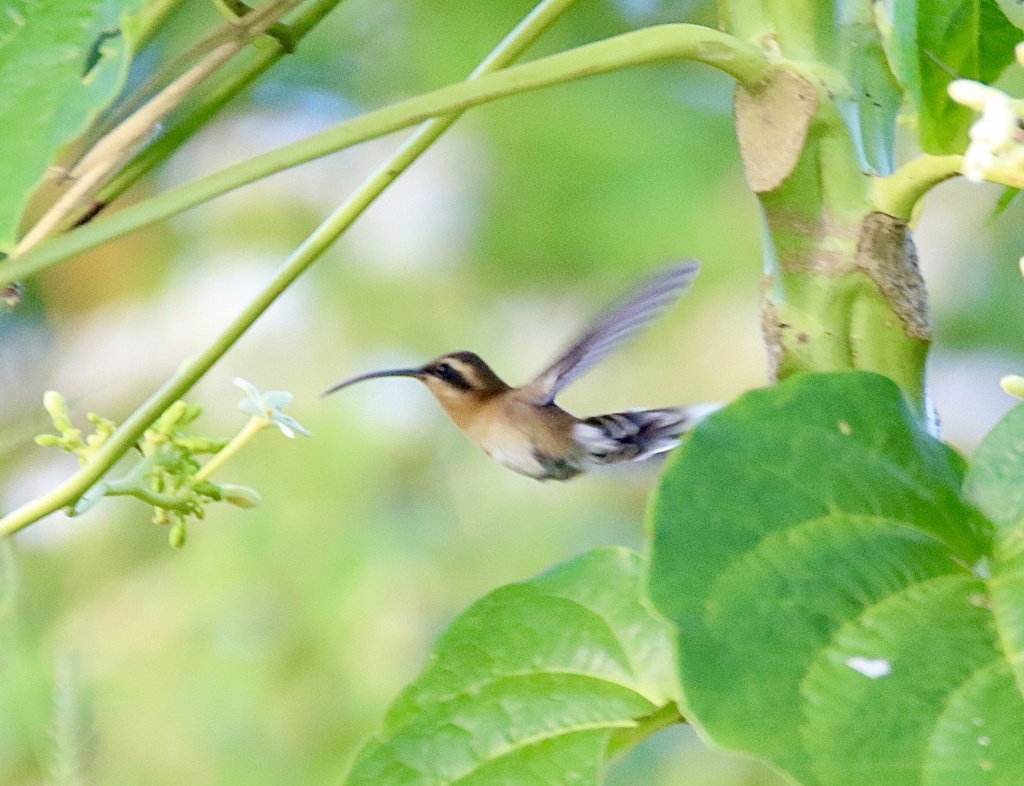
The little hermit (Phaethornis longuemareus) is a hummingbird that is a resident breeder in north-eastern Venezuela, northern Guyana, Suriname, French Guiana and Trinidad.
- Kingdom
- Animalia
- Phylum
- Chordata
- Class
- Aves
- Order
- Apodiformes
- Family
- Trochilidae
- Genus
- Phaethornis
- Species
- Phaethornis longuemareus
Description
The little hermit (Phaethornis longuemareus) is a hummingbird that is a resident breeder in north-eastern Venezuela, northern Guyana, Suriname, French Guiana and Trinidad. This lowland species occurs in various semi-open wooded habitats, e.g. mangrove, secondary forest, plantations and scrub. In Trinidad it also occurs in rainforest. It is fairly common in most of its range, and therefore listed as Least Concern by BirdLife International on the IUCN Red List. Previously, several other small hermits were considered subspecies of this species. This includes the stripe-throated hermit (P. striigularis) of Central America and north-western South America, the minute hermit (P. idaliae) of south-eastern Brazil, the Tapajós hermit (P. aethopyga) of south-eastern Amazonia, and the black-throated hermit (P. atrimentalis) of western Amazonia. As presently defined, the little hermit is monotypic. It is among the smallest hummingbirds and birds overall with a total length of about 9 cm (3.5 in) and a weight of 2.5–3.5 g (0.09–0.12 oz). It is olive-green above with orange-ochraceous uppertail coverts and underparts (the belly often is greyer). As most other hermits, it has a long decurved bill, elongated central rectrices with whitish tips and a blackish mask bordered by a whitish-buff malar and supercilium. The upper mandible is black, the lower is yellow with a black tip. The male has a slightly darker throat than the female. The males form communal leks where they sing and flash their tails to attract the females. The song varies over its range, but typically is high, squeaky, complex and repeated again and again. The little hermit lays two eggs in a conical nest suspended under a large leaf. Incubation and fledging period not reported, but probably as relatives where incubations is 14–16 days, and fledging another 20–23 days. The food of this species is nectar, taken from a wide variety of flowers (e.g. Heliconia), and some small insects and spiders. It feeds mainly by trap-lining.
Gallery
Ajouter des photos
Partagez vos photos de cette espèce (jusqu'à 20 à la fois) : elles sont vérifiées automatiquement, puis publiées.
Répartition
Occurrences observées (données GBIF). Les zones hors aire d'origine peuvent indiquer une présence introduite ou invasive.
Sources et crédits
Informations provenant de plusieurs sources vérifiées. Dernière mise à jour : .
Crédits photos (8)
- Photo : EM (@emrsa) · CC BY-NC 4.0 · via iNaturalist
- Photo : Matthieu Gauvain (@matthieu_gauvain) · CC BY-NC 4.0 · via iNaturalist
- Photo : Gerold Morrison (@gmcycle) · CC BY-NC 4.0 · via iNaturalist
- Photo : Jean-Dominique LEBRETON (@lebreton_jean-do) · CC BY-NC 4.0 · via iNaturalist
- Photo : QUARTIER Thomas (@thomqrt) · CC BY-NC 4.0 · via iNaturalist
- Photo : Mark Hulme (@markhulme) · CC BY-NC 4.0 · via iNaturalist
- Photo : David Jeffrey Ringer (@djringer) · CC BY-NC 4.0 · via iNaturalist
- Photo : Melissa McMasters (@mmcmasters) · CC BY 4.0 · via iNaturalist
Mentions de licence
Texte disponible sous licence CC BY-SA 4.0. Il adapte notamment Wikipedia (CC BY-SA) : Little hermit, Ermite nain (Wikipédia, auteurs dans l’historique de l’article).
- Taxonomie : GBIF Backbone Taxonomy (CC BY 4.0)
- Carte : occurrences GBIF, fond © contributeurs OpenStreetMap (ODbL)
- Statut de conservation : Liste rouge de l'UICN, via Wikidata (CC0)
Détail : Sources et licences.
Discussion (0)
Aucun message pour l’instant. Lancez la discussion sur cette fiche (sources, précisions, débats éditoriaux).
Connectez-vous pour participer à la discussion.