
Black-backed Forktail
Enicurus immaculatus
The black-backed forktail (Enicurus immaculatus), occasionally referred to as the black-throated forktail, is a forktail species in the family Muscicapidae.
- Kingdom
- Animalia
- Phylum
- Chordata
- Class
- Aves
- Order
- Passeriformes
- Family
- Muscicapidae
- Genus
- Enicurus
- Species
- Enicurus immaculatus
Description
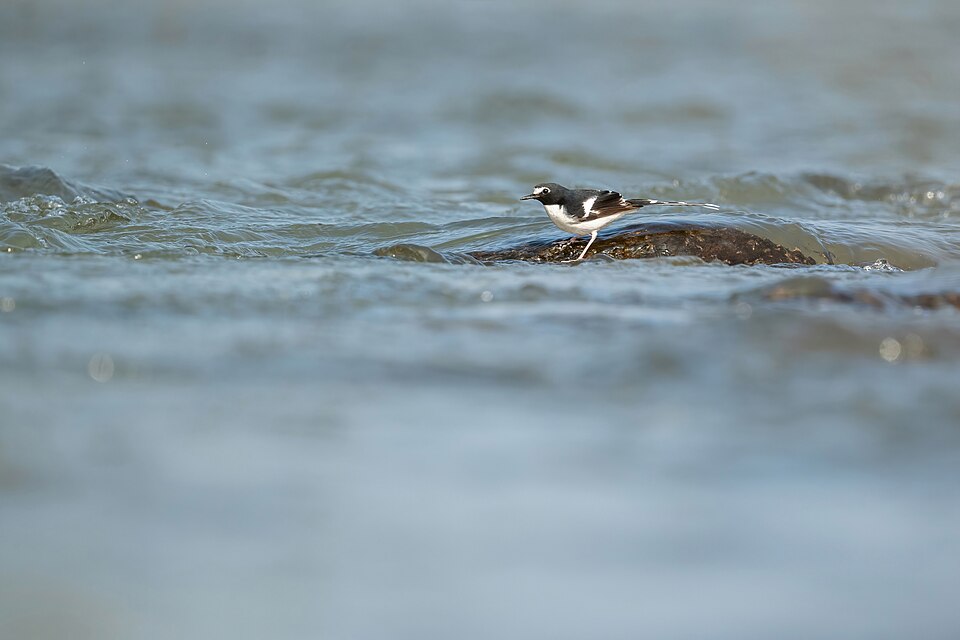
The black-backed forktail (Enicurus immaculatus), occasionally referred to as the black-throated forktail, is a forktail species in the family Muscicapidae. The species was described in 1836, from a specimen collected in Nepal. It is a medium-sized forktail, weighing between 25 and 29 grams, with a length of 20.5 to 23 centimetres (8+1⁄8 to 9 in). The species has a broad white stripe across its forehead. The crown, face, and mantle are black, while the bird's underparts are white, sharply divided from the black above. The wings are largely black with a broad white stripe across the greater coverts. The tail of the species, similar to that of other forktails, is long, graduated, and deeply forked. The tail is black with a white tip and three white bands created by shorter tail feathers. The beak of the bird is black, while the feet and legs are light pink, and the iris is brown. The species is monomorphic. The black backed forktail is solitary, but is occasionally found in pairs or in family groups. It is described as a shy species. The bird breeds between March and June, building a nest of plant matter in holes or crevices in rocks and dead trees. Three eggs are generally laid, which are pink and spotted with red-brown. Both sexes build the nest and incubate the eggs. The species frequents fast-flowing rivers and streams in temperate forests and subtropical or tropical moist lowland forests. It is found in the Indian subcontinent and in some adjoining regions of Southeast Asia. It ranges across Bangladesh, Bhutan, India, Myanmar, Nepal and Thailand. It is generally found below 1,450 metres (4,760 ft) above sea level, but has been recorded as high as 2,600 metres (8,530 ft). Its precise range and population are unknown. It is classified as a species of Least Concern by the International Union for Conservation of Nature.
Gallery
Ajouter des photos
Partagez vos photos de cette espèce (jusqu'à 20 à la fois) : elles sont vérifiées automatiquement, puis publiées.
Répartition
Occurrences observées (données GBIF). Les zones hors aire d'origine peuvent indiquer une présence introduite ou invasive.
Sources et crédits
Informations provenant de plusieurs sources vérifiées. Dernière mise à jour : .
Crédits photos (6)
- Photo : Mildeep · CC BY-SA 4.0
- Photo : Rejoice Gassah (@rejoicegassah) · CC BY 4.0 · via iNaturalist
- Photo : @luluchouette · CC BY 4.0 · via iNaturalist
- Photo : Johnson Tao (@johnson33047) · CC BY-NC 4.0 · via iNaturalist
- Photo : MSH Sourav (@souravmahmud) · CC BY-NC 4.0 · via iNaturalist
- Photo : Subhayan Biswas (@subhayan) · CC BY-NC 4.0 · via iNaturalist
Mentions de licence
Texte disponible sous licence CC BY-SA 4.0. Il adapte notamment Wikipedia (CC BY-SA) : Black-backed forktail (Wikipédia, auteurs dans l’historique de l’article).
- Taxonomie : GBIF Backbone Taxonomy (CC BY 4.0)
- Carte : occurrences GBIF, fond © contributeurs OpenStreetMap (ODbL)
- Statut de conservation : Liste rouge de l'UICN, via Wikidata (CC0)
Détail : Sources et licences.
Discussion (0)
Aucun message pour l’instant. Lancez la discussion sur cette fiche (sources, précisions, débats éditoriaux).
Connectez-vous pour participer à la discussion.