
Common Nighthawk
Chordeiles minor
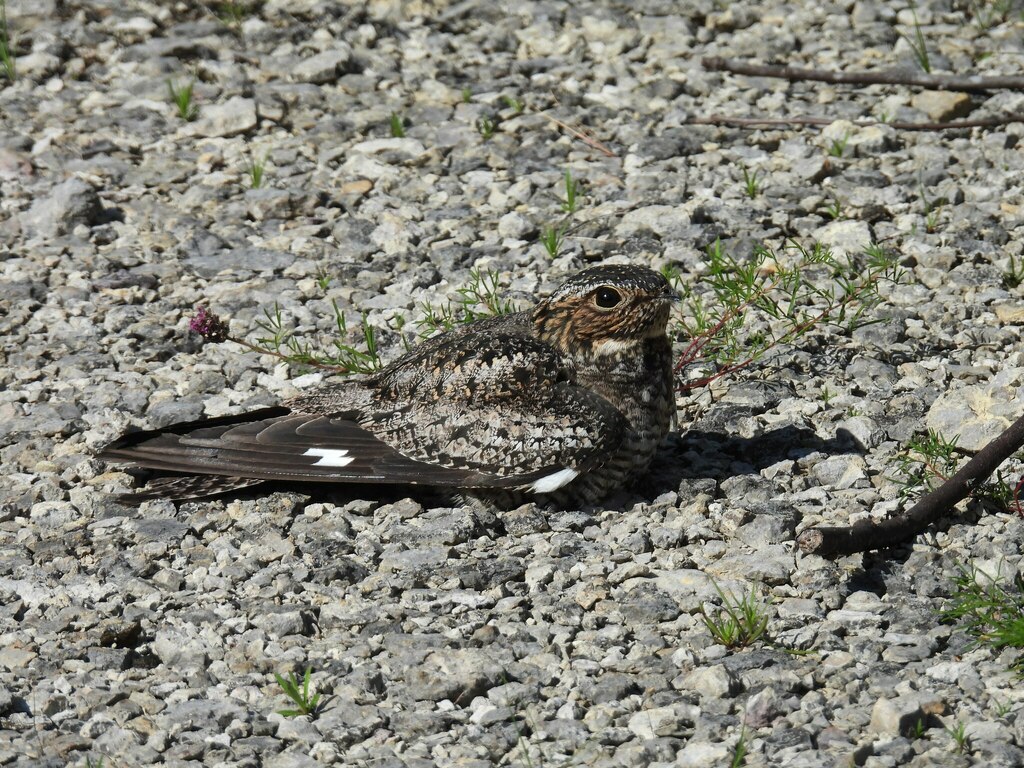
The common nighthawk or bullbat (Chordeiles minor) is a medium-sized crepuscular or nocturnal bird of the Americas within the nightjar (Caprimulgidae) family, whose presence and identity are best revealed by its vocalization.
- Kingdom
- Animalia
- Phylum
- Chordata
- Class
- Aves
- Order
- Caprimulgiformes
- Family
- Caprimulgidae
- Genus
- Chordeiles
- Species
- Chordeiles minor
Description
The common nighthawk or bullbat (Chordeiles minor) is a medium-sized crepuscular or nocturnal bird of the Americas within the nightjar (Caprimulgidae) family, whose presence and identity are best revealed by its vocalization. Typically dark (gray, black and brown), displaying cryptic colouration and intricate patterns, this bird is difficult to spot with the naked eye during the day. This bird is most conspicuous when in its buoyant and erratic flight. The most remarkable feature of this aerial insectivore is its small beak that belies the massiveness of its mouth. Some claim appearance similarities to owls. With its horizontal stance and short legs, the common nighthawk does not travel frequently on the ground, instead preferring to perch horizontally, parallel to branches, on posts, on the ground or on a roof. The males of this species may roost together but the bird is primarily solitary. The common nighthawk shows variability in territory size. This caprimulgid has a large, flattened head with large eyes; facially it lacks rictal bristles. The common nighthawk has long slender wings that at rest extend beyond a notched tail. There is noticeable barring on the sides and abdomen, also white wing-patches. The common nighthawk measures 22 to 25 cm (8.7 to 9.8 in) long, displays a wing span of 51 to 61 cm (20 to 24 in) weighs 55 to 98 g (1.9 to 3.5 oz), and has a life span of 4 to 5 years.
Gallery
Ajouter des photos
Partagez vos photos de cette espèce (jusqu'à 20 à la fois) : elles sont vérifiées automatiquement, puis publiées.
Répartition
Occurrences observées (données GBIF). Les zones hors aire d'origine peuvent indiquer une présence introduite ou invasive.
Sources et crédits
Informations provenant de plusieurs sources vérifiées. Dernière mise à jour : .
Crédits photos (8)
- Photo : Holly Taylor (@phacelia15) · CC BY-NC 4.0 · via iNaturalist
- Photo : @nevadawolf · CC BY-NC 4.0 · via iNaturalist
- Photo : Sandino Guerrero (@sandinoguerrero_naturalista) · CC BY 4.0 · via iNaturalist
- Photo : @jamesjarrett00 · CC BY-NC 4.0 · via iNaturalist
- Photo : @nurseanne · CC BY-NC 4.0 · via iNaturalist
- Photo : Steve (@helado) · CC BY-NC 4.0 · via iNaturalist
- Photo : Tom Benson (@thomasabenson) · CC BY-NC 4.0 · via iNaturalist
- Photo : Emily Hjalmarson (@ehjalmarson) · CC BY-NC 4.0 · via iNaturalist
Mentions de licence
Texte disponible sous licence CC BY-SA 4.0. Il adapte notamment Wikipedia (CC BY-SA) : Common nighthawk (Wikipédia, auteurs dans l’historique de l’article).
- Taxonomie : GBIF Backbone Taxonomy (CC BY 4.0)
- Carte : occurrences GBIF, fond © contributeurs OpenStreetMap (ODbL)
- Statut de conservation : Liste rouge de l'UICN, via Wikidata (CC0)
Détail : Sources et licences.
Discussion (0)
Aucun message pour l’instant. Lancez la discussion sur cette fiche (sources, précisions, débats éditoriaux).
Connectez-vous pour participer à la discussion.