
Emu
Dromaius novaehollandiae
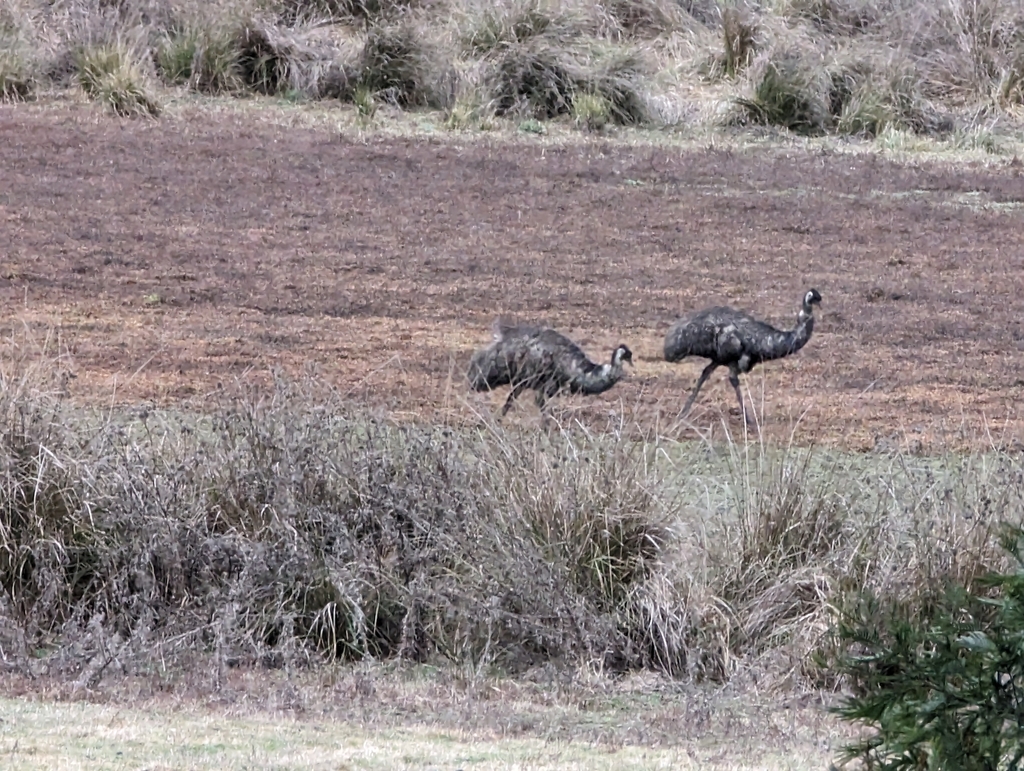
The emu (; Dromaius novaehollandiae) is a species of flightless bird endemic to Australia, where it is the tallest native bird.
- Kingdom
- Animalia
- Phylum
- Chordata
- Class
- Aves
- Order
- Casuariiformes
- Family
- Dromaiidae
- Genus
- Dromaius
- Species
- Dromaius novaehollandiae
Description
The emu (; Dromaius novaehollandiae) is a species of flightless bird endemic to Australia, where it is the tallest native bird. It is the only extant member of the genus Dromaius and the third-tallest living bird after its African ratite relatives, the common ostrich and Somali ostrich. The emu's native ranges cover most of the Australian mainland. The Tasmanian, Kangaroo Island and King Island subspecies became extinct after the European settlement of Australia in 1788. The emu has soft, brown feathers, a long neck, and long legs. It can grow up to 1.9 m (6 ft 3 in) in height. It is a robust bipedal runner that can travel great distances, and when necessary can sprint at 48 km/h (30 mph). It is omnivorous and forages on a variety of plants and insects, and can go for weeks without eating. It drinks infrequently, but takes in copious amounts of fresh water when the opportunity arises. Breeding takes place in May and June, and fighting among females for a mate is common. Females can mate several times and lay several clutches of eggs in one season. The male incubates the eggs; during this process he hardly eats or drinks and loses a significant amount of weight. The eggs hatch after around eight weeks, and the young are nurtured by their fathers. They reach full size after around six months, but can remain as a family unit until the next breeding season. The emu is sufficiently common to be rated as a least-concern species by the International Union for Conservation of Nature. Despite this, some local populations are listed as endangered, with all the insular subspecies going extinct by the 1800s. Threats to their survival include egg predation by other animals (especially invasive species), roadkills and habitat fragmentation. The emu is an important cultural icon of Australia, appearing on the coat of arms and various coinages. The bird features prominently in Indigenous Australian mythologies.
Gallery
Ajouter des photos
Partagez vos photos de cette espèce (jusqu'à 20 à la fois) : elles sont vérifiées automatiquement, puis publiées.
Répartition
Occurrences observées (données GBIF). Les zones hors aire d'origine peuvent indiquer une présence introduite ou invasive.
Sources et crédits
Informations provenant de plusieurs sources vérifiées. Dernière mise à jour : .
Crédits photos (5)
- Photo : Travis Nolan (@tankoda) · CC BY-NC 4.0 · via iNaturalist
- Photo : Mark Calyx (@markcalyx) · CC BY-NC 4.0 · via iNaturalist
- Photo : @jackfegan · CC BY-NC 4.0 · via iNaturalist
- Photo : Leigh Mathieson (@elroypine) · CC BY-NC 4.0 · via iNaturalist
- Photo : Johannes (@der_biologist) · CC BY-NC 4.0 · via iNaturalist
Mentions de licence
Texte disponible sous licence CC BY-SA 4.0. Il adapte notamment Wikipedia (CC BY-SA) : Emu (Wikipédia, auteurs dans l’historique de l’article).
- Taxonomie : GBIF Backbone Taxonomy (CC BY 4.0)
- Carte : occurrences GBIF, fond © contributeurs OpenStreetMap (ODbL)
- Statut de conservation : Liste rouge de l'UICN, via Wikidata (CC0)
Détail : Sources et licences.
Discussion (0)
Aucun message pour l’instant. Lancez la discussion sur cette fiche (sources, précisions, débats éditoriaux).
Connectez-vous pour participer à la discussion.