
Banded Stilt
Cladorhynchus leucocephalus
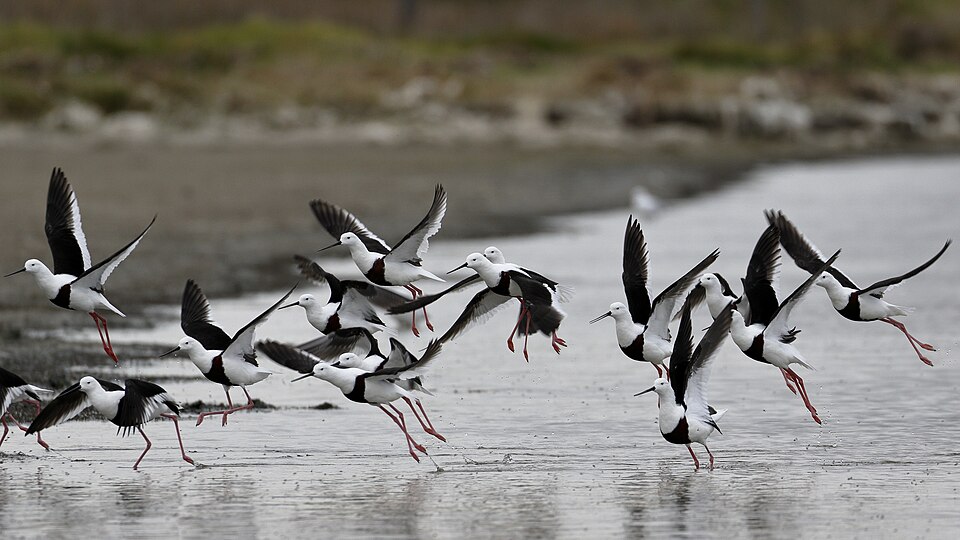
The banded stilt (Cladorhynchus leucocephalus) is a wader of the stilt and avocet family, Recurvirostridae, native to Australia.
- Kingdom
- Animalia
- Phylum
- Chordata
- Class
- Aves
- Order
- Charadriiformes
- Family
- Recurvirostridae
- Genus
- Cladorhynchus
- Species
- Cladorhynchus leucocephalus
Description
The banded stilt (Cladorhynchus leucocephalus) is a wader of the stilt and avocet family, Recurvirostridae, native to Australia. It belongs to the monotypic genus Cladorhynchus. It gets its name from the red-brown breast band found on breeding adults, though this is mottled or entirely absent in non-breeding adults and juveniles. Its remaining plumage is pied and the eyes are dark brown. Nestling banded stilts have white down, unlike any other species of wader. Breeding is triggered by the filling of inland salt lakes by rainfall, creating large shallow lakes rich in tiny shrimp on which the birds feed. A nomadic species, banded stilts migrate to these lakes in large numbers and assemble in large breeding colonies. The female lays three to four brown- or black-splotched whitish eggs on a scrape. If conditions are favourable, a second brood might be laid, though if the lakes dry up prematurely the breeding colonies may be abandoned. The banded stilt is considered to be a species of least concern by the International Union for Conservation of Nature (IUCN). Under the South Australian National Parks and Wildlife Act 1972, however, this bird is considered to be Vulnerable. This is due to the predation of it by silver gulls, which are considered to be a serious threat. Black falcons and wedge-tailed eagles are also predators, taking the banded stilt and its young.
Gallery
Ajouter des photos
Partagez vos photos de cette espèce (jusqu'à 20 à la fois) : elles sont vérifiées automatiquement, puis publiées.
Répartition
Occurrences observées (données GBIF). Les zones hors aire d'origine peuvent indiquer une présence introduite ou invasive.
Sources et crédits
Informations provenant de plusieurs sources vérifiées. Dernière mise à jour : .
Crédits photos (6)
- Photo : Ed Dunens · CC BY 2.0
- Photo : @alcedo77 · CC BY-NC 4.0 · via iNaturalist
- Photo : Velimir (@pfncvd) · CC BY-NC 4.0 · via iNaturalist
- Photo : Marilyn Hewish (@mhewish) · CC BY-NC 4.0 · via iNaturalist
- Photo : @pimelea · CC BY 4.0 · via iNaturalist
- Photo : Keith Morris (@boobook99) · CC BY-NC 4.0 · via iNaturalist
Mentions de licence
Texte disponible sous licence CC BY-SA 4.0. Il adapte notamment Wikipedia (CC BY-SA) : Banded stilt (Wikipédia, auteurs dans l’historique de l’article).
- Taxonomie : GBIF Backbone Taxonomy (CC BY 4.0)
- Carte : occurrences GBIF, fond © contributeurs OpenStreetMap (ODbL)
- Statut de conservation : Liste rouge de l'UICN, via Wikidata (CC0)
Détail : Sources et licences.
Discussion (0)
Aucun message pour l’instant. Lancez la discussion sur cette fiche (sources, précisions, débats éditoriaux).
Connectez-vous pour participer à la discussion.