
Black Drongo
Dicrurus macrocercus
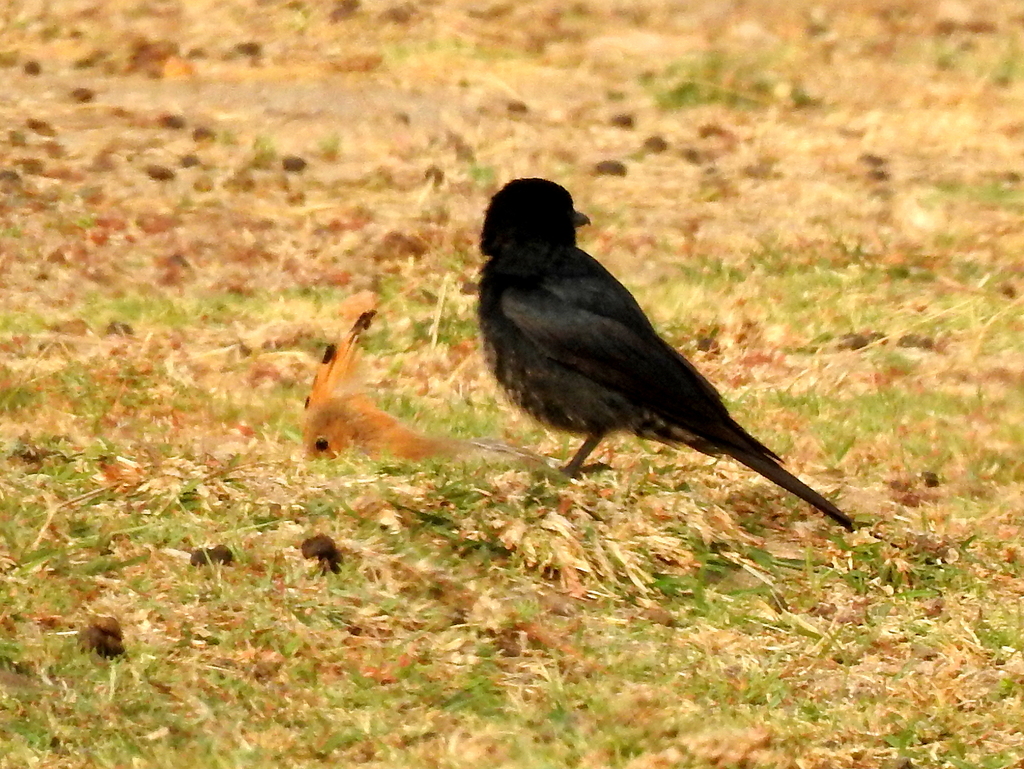
The black drongo (Dicrurus macrocercus) is a small Asian passerine bird of the drongo family Dicruridae.
- Kingdom
- Animalia
- Phylum
- Chordata
- Class
- Aves
- Order
- Passeriformes
- Family
- Dicruridae
- Genus
- Dicrurus
- Species
- Dicrurus macrocercus
Description
The black drongo (Dicrurus macrocercus) is a small Asian passerine bird of the drongo family Dicruridae. It is a common resident breeder in much of tropical southern Asia from southwest Iran through Pakistan, India, Bangladesh and Sri Lanka east to southern China and Indonesia and accidental visitor of Japan. It is an all black bird with a distinctive forked tail and measures 28 cm (11 in) in length. It feeds on insects, and is common in open agricultural areas and light forest throughout its range, perching conspicuously on a bare perch or along power or telephone lines. The species is known for its aggressive behaviour towards much larger birds, such as crows, never hesitating to dive-bomb any bird of prey that invades its territory. This behaviour earns it the informal name of king crow. Smaller birds often nest in the well-guarded vicinity of a nesting black drongo. Previously grouped along with the African fork-tailed drongo (Dicrurus adsimilis), the Asian forms are now treated as a separate species with several distinct populations. The black drongo is listed as least concern by the International Union for Conservation of Nature (IUCN) on the IUCN Red List, due to its large range and relative commonness. It has been introduced to some Pacific islands, where it has thrived and become abundant to the point of threatening and causing the extinction of native and endemic bird species there.
Gallery
Ajouter des photos
Partagez vos photos de cette espèce (jusqu'à 20 à la fois) : elles sont vérifiées automatiquement, puis publiées.
Répartition
Occurrences observées (données GBIF). Les zones hors aire d'origine peuvent indiquer une présence introduite ou invasive.
Sources et crédits
Informations provenant de plusieurs sources vérifiées. Dernière mise à jour : .
Crédits photos (8)
- Photo : @shivaprakash · CC BY-NC 4.0 · via iNaturalist
- Photo : Yves Bas (@yvesbas) · CC BY 4.0 · via iNaturalist
- Photo : Chen Jia Hong (@jiahong) · CC BY 4.0 · via iNaturalist
- Photo : @wsw_flycatcher · CC BY-NC 4.0 · via iNaturalist
- Photo : @rosalisbury · CC BY-NC 4.0 · via iNaturalist
- Photo : Navaneeth Sini George (@navaneethsinigeorge) · CC BY 4.0 · via iNaturalist
- Photo : Gertraud Seiser (@gertiseiser) · CC BY-NC 4.0 · via iNaturalist
- Photo : 方伊琳(阿鈣) (@calcium) · CC BY-NC 4.0 · via iNaturalist
Mentions de licence
Texte disponible sous licence CC BY-SA 4.0. Il adapte notamment Wikipedia (CC BY-SA) : Black drongo (Wikipédia, auteurs dans l’historique de l’article).
- Taxonomie : GBIF Backbone Taxonomy (CC BY 4.0)
- Carte : occurrences GBIF, fond © contributeurs OpenStreetMap (ODbL)
- Statut de conservation : Liste rouge de l'UICN, via Wikidata (CC0)
Détail : Sources et licences.
Discussion (0)
Aucun message pour l’instant. Lancez la discussion sur cette fiche (sources, précisions, débats éditoriaux).
Connectez-vous pour participer à la discussion.