
Fork-tailed Drongo
Dicrurus adsimilis
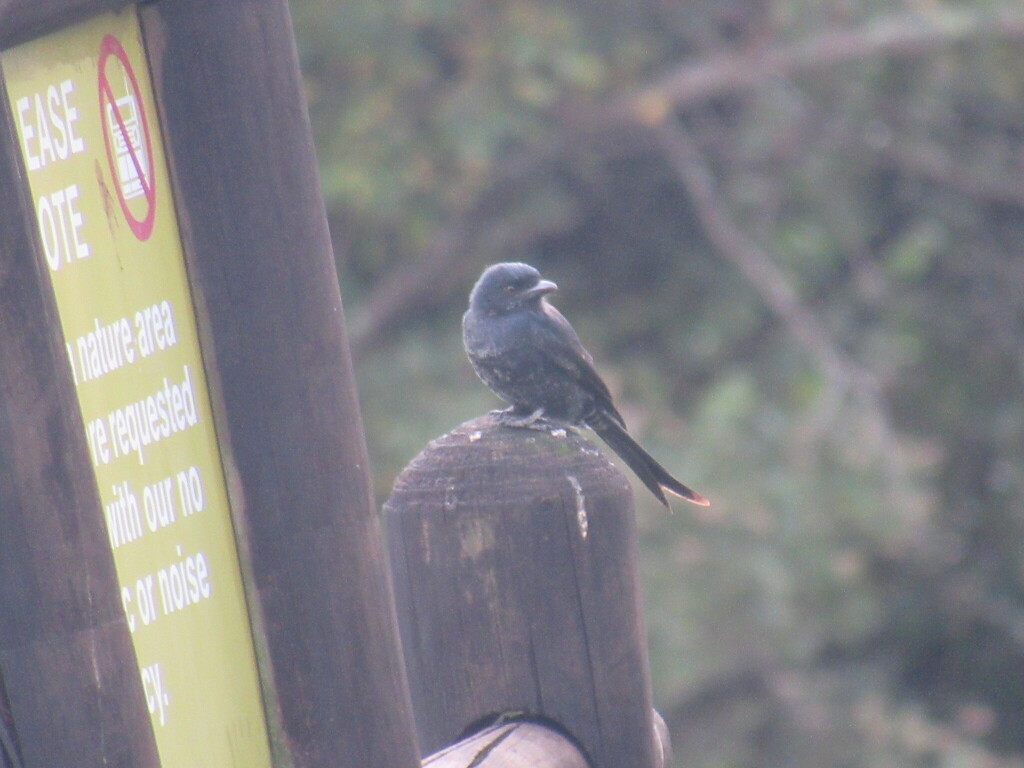
The fork-tailed drongo (Dicrurus adsimilis), also called the common drongo or African drongo, is a small bird found from the Sahel to South Africa that lives in wooded habitats, particularly woodlands and savannas.
- Kingdom
- Animalia
- Phylum
- Chordata
- Class
- Aves
- Order
- Passeriformes
- Family
- Dicruridae
- Genus
- Dicrurus
- Species
- Dicrurus adsimilis
Description
The fork-tailed drongo (Dicrurus adsimilis), also called the common drongo or African drongo, is a small bird found from the Sahel to South Africa that lives in wooded habitats, particularly woodlands and savannas. It is part of the family Dicruridae and has four recognized subspecies, D. a adsimilis, D. a. apivorus, D. a. fugax and D. a. jubaensis. Like other drongos, the fork-tailed is mostly insectivorous; its diet mainly consists of butterflies, termites, and grasshoppers. Physically, this species is characterized with a narrow fork-shaped tail, red-brownish eyes, and black plumage throughout all of its body. These birds nest close to wetlands, forests, and farms and the breeding season varies depending the region. The female usually lays one to four eggs, which hatch in 15 to 18 days. The fork-tailed drongo is known for its ability to deceptively mimic other bird alarm calls in order for a certain animal to flee the scene so it can steal their food (kleptoparasitism). They are also known for their aggressive and fearless behavior, often attacking and driving away much larger animals, including birds of prey, when their nest is in danger. Due to its extensive range and stable population, the fork-tailed drongo is classified by the IUCN Red List as a least-concern species.
Gallery
Ajouter des photos
Partagez vos photos de cette espèce (jusqu'à 20 à la fois) : elles sont vérifiées automatiquement, puis publiées.
Répartition
Occurrences observées (données GBIF). Les zones hors aire d'origine peuvent indiquer une présence introduite ou invasive.
Sources et crédits
Informations provenant de plusieurs sources vérifiées. Dernière mise à jour : .
Crédits photos (8)
- Photo : c (@sylvc) · CC BY-NC 4.0 · via iNaturalist
- Photo : Marion Holmes (@marionholmes) · CC BY-NC 4.0 · via iNaturalist
- Photo : Nicole Brooker (@oznaturephotos) · CC BY-NC 4.0 · via iNaturalist
- Photo : Fred Berrington (@readyfreddy123) · CC BY-NC 4.0 · via iNaturalist
- Photo : c (@sylvc) · CC BY-NC 4.0 · via iNaturalist
- Photo : Almut Martens (@almut_66) · CC BY-NC 4.0 · via iNaturalist
- Photo : John Gale (@jrgale) · CC BY-NC 4.0 · via iNaturalist
- Photo : Wynand (@wynandvlok) · CC BY-NC 4.0 · via iNaturalist
Mentions de licence
Texte disponible sous licence CC BY-SA 4.0. Il adapte notamment Wikipedia (CC BY-SA) : Fork-tailed drongo (Wikipédia, auteurs dans l’historique de l’article).
- Taxonomie : GBIF Backbone Taxonomy (CC BY 4.0)
- Carte : occurrences GBIF, fond © contributeurs OpenStreetMap (ODbL)
- Statut de conservation : Liste rouge de l'UICN, via Wikidata (CC0)
Détail : Sources et licences.
Discussion (0)
Aucun message pour l’instant. Lancez la discussion sur cette fiche (sources, précisions, débats éditoriaux).
Connectez-vous pour participer à la discussion.