
Black-sided Flowerpecker
Dicaeum monticolum
The black-sided flowerpecker (Dicaeum monticolum), also known as the Bornean flowerpecker, is a species of bird in the family Dicaeidae.
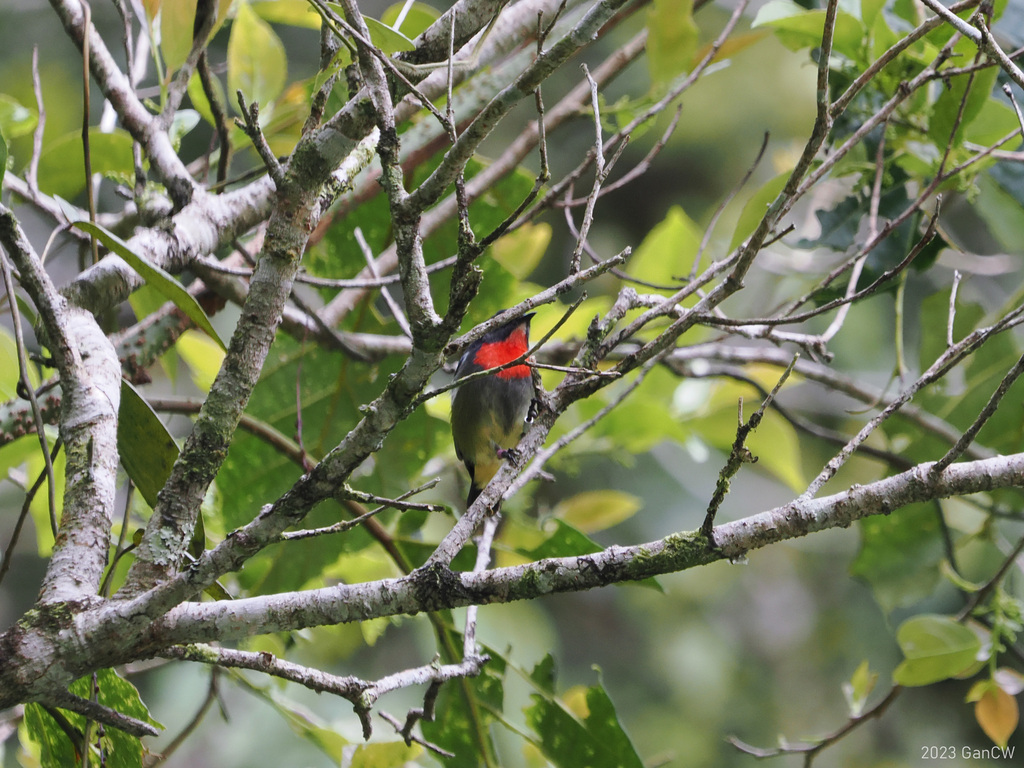
- Kingdom
- Animalia
- Phylum
- Chordata
- Class
- Aves
- Order
- Passeriformes
- Family
- Dicaeidae
- Genus
- Dicaeum
- Species
- Dicaeum monticolum
Description
The black-sided flowerpecker (Dicaeum monticolum), also known as the Bornean flowerpecker, is a species of bird in the family Dicaeidae. It is endemic to the island of Borneo, where it is found in the mountains, primarily above 1,000 m (3,300 ft) in elevation. The species is sexually dimorphic. The male has glossy blue-black upperparts, with a scarlet throat and breast, a dark grey upper belly, olive flanks, a white lower belly, and a buffy vent and undertail coverts. The female is olive-green above and greyish below, with buffy flanks and a whitish throat. It inhabits a range of forest habitats, including primary and secondary montane forest, kerangas forest, and scrub, and is also occasionally found in gardens. It feeds primarily on small fruits-particularly mistletoe berries-as well as seeds, nectar, and various invertebrates. It builds a nest of moss, camouflaged on the outside with lichens and lined with the pith of tree ferns. The International Union for Conservation of Nature rates it as a species of least concern. Though its numbers have not been quantified, the black-sided flowerpecker is said to be common throughout much of its range, and any declines are not thought to be precipitous. However, destruction of forest for palm plantations may impact it.
Gallery
Ajouter des photos
Partagez vos photos de cette espèce (jusqu'à 20 à la fois) : elles sont vérifiées automatiquement, puis publiées.
Répartition
Occurrences observées (données GBIF). Les zones hors aire d'origine peuvent indiquer une présence introduite ou invasive.
Sources et crédits
Informations provenant de plusieurs sources vérifiées. Dernière mise à jour : .
Crédits photos (8)
- Photo : Cheongweei Gan (@gancw1) · CC BY 4.0 · via iNaturalist
- Photo : Natalia Rojas-Estevez (@nat_rojasestevez) · CC BY-NC 4.0 · via iNaturalist
- Photo : Jacques (@jacqu0) · CC BY-NC 4.0 · via iNaturalist
- Photo : @johnharshman · CC BY-NC 4.0 · via iNaturalist
- Photo : Tim Forrester (@tim_forrester) · CC BY-NC 4.0 · via iNaturalist
- Photo : Adam Sell (@adamwardsell) · CC BY-NC 4.0 · via iNaturalist
- Photo : @lunarjade · CC BY-NC 4.0 · via iNaturalist
- Photo : greg n (@gjn) · CC BY-NC 4.0 · via iNaturalist
Mentions de licence
Texte disponible sous licence CC BY-SA 4.0. Il adapte notamment Wikipedia (CC BY-SA) : Black-sided flowerpecker (Wikipédia, auteurs dans l’historique de l’article).
- Taxonomie : GBIF Backbone Taxonomy (CC BY 4.0)
- Carte : occurrences GBIF, fond © contributeurs OpenStreetMap (ODbL)
- Statut de conservation : Liste rouge de l'UICN, via Wikidata (CC0)
Détail : Sources et licences.
Discussion (0)
Aucun message pour l’instant. Lancez la discussion sur cette fiche (sources, précisions, débats éditoriaux).
Connectez-vous pour participer à la discussion.