
Red-eared Firetail
Stagonopleura oculata
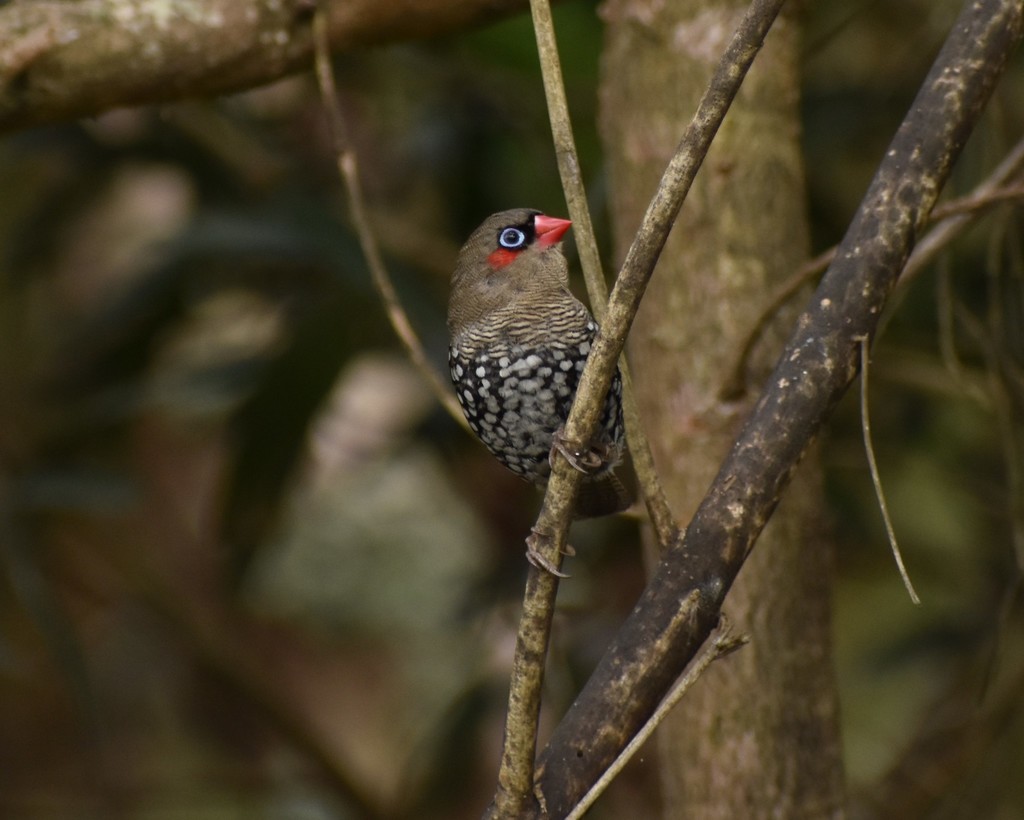
The red-eared firetail (Stagonopleura oculata), also known as the boorin, is a small finch-like species of bird.
- Kingdom
- Animalia
- Phylum
- Chordata
- Class
- Aves
- Order
- Passeriformes
- Family
- Estrildidae
- Genus
- Stagonopleura
- Species
- Stagonopleura oculata
Description
The red-eared firetail (Stagonopleura oculata), also known as the boorin, is a small finch-like species of bird. It occurs in dense wetland vegetation of coastal to sub-coastal regions in Southwest Australia. Its appearance is considered appealing, with white spots, black barring and vivid crimson marks at the ear and upper tail. Red-eared firetails are usually only glimpsed briefly, if at all, as they move rapidly and discreetly through their habitat. Most observations occur when their soft voice is heard, or in flight when flushed from the dense scrub. Males and females are similar in colouring and bond as lifelong pairs that occupy a territory centred on their roosting and brooding nest site. The species occupies a similar ecological niche to the beautiful firetail (Stagonopleura bella) found in the east of Australia, although unlike other species of the genus they only occasionally group together and are almost never seen in large flocks. The red-eared firetail is rare in captivity, being neither recommended nor generally permitted, as they require expertise and a large specialised environment to maintain their secretive habits; however, the observations in avicultural literature have supported and contributed to knowledge of its behaviour. Despite their shyness toward other birds and people, they are known to be less so when venturing out to bird feeders. The species is not easily confused with other birds in its native habitat, excepting perhaps the red-browed finch (Neochmia temporalis) that has escaped captivity and bred in the region.
Gallery
Ajouter des photos
Partagez vos photos de cette espèce (jusqu'à 20 à la fois) : elles sont vérifiées automatiquement, puis publiées.
Répartition
Occurrences observées (données GBIF). Les zones hors aire d'origine peuvent indiquer une présence introduite ou invasive.
Sources et crédits
Informations provenant de plusieurs sources vérifiées. Dernière mise à jour : .
Crédits photos (8)
- Photo : Bryce van der Heide (@snakesrcool) · CC BY-NC 4.0 · via iNaturalist
- Photo : Kerry + Darren (@kezzza4) · CC BY-NC 4.0 · via iNaturalist
- Photo : Kerry + Darren (@kezzza4) · CC BY-NC 4.0 · via iNaturalist
- Photo : heiko (@drheiko) · CC BY-NC 4.0 · via iNaturalist
- Photo : Tommy Osborne (@tommyosborne2444) · CC BY-NC 4.0 · via iNaturalist
- Photo : EcoNeighbour_ (@econeighbour_) · CC BY-NC 4.0 · via iNaturalist
- Photo : Dustyn and Catherine (@dustycat) · CC BY-NC 4.0 · via iNaturalist
- Photo : @dandm22 · CC BY-NC 4.0 · via iNaturalist
Mentions de licence
Texte disponible sous licence CC BY-SA 4.0. Il adapte notamment Wikipedia (CC BY-SA) : Red-eared firetail (Wikipédia, auteurs dans l’historique de l’article).
- Taxonomie : GBIF Backbone Taxonomy (CC BY 4.0)
- Carte : occurrences GBIF, fond © contributeurs OpenStreetMap (ODbL)
- Statut de conservation : Liste rouge de l'UICN, via Wikidata (CC0)
Détail : Sources et licences.
Discussion (0)
Aucun message pour l’instant. Lancez la discussion sur cette fiche (sources, précisions, débats éditoriaux).
Connectez-vous pour participer à la discussion.