
Fiji Parrotfinch
Erythrura pealii
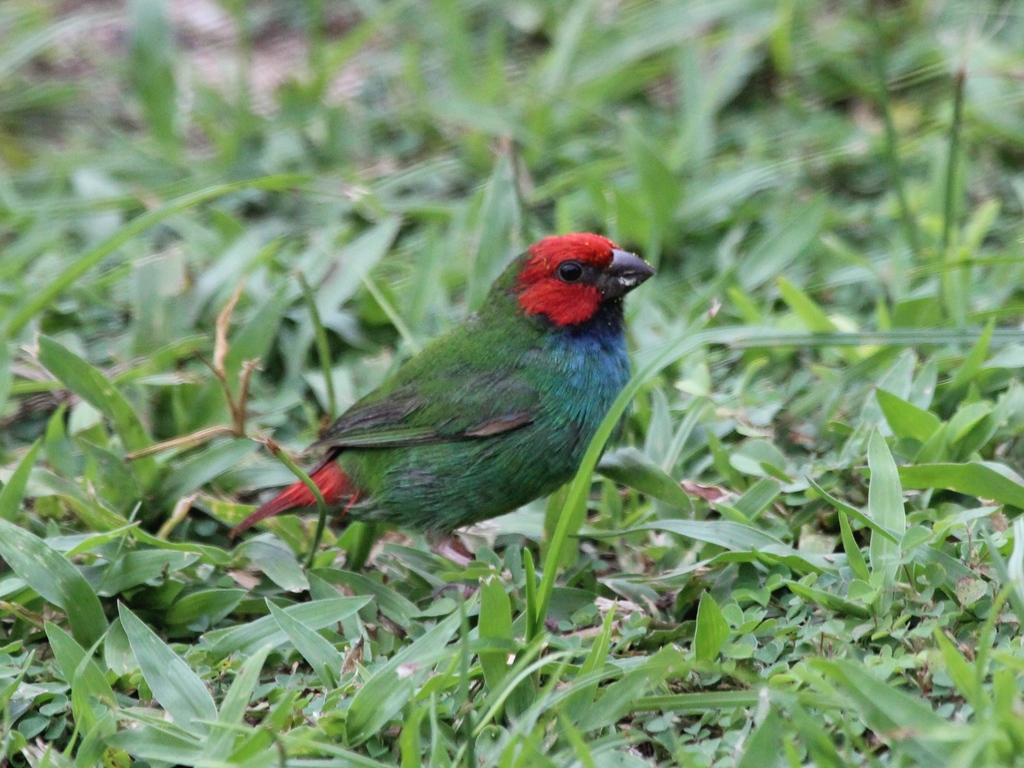
The Fiji parrotfinch (Erythrura pealii) is a species of estrildid finch endemic to Fiji that was formerly considered to be a subspecies of the red-headed parrotfinch.
- Kingdom
- Animalia
- Phylum
- Chordata
- Class
- Aves
- Order
- Passeriformes
- Family
- Estrildidae
- Genus
- Erythrura
- Species
- Erythrura pealii
Description
The Fiji parrotfinch (Erythrura pealii) is a species of estrildid finch endemic to Fiji that was formerly considered to be a subspecies of the red-headed parrotfinch. This parrotfinch is a small, mainly green bird with a red head and tail and a stubby dark grey bill. It is found in both forested and open habitats, and has adapted well to man-made environments such as grasslands, pasture and gardens. Pairs have a courtship display in which they fly above the trees in an undulating flight, calling constantly. Breeding birds build a domed grass nest with a side entrance, and lay a clutch normally of four white eggs. Newly hatched chicks are naked and pink, with blue balls at the upper and lower corners of the gape, and black markings inside the mouth; older fledglings resemble the adults, but lack the red head colouring. The Fiji parrotfinch eats seeds, especially of grasses, and also readily feeds on insects and nectar. It forms small flocks of up to six birds after the breeding season. Parrotfinches may be preyed upon by indigenous birds of prey such as the endemic Fiji goshawk, or by introduced mammals such as the small Asian mongoose, rats, and mice, and they may be susceptible to disease. The Fiji species, despite being both uncommon and endemic to one island group, appears to be stable in numbers. It is therefore classified as Least Concern on the IUCN Red List, and it is protected under Fijian law.
Gallery
Ajouter des photos
Partagez vos photos de cette espèce (jusqu'à 20 à la fois) : elles sont vérifiées automatiquement, puis publiées.
Répartition
Occurrences observées (données GBIF). Les zones hors aire d'origine peuvent indiquer une présence introduite ou invasive.
Sources et crédits
Informations provenant de plusieurs sources vérifiées. Dernière mise à jour : .
Crédits photos (8)
- Photo : Floyd E. Hayes (@floydehayes) · CC BY-NC 4.0 · via iNaturalist
- Photo : @danicalockett · CC BY-NC 4.0 · via iNaturalist
- Photo : Kenneth Bader (@kucycads) · CC BY-NC 4.0 · via iNaturalist
- Photo : David R (@davidr) · CC BY-NC 4.0 · via iNaturalist
- Photo : @jackriddell · CC BY-NC 4.0 · via iNaturalist
- Photo : @alanvannorman · CC BY-NC 4.0 · via iNaturalist
- Photo : Leon Perrie (@leonperrie) · CC BY 4.0 · via iNaturalist
- Photo : @angelinbotanico · CC BY-NC 4.0 · via iNaturalist
Mentions de licence
Texte disponible sous licence CC BY-SA 4.0. Il adapte notamment Wikipedia (CC BY-SA) : Fiji parrotfinch (Wikipédia, auteurs dans l’historique de l’article).
- Taxonomie : GBIF Backbone Taxonomy (CC BY 4.0)
- Carte : occurrences GBIF, fond © contributeurs OpenStreetMap (ODbL)
- Statut de conservation : Liste rouge de l'UICN, via Wikidata (CC0)
Détail : Sources et licences.
Discussion (0)
Aucun message pour l’instant. Lancez la discussion sur cette fiche (sources, précisions, débats éditoriaux).
Connectez-vous pour participer à la discussion.