
Black-lored Babbler
Turdoides sharpei
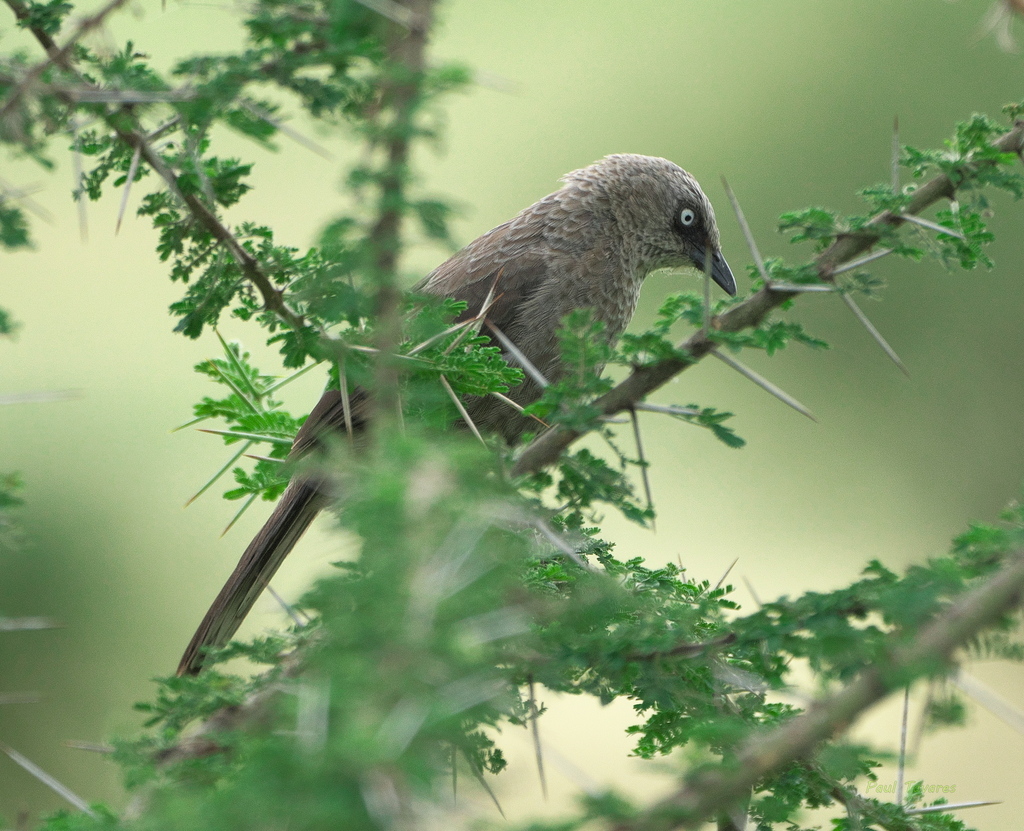
The black-lored babbler or Sharpe's pied-babbler (Turdoides sharpei) is a species of bird in the family Leiothrichidae.
- Kingdom
- Animalia
- Phylum
- Chordata
- Class
- Aves
- Order
- Passeriformes
- Family
- Leiothrichidae
- Genus
- Turdoides
- Species
- Turdoides sharpei
Description
The black-lored babbler or Sharpe's pied-babbler (Turdoides sharpei) is a species of bird in the family Leiothrichidae. It is found in southwestern Kenya, Tanzania, Uganda, Burundi, Rwanda, and the part of the Democratic Republic of the Congo immediately adjacent to the three last-named countries. This bird was formerly considered the same species as Turdoides melanops of southern Africa, now known as the black-faced babbler. These birds are mostly grey-brown with white mottling, especially on the underparts, that varies according to location and the individual. The population near Nanyuki, Kenya, is darker but can have a pure white chin or entire throat. The combination of pale yellow or white eyes and black lores (the areas between the eye and the bill) separates adults of this species from similar babblers except melanops, though all juvenile babblers have brown eyes. In Kenya, single birds give repeated single or double harsh notes such as waaach or a muffled kurr-ack; pairs or groups give longer phrases in chorus. The tempo is frequently slow for a babbler. They are most vocal in the early morning and late afternoon. Like other Turdoides, it is found low or on the ground in or near dense woody vegetation, including in cultivated areas. Kenyan birds forage in bushes and tall grass. They are "restless, noisy, and suspicious" and "typical gregarious babblers". Single birds give repeated single or double harsh notes such as waaach or a muffled kurr-ack; pairs or groups give longer phrases in chorus. The tempo is frequently slow for a babbler. They are most vocal in the early morning and late afternoon.
Gallery
Ajouter des photos
Partagez vos photos de cette espèce (jusqu'à 20 à la fois) : elles sont vérifiées automatiquement, puis publiées.
Répartition
Occurrences observées (données GBIF). Les zones hors aire d'origine peuvent indiquer une présence introduite ou invasive.
Sources et crédits
Informations provenant de plusieurs sources vérifiées. Dernière mise à jour : .
Crédits photos (8)
- Photo : Paul Tavares (@paultavares) · CC BY-NC 4.0 · via iNaturalist
- Photo : Wilson Yau (@wilsonyau62) · CC BY-NC 4.0 · via iNaturalist
- Photo : Wilson Yau (@wilsonyau62) · CC BY-NC 4.0 · via iNaturalist
- Photo : Duncan McKenzie (@drmckenzie) · CC BY-NC 4.0 · via iNaturalist
- Photo : MARIA LUISA BACCI (@marialuisa-patagonia) · CC BY-NC 4.0 · via iNaturalist
- Photo : Martin Grimm (@martingrimm) · CC BY-NC 4.0 · via iNaturalist
- Photo : @angela_husfeld · CC BY-NC 4.0 · via iNaturalist
- Photo : Almut Martens (@almut_66) · CC BY-NC 4.0 · via iNaturalist
Mentions de licence
Texte disponible sous licence CC BY-SA 4.0. Il adapte notamment Cratérope de Sharpe, Wikipedia (CC BY-SA) : Black-lored babbler (Wikipédia, auteurs dans l’historique de l’article).
- Taxonomie : GBIF Backbone Taxonomy (CC BY 4.0)
- Carte : occurrences GBIF, fond © contributeurs OpenStreetMap (ODbL)
- Statut de conservation : Liste rouge de l'UICN, via Wikidata (CC0)
Détail : Sources et licences.
Discussion (0)
Aucun message pour l’instant. Lancez la discussion sur cette fiche (sources, précisions, débats éditoriaux).
Connectez-vous pour participer à la discussion.