
Ethiopian Bush-crow
Zavattariornis stresemanni
The Ethiopian bushcrow (Zavattariornis stresemanni), also known as the Stresemann's bushcrow, Abyssinian pie, bush crow, or by its generic name Zavattariornis, is a rather starling-like bird, which is a member of the crow family, Corvidae.
- Kingdom
- Animalia
- Phylum
- Chordata
- Class
- Aves
- Order
- Passeriformes
- Family
- Corvidae
- Genus
- Zavattariornis
- Species
- Zavattariornis stresemanni
Description
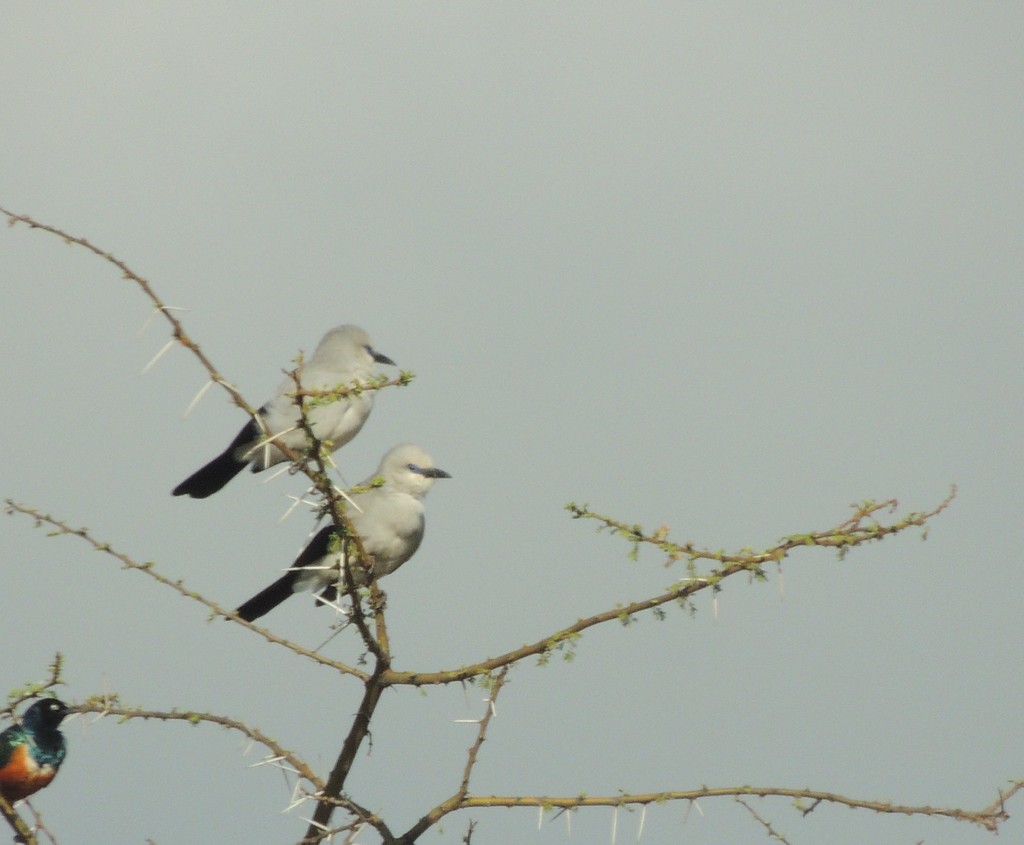
The Ethiopian bushcrow (Zavattariornis stresemanni), also known as the Stresemann's bushcrow, Abyssinian pie, bush crow, or by its generic name Zavattariornis, is a rather starling-like bird, which is a member of the crow family, Corvidae. It is slightly larger than the North American blue jay and is a bluish-grey in overall colour which becomes almost white on the forehead. The throat and chest are creamy-white with the tail and wings a glossy black. The black feathers have a tendency to bleach to brown at their tips. The iris of the bird is brown and the eye is surrounded by a band of naked bright blue skin. The bill, legs, and feet are black. Feeding is usually in small groups and the bird takes mainly insects. Breeding usually starts in March, with the birds building their nest high in an acacia tree. The birds usually lay five to six cream eggs with lilac blotches. The nest itself is globular in shape with a tubular entrance on top. It is possible that more than just the breeding pair visit the nest and that the young of previous years help in rearing the young. The range of this species is quite restricted, it being confined to thorn acacia country in southern Ethiopia near Yavello (Javello), Mega, and Arero. It can be absent from apparently suitable country near these areas; the reasons for this were formerly unclear, but are now thought to be related to the species requiring a "bubble" of lower temperature for proper foraging, which is only present within its small range, making it one of the few warm-blooded animals whose survival is wholly dependent on temperature (along with the sympatric white-tailed swallow). This requirement makes it extremely vulnerable to climate change, and massive declines and even potential extinction in the wild are projected in the future, making it one of the birds most threatened by climate change.
Gallery
Ajouter des photos
Partagez vos photos de cette espèce (jusqu'à 20 à la fois) : elles sont vérifiées automatiquement, puis publiées.
Répartition
Occurrences observées (données GBIF). Les zones hors aire d'origine peuvent indiquer une présence introduite ou invasive.
Sources et crédits
Informations provenant de plusieurs sources vérifiées. Dernière mise à jour : .
Crédits photos (8)
- Photo : Jeff Chapman (@woodridgejeff) · CC BY-NC 4.0 · via iNaturalist
- Photo : Mikael Bauer (@neomorphus) · CC BY-NC 4.0 · via iNaturalist
- Photo : @birdcalculator · CC BY-NC 4.0 · via iNaturalist
- Photo : @avocat · CC BY 4.0 · via iNaturalist
- Photo : Rafael Medina (@rmedina) · CC BY 4.0 · via iNaturalist
- Photo : Carlo (@jeanlouiscarlo) · CC BY-NC 4.0 · via iNaturalist
- Photo : @luotuo · CC BY-NC 4.0 · via iNaturalist
- Photo : @ajpembo · CC BY-NC 4.0 · via iNaturalist
Mentions de licence
Texte disponible sous licence CC BY-SA 4.0. Il adapte notamment Wikipedia (CC BY-SA) : Ethiopian bushcrow (Wikipédia, auteurs dans l’historique de l’article).
- Taxonomie : GBIF Backbone Taxonomy (CC BY 4.0)
- Carte : occurrences GBIF, fond © contributeurs OpenStreetMap (ODbL)
Détail : Sources et licences.
Discussion (0)
Aucun message pour l’instant. Lancez la discussion sur cette fiche (sources, précisions, débats éditoriaux).
Connectez-vous pour participer à la discussion.