
Guianan Cock-of-the-rock
Rupicola rupicola
The Guianan cock-of-the-rock (Rupicola rupicola) is a species of cotinga, a passerine bird from South America.
- Kingdom
- Animalia
- Phylum
- Chordata
- Class
- Aves
- Order
- Passeriformes
- Family
- Cotingidae
- Genus
- Rupicola
- Species
- Rupicola rupicola
Description
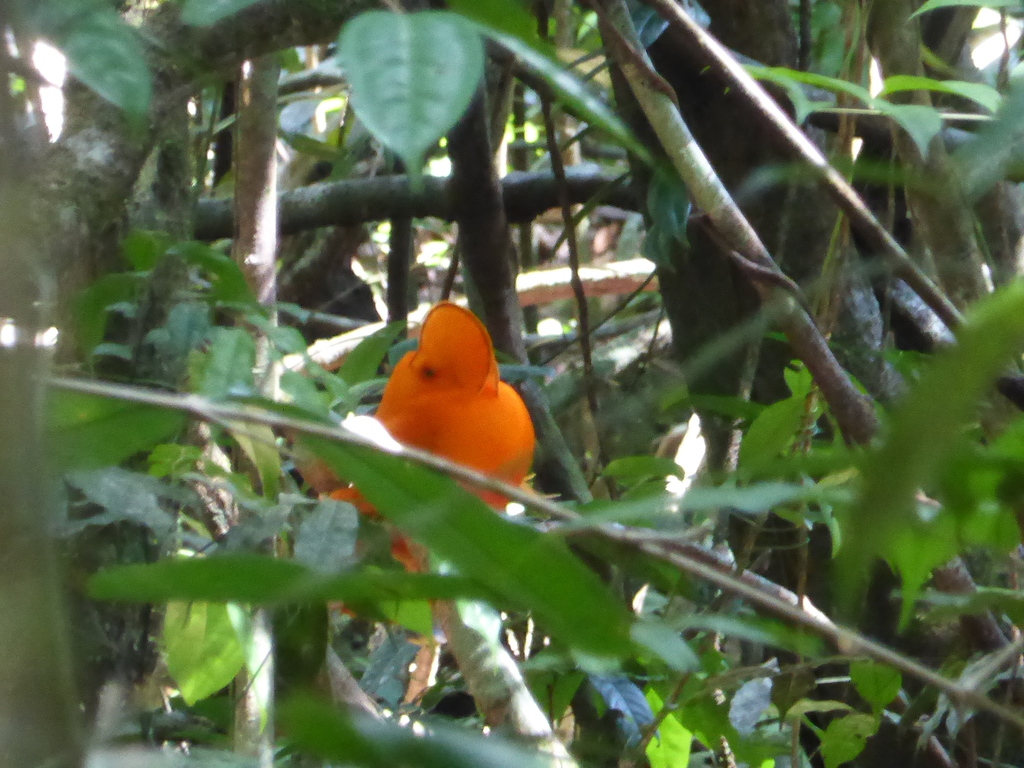
The Guianan cock-of-the-rock (Rupicola rupicola) is a species of cotinga, a passerine bird from South America. It is about 30 cm (12 in) in length and weighs about 200 to 220 g (7.1 to 7.8 oz). It is found in tropical rainforests, near its preferred habitat of rocky outcrops. The female's plumage is brownish/dark smokey grey in colour, and generally less noticeable than the males because of their nesting work in rocky areas. The male's feathers are a bright orange. Both have a heavy body, broad-based bill and wear a remarkable half-moon crest on the head. It is one of two species of the genus Rupicola, the other being the Andean cock-of-the-rock. The Guianan cock-of-the-rock lives across the forested region of northeastern South America. Its diet consists mostly of fruit, but they sometimes feast on small snakes and lizards. The Guianan cock-of-the-rock breeds in the early months of the year and, on average, the female lays her eggs around March. The females choose a mate by flying down to the ground and pecking the male on his rump. The male then turns around and the mating takes place almost immediately. During the height of the mating season, males engage in competitive displays in the lek, which is a complex courting behaviour that is done to attract females. Males and females live separately except when the females choose a mate. The mating success varies based on multiple factors, ranging from the plumage exhibited by a male to the composition of the lek itself. There is speculation that the male–male competition is an important factor in lek formation and breeding. The main predators of the Guianan cock-of-the-rock are harpy eagles and black-and-white hawk-eagles.
Gallery
Ajouter des photos
Partagez vos photos de cette espèce (jusqu'à 20 à la fois) : elles sont vérifiées automatiquement, puis publiées.
Répartition
Occurrences observées (données GBIF). Les zones hors aire d'origine peuvent indiquer une présence introduite ou invasive.
Sources et crédits
Informations provenant de plusieurs sources vérifiées. Dernière mise à jour : .
Crédits photos (8)
- Photo : Tommy Andriollo (@tommy_andriollo) · CC BY 4.0 · via iNaturalist
- Photo : Fundación Diamante de las Aguas (@fundiamanteaguas) · CC BY-NC 4.0 · via iNaturalist
- Photo : @guyrufray · CC BY-NC 4.0 · via iNaturalist
- Photo : @reinaldogibin · CC BY-NC 4.0 · via iNaturalist
- Photo : André Ambrozio (@andre_ambrozio) · CC BY 4.0 · via iNaturalist
- Photo : Fundación Diamante de las Aguas (@fundiamanteaguas) · CC BY-NC 4.0 · via iNaturalist
- Photo : @eliot_rbls · CC BY-NC 4.0 · via iNaturalist
- Photo : Arnaud Aury (@arnaud_aury) · CC BY-NC 4.0 · via iNaturalist
Mentions de licence
Texte disponible sous licence CC BY-SA 4.0. Il adapte notamment Wikipedia (CC BY-SA) : Guianan cock-of-the-rock (Wikipédia, auteurs dans l’historique de l’article).
- Taxonomie : GBIF Backbone Taxonomy (CC BY 4.0)
- Carte : occurrences GBIF, fond © contributeurs OpenStreetMap (ODbL)
- Statut de conservation : Liste rouge de l'UICN, via Wikidata (CC0)
Détail : Sources et licences.
Discussion (0)
Aucun message pour l’instant. Lancez la discussion sur cette fiche (sources, précisions, débats éditoriaux).
Connectez-vous pour participer à la discussion.