
Stephan's Emerald Dove
Chalcophaps stephani
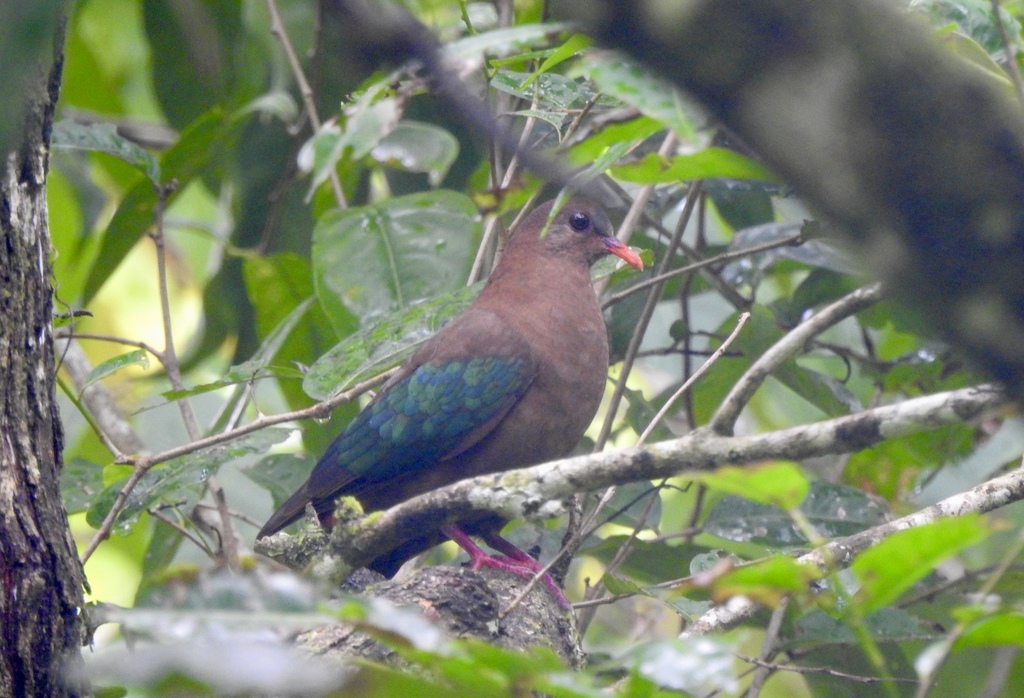
Stephan's emerald dove, also known as Stephan's dove (Chalcophaps stephani), is a species of bird in the pigeon family Columbidae.
- Kingdom
- Animalia
- Phylum
- Chordata
- Class
- Aves
- Order
- Columbiformes
- Family
- Columbidae
- Genus
- Chalcophaps
- Species
- Chalcophaps stephani
Description
Stephan's emerald dove, also known as Stephan's dove (Chalcophaps stephani), is a species of bird in the pigeon family Columbidae. Formally described by the French zoologist Jacques Pucheran in 1853, the dove is named after Étienne Jacquinot, the father of the French naturalist Honoré Jacquinot. The emerald dove has a large range in Indonesia and Melanesia, stretching from Sulawesi and Taliabu east through most of lowland New Guinea and its satellite islands to the Admiralty Islands, Bismarck Archipelago, and Solomon Islands. It is a forest-dwelling species that is usually seen in inland rainforests, although it can inhabit other wooded habitats like scrubby coconut plantations and coastal forests if competing species like the common emerald dove are absent. Stephan's emerald doves migrate locally in response to local climactic conditions and food availability. The dove is mainly frugivorous, foraging on the forest floor for fallen fruits, seeds, and occasionally insects and other invertebrates. In New Guinea, the breeding season last from January to May during the wet season. The nest is a flimsy structure made of twigs, containing two cream or pale yellowish eggs. Stephan's emerald is listed as being of least concern on the IUCN Red List due to its large range and stable population. The species is fairly common throughout its range and is especially common on smaller islands in the Bismarck Archipelago.
Gallery
Ajouter des photos
Partagez vos photos de cette espèce (jusqu'à 20 à la fois) : elles sont vérifiées automatiquement, puis publiées.
Répartition
Occurrences observées (données GBIF). Les zones hors aire d'origine peuvent indiquer une présence introduite ou invasive.
Sources et crédits
Informations provenant de plusieurs sources vérifiées. Dernière mise à jour : .
Crédits photos (8)
- Photo : Noam Markus (@noammarkus) · CC BY-NC 4.0 · via iNaturalist
- Photo : Jay Pruett (@greenjay6) · CC BY 4.0 · via iNaturalist
- Photo : Winston Poh (@winstonpoh) · CC BY-NC 4.0 · via iNaturalist
- Photo : @leekelai · CC BY-NC 4.0 · via iNaturalist
- Photo : Shawn O'Donnell (@shawnodonnell) · CC BY 4.0 · via iNaturalist
- Photo : Don Wellmann (@don54) · CC0 (domaine public) · via iNaturalist
- Photo : Euan Moore (@calamanthus) · CC BY-NC 4.0 · via iNaturalist
- Photo : Premala Arulampalam (@malafish) · CC BY-NC 4.0 · via iNaturalist
Mentions de licence
Texte disponible sous licence CC BY-SA 4.0. Il adapte notamment Wikipedia (CC BY-SA) : Stephan's emerald dove (Wikipédia, auteurs dans l’historique de l’article).
- Taxonomie : GBIF Backbone Taxonomy (CC BY 4.0)
- Carte : occurrences GBIF, fond © contributeurs OpenStreetMap (ODbL)
- Statut de conservation : Liste rouge de l'UICN, via Wikidata (CC0)
Détail : Sources et licences.
Discussion (0)
Aucun message pour l’instant. Lancez la discussion sur cette fiche (sources, précisions, débats éditoriaux).
Connectez-vous pour participer à la discussion.