
Red-faced Mousebird
Urocolius indicus
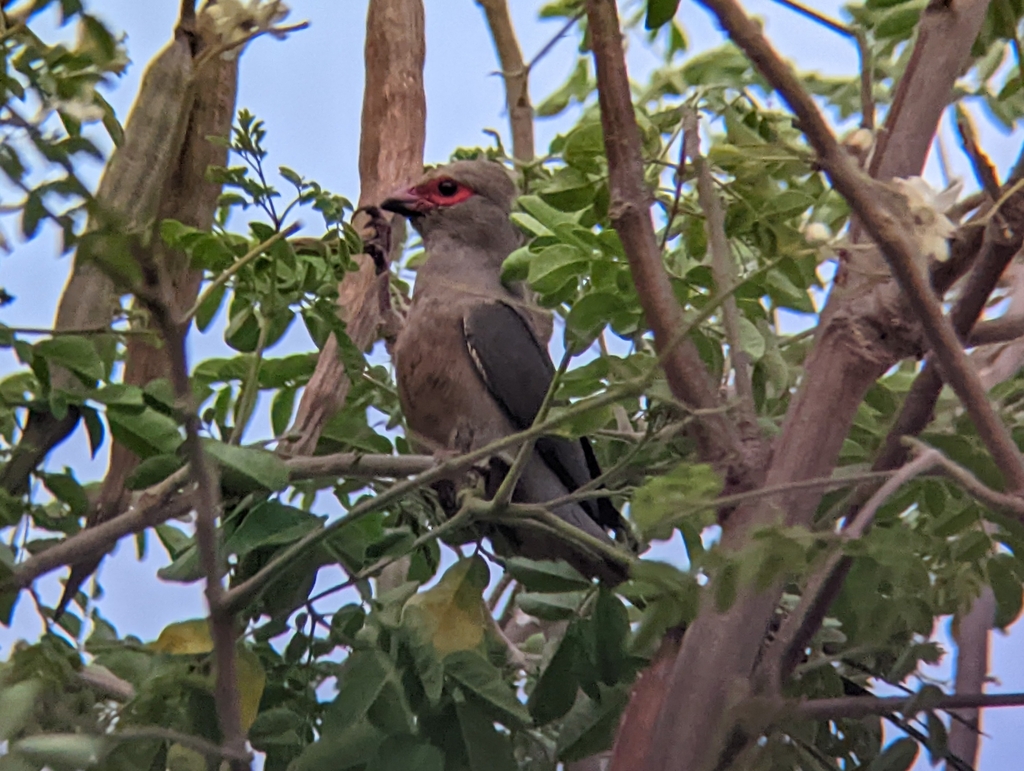
The red-faced mousebird (Urocolius indicus) is a species of mousebird or coly.
- Kingdom
- Animalia
- Phylum
- Chordata
- Class
- Aves
- Order
- Coliiformes
- Family
- Coliidae
- Genus
- Urocolius
- Species
- Urocolius indicus
Description
The red-faced mousebird (Urocolius indicus) is a species of mousebird or coly. It is a common in southern Africa from the Democratic Republic of Congo (formerly Zaire), Zambia and Tanzania south to the Cape. Its habitat is savanna with thickets, fynbos scrub, other open woodland, gardens and orchards. There are a total of five recognized subspecies: Urocolius indicus mossambicus (Distribution: east Angola to southwest Tanzania and Malawi) Urocolius indicus lacteifrons (Distribution: western Angola, north & central Namibia and western Botswana) Urocolius indicus pallidus (Distribution: southeast Tanzania and northeast Mozambique) Urocolius indicus transvaalensis (Distribution: Central and eastern Botswana and southwest Zambia to Mozambique and South Africa) Urocolius indicus indicus (Distribution: south and central South Africa) This bird is about 34 cm (13 in) long, with the tail comprising approximately half the length. The crested head and breast are pale cinnamon with a red bill and eye mask. The rest of the upperparts and tail are blue-grey apart from a paler grey rump. The belly is whitish. The sexes are similar, but juveniles lack the crest and have a green mask. Their call is tree-ree-ree whistle, and regularly called in multiple repetitions. Red-faced mousebirds make the same call whether in-flight or perched. The red-faced mousebird is a frugivore which subsists on fruits, berries, leaves, seeds and nectar. Its flight is typically fast, strong and direct from one feeding area to another. This is a social bird outside the breeding season, feeding together in small groups, normally of about half a dozen birds, but sometimes up to 15 or more. They fly and interact in tight collections. It engages in mutual preening and roosts in groups at night. It is more wary than other mousebirds. These sedentary birds breed between June and February. The nest is a large untidy cup of plant material lined with material such as sheep wool. The clutch is 2–6 eggs, creamy white with reddish brown spots and hatch in about two weeks.
Gallery
Ajouter des photos
Partagez vos photos de cette espèce (jusqu'à 20 à la fois) : elles sont vérifiées automatiquement, puis publiées.
Répartition
Occurrences observées (données GBIF). Les zones hors aire d'origine peuvent indiquer une présence introduite ou invasive.
Sources et crédits
Informations provenant de plusieurs sources vérifiées. Dernière mise à jour : .
Crédits photos (8)
- Photo : Daryl Coldren (@dcoldren) · CC BY-NC 4.0 · via iNaturalist
- Photo : Daniel France (@danielfrance) · CC BY-NC 4.0 · via iNaturalist
- Photo : Jacobus Retief (@koosretief) · CC BY-NC 4.0 · via iNaturalist
- Photo : Raúl MT (@ornagrion) · CC BY-NC 4.0 · via iNaturalist
- Photo : Nogga_Eugene (@eugenemarais) · CC0 (domaine public) · via iNaturalist
- Photo : Jack Cochran (@jcochran706) · CC BY-NC 4.0 · via iNaturalist
- Photo : Paolo Candotti (@paolocandotti) · CC BY-NC 4.0 · via iNaturalist
- Photo : Doug Macdonald (@dougmacsafaris) · CC BY-NC 4.0 · via iNaturalist
Mentions de licence
Texte disponible sous licence CC BY-SA 4.0. Il adapte notamment Wikipedia (CC BY-SA) : Red-faced mousebird, Coliou quiriva (Wikipédia, auteurs dans l’historique de l’article).
- Taxonomie : GBIF Backbone Taxonomy (CC BY 4.0)
- Carte : occurrences GBIF, fond © contributeurs OpenStreetMap (ODbL)
- Statut de conservation : Liste rouge de l'UICN, via Wikidata (CC0)
Détail : Sources et licences.
Discussion (0)
Aucun message pour l’instant. Lancez la discussion sur cette fiche (sources, précisions, débats éditoriaux).
Connectez-vous pour participer à la discussion.