
Meves's Starling
Lamprotornis mevesii
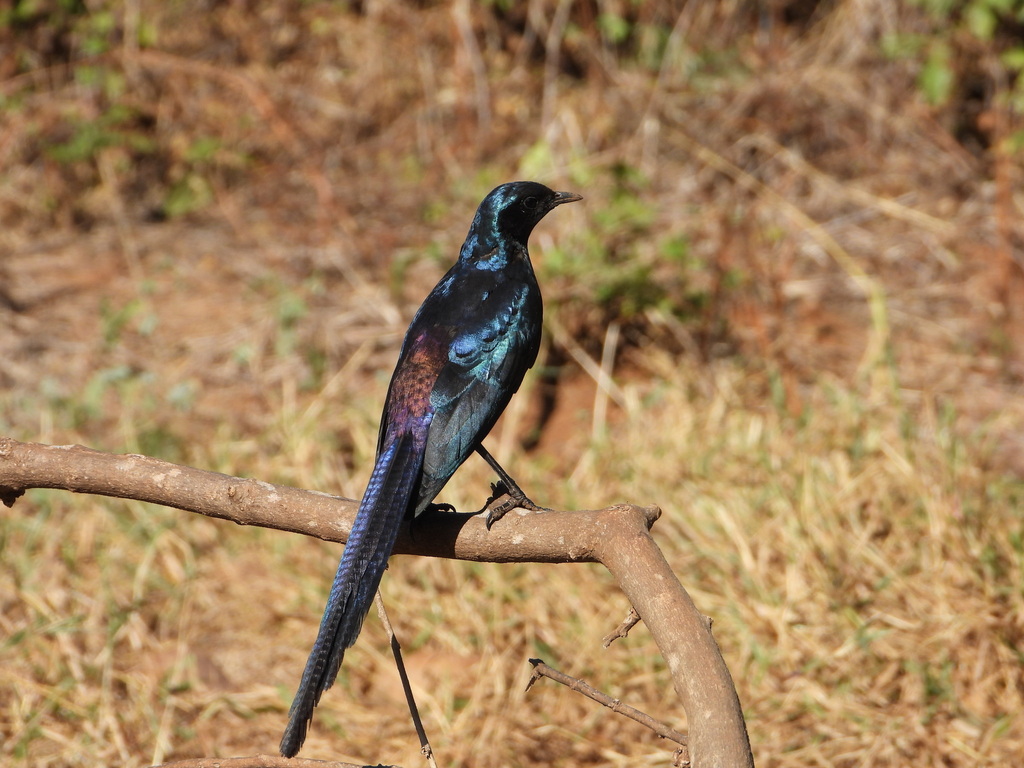
Meves's starling (Lamprotornis mevesii), also Meves's glossy starling and Long-tailed starling, is a species of starling in the genus Lamprotornis.
- Kingdom
- Animalia
- Phylum
- Chordata
- Class
- Aves
- Order
- Passeriformes
- Family
- Sturnidae
- Genus
- Lamprotornis
- Species
- Lamprotornis mevesii
Description
Meves's starling (Lamprotornis mevesii), also Meves's glossy starling and Long-tailed starling, is a species of starling in the genus Lamprotornis. It is found in Angola, Botswana, Malawi, Mozambique, Namibia, South Africa, Zambia, and Zimbabwe. Its English and Latin names commemorate the German ornithologist Friedrich Wilhelm Meves. It is 30–36 cm long, with a very long tail; in dull light coloured black, but in bright light, with moderate to intensely strong iridescent gloss. It can be distinguished from the similar Burchell's starling by its longer tail with strongly graduated feathers (the central pair of tail feathers the longest, with subsequent pairs of feathers shorter to the outermost), and from other long-tailed species of Lamprotornis by its dark eyes. Three subspecies are accepted: Lamprotornis mevesii benguelensis Shelley, 1906 : southwestern Angola (Angola Escarpment). Duller and browner, less glossy on the body and tail than the other subspecies. Lamprotornis mevesii violacior Clancey, 1973 : northern Namibia and south-central Angola. Dark, violet-purple glossed. Lamprotornis mevesii mevesii (Wahlberg, 1856) : southeasternmost Angola, northeastern Namibia (Caprivi Strip), Botswana, east to southeastern Zambia, southern Malawi, and northeastern South Africa. Intensely green-and-blue glossed, with some bronze gloss on the flanks. Some authorities have treated the three as separate species, but this is not widely followed. It is typically found in small flocks in mopane woodland, usually along major river basins, and often in areas which are flooded in the rainy season. The breeding season lasts from September to May, with peak nesting activity in February to March.
Gallery
Ajouter des photos
Partagez vos photos de cette espèce (jusqu'à 20 à la fois) : elles sont vérifiées automatiquement, puis publiées.
Répartition
Occurrences observées (données GBIF). Les zones hors aire d'origine peuvent indiquer une présence introduite ou invasive.
Sources et crédits
Informations provenant de plusieurs sources vérifiées. Dernière mise à jour : .
Crédits photos (8)
- Photo : Tivan Kotze (@tivankotze) · CC BY-NC 4.0 · via iNaturalist
- Photo : HeatherB (@hbean01) · CC BY-NC 4.0 · via iNaturalist
- Photo : brian fisher (@supergan) · CC BY-NC 4.0 · via iNaturalist
- Photo : A Tweedie (@alex1446) · CC BY-NC 4.0 · via iNaturalist
- Photo : Stephan Pflume (@misumeta) · CC BY-NC 4.0 · via iNaturalist
- Photo : @owlice · CC BY-NC 4.0 · via iNaturalist
- Photo : Clare Mateke (@claremateke) · CC BY-NC 4.0 · via iNaturalist
- Photo : Richard Johnstone (@richard_johnstone) · CC BY-NC 4.0 · via iNaturalist
Mentions de licence
Texte disponible sous licence CC BY-SA 4.0. Il adapte notamment Choucador de Meves, Wikipédia (EN) : Meves's starling, Wikipedia (CC BY-SA) : Meves's starling (Wikipédia, auteurs dans l’historique de l’article).
- Taxonomie : GBIF Backbone Taxonomy (CC BY 4.0)
- Carte : occurrences GBIF, fond © contributeurs OpenStreetMap (ODbL)
- Statut de conservation : Liste rouge de l'UICN, via Wikidata (CC0)
Détail : Sources et licences.
Discussion (0)
Aucun message pour l’instant. Lancez la discussion sur cette fiche (sources, précisions, débats éditoriaux).
Connectez-vous pour participer à la discussion.