
Burrowing Owl
Athene cunicularia
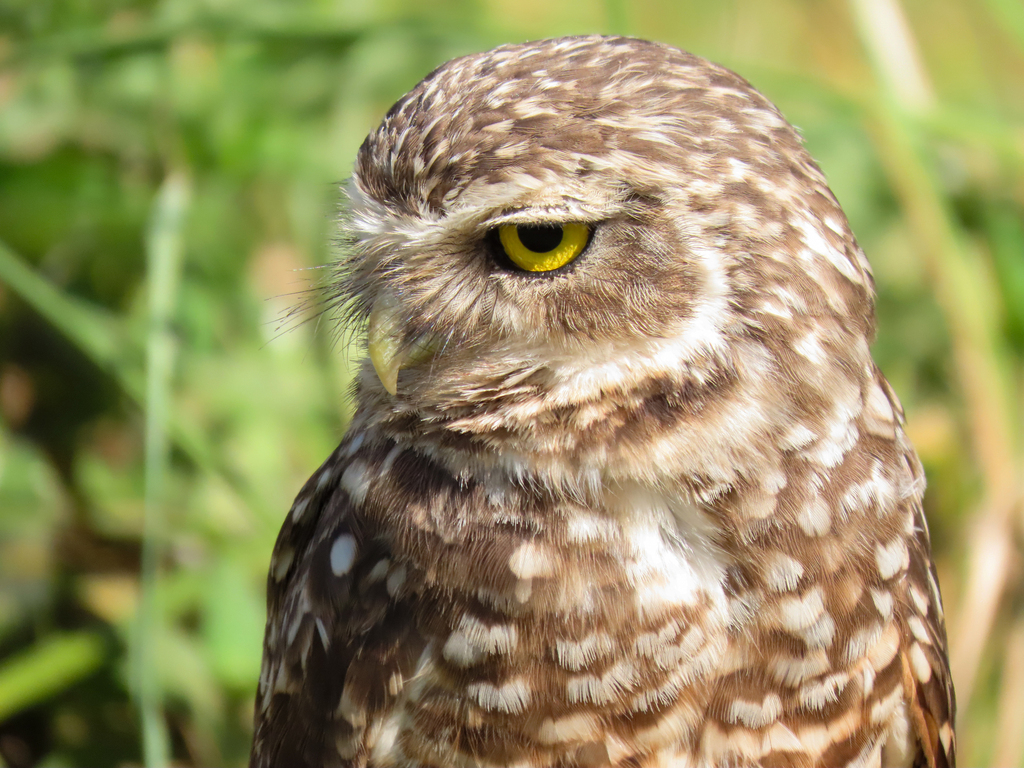
The burrowing owl (Athene cunicularia) is a small, long-legged, primarily terrestrial-though not flightless-species of owl native to the open landscapes of North and South America.
- Kingdom
- Animalia
- Phylum
- Chordata
- Class
- Aves
- Order
- Strigiformes
- Family
- Strigidae
- Genus
- Athene
- Species
- Athene cunicularia
Description
The burrowing owl (Athene cunicularia) is a small, long-legged, primarily terrestrial-though not flightless-species of owl native to the open landscapes of North and South America. They are typically found in grasslands, rangelands, agricultural areas, deserts, or any other open, dry area with low vegetation. They nest and roost in burrows, and, despite their common name, do not often construct these dwellings themselves, rather repurposing disused burrows or tunnels previously excavated and inhabited by other species, such as American badgers (Taxidea taxus), foxes (Vulpes sp.), ground squirrels or prairie dogs (Cynomys spp.), among others. Unlike most owls, burrowing owls are often active during the day, although they tend to avoid the heat of midday. But, similar to many other species of owls, they are mostly crepuscular hunters, as they can utilize their night vision and attuned hearing to maximum potential during sunrise and sunset. Having evolved to live on open grasslands and prairie habitat (as well as badlands, chaparral and desert ecosystems), as opposed to dense forest, the burrowing owl has developed longer legs than other owls, a trait which enables it to sprint when pursuing its prey, not dissimilarly to the greater roadrunner, as well as providing momentum when taking flight; however, burrowing owls typically only become airborne for short bursts, such as when fleeing threats, and typically do not fly very high off of the ground.
Gallery
Ajouter des photos
Partagez vos photos de cette espèce (jusqu'à 20 à la fois) : elles sont vérifiées automatiquement, puis publiées.
Répartition
Occurrences observées (données GBIF). Les zones hors aire d'origine peuvent indiquer une présence introduite ou invasive.
Sources et crédits
Informations provenant de plusieurs sources vérifiées. Dernière mise à jour : .
Crédits photos (8)
- Photo : Patrícia Nicoloso (@patricianicoloso) · CC BY-NC 4.0 · via iNaturalist
- Photo : Luciana Chiyo (@lucianachiyo) · CC BY-NC 4.0 · via iNaturalist
- Photo : K Schneider (@kschnei) · CC BY-NC 4.0 · via iNaturalist
- Photo : Nil Rodrigues (@nilrodrigues) · CC BY-NC 4.0 · via iNaturalist
- Photo : Joel Chamberlain (@naturenerd_joel) · CC BY-NC 4.0 · via iNaturalist
- Photo : @landeyracamila · CC BY-NC 4.0 · via iNaturalist
- Photo : Maite Etchevarne (@maite39) · CC BY-NC 4.0 · via iNaturalist
- Photo : Conrado Pável de Oliveira (@conradopavel) · CC BY 4.0 · via iNaturalist
Mentions de licence
Texte disponible sous licence CC BY-SA 4.0. Il adapte notamment Wikipedia (CC BY-SA) : Burrowing owl (Wikipédia, auteurs dans l’historique de l’article).
- Taxonomie : GBIF Backbone Taxonomy (CC BY 4.0)
- Carte : occurrences GBIF, fond © contributeurs OpenStreetMap (ODbL)
- Statut de conservation : Liste rouge de l'UICN, via Wikidata (CC0)
Détail : Sources et licences.
Discussion (0)
Aucun message pour l’instant. Lancez la discussion sur cette fiche (sources, précisions, débats éditoriaux).
Connectez-vous pour participer à la discussion.