
Little Owl
Athene noctua
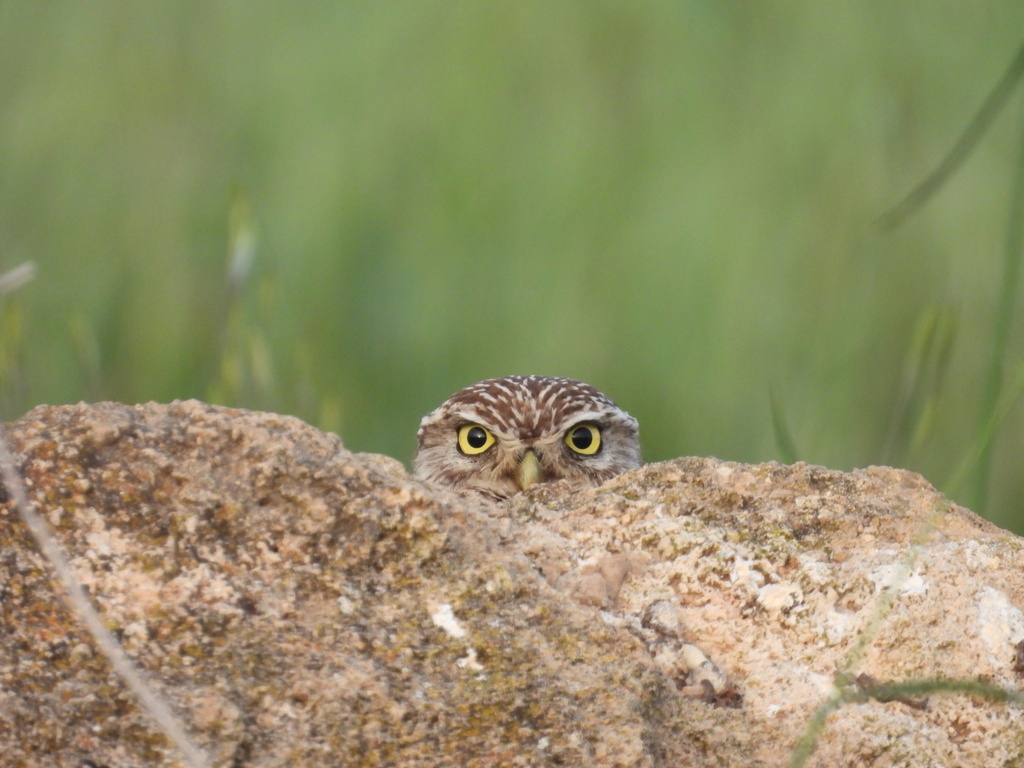
The little owl (Athene noctua), also known as the owl of Athena or owl of Minerva, is a bird that inhabits much of the temperate and warmer parts of Europe, the Palearctic east to Korea, and North Africa.
- Kingdom
- Animalia
- Phylum
- Chordata
- Class
- Aves
- Order
- Strigiformes
- Family
- Strigidae
- Genus
- Athene
- Species
- Athene noctua
Description
The little owl (Athene noctua), also known as the owl of Athena or owl of Minerva, is a bird that inhabits much of the temperate and warmer parts of Europe, the Palearctic east to Korea, and North Africa. It was introduced into Britain at the end of the 19th century and into the South Island of New Zealand in the early 20th century. This owl is a member of the typical or true owl family Strigidae, which contains most species of owl, the other grouping being the barn owls, Tytonidae. It is a small (approx. 22 cm long), cryptically coloured, mainly nocturnal species and is found in a range of habitats including farmland, woodland fringes, steppes and semi-deserts. It feeds on insects, earthworms, other invertebrates and small vertebrates. Males hold territories that they defend against intruders. This owl is a cavity nester, and a clutch of about four eggs is laid in spring. The female does the incubation and the male brings food to the nest, first for the female and later for the newly hatched young. As the chicks grow, both parents hunt and bring them food, and the chicks leave the nest at about seven weeks of age. Being a common species with a wide range and large total population, the International Union for Conservation of Nature has assessed its conservation status as "least concern".
Gallery
Ajouter des photos
Partagez vos photos de cette espèce (jusqu'à 20 à la fois) : elles sont vérifiées automatiquement, puis publiées.
Répartition
Occurrences observées (données GBIF). Les zones hors aire d'origine peuvent indiquer une présence introduite ou invasive.
Sources et crédits
Informations provenant de plusieurs sources vérifiées. Dernière mise à jour : .
Crédits photos (5)
- Photo : Javisa Hun (@javisahun) · CC BY-NC 4.0 · via iNaturalist
- Photo : Dérozier Violette (@violettederozier) · CC BY-NC 4.0 · via iNaturalist
- Photo : Pablo Gimeno Castellanos (@pgimeno) · CC BY-NC 4.0 · via iNaturalist
- Photo : @lena_gurdina · CC BY-NC 4.0 · via iNaturalist
- Photo : @philippedebruille · CC BY-NC 4.0 · via iNaturalist
Mentions de licence
Texte disponible sous licence CC BY-SA 4.0. Il adapte notamment Wikipedia (CC BY-SA) : Little owl (Wikipédia, auteurs dans l’historique de l’article).
- Taxonomie : GBIF Backbone Taxonomy (CC BY 4.0)
- Carte : occurrences GBIF, fond © contributeurs OpenStreetMap (ODbL)
- Statut de conservation : Liste rouge de l'UICN, via Wikidata (CC0)
Détail : Sources et licences.
Discussion (0)
Aucun message pour l’instant. Lancez la discussion sur cette fiche (sources, précisions, débats éditoriaux).
Connectez-vous pour participer à la discussion.