
Black Imperial Pigeon
Ducula melanochroa
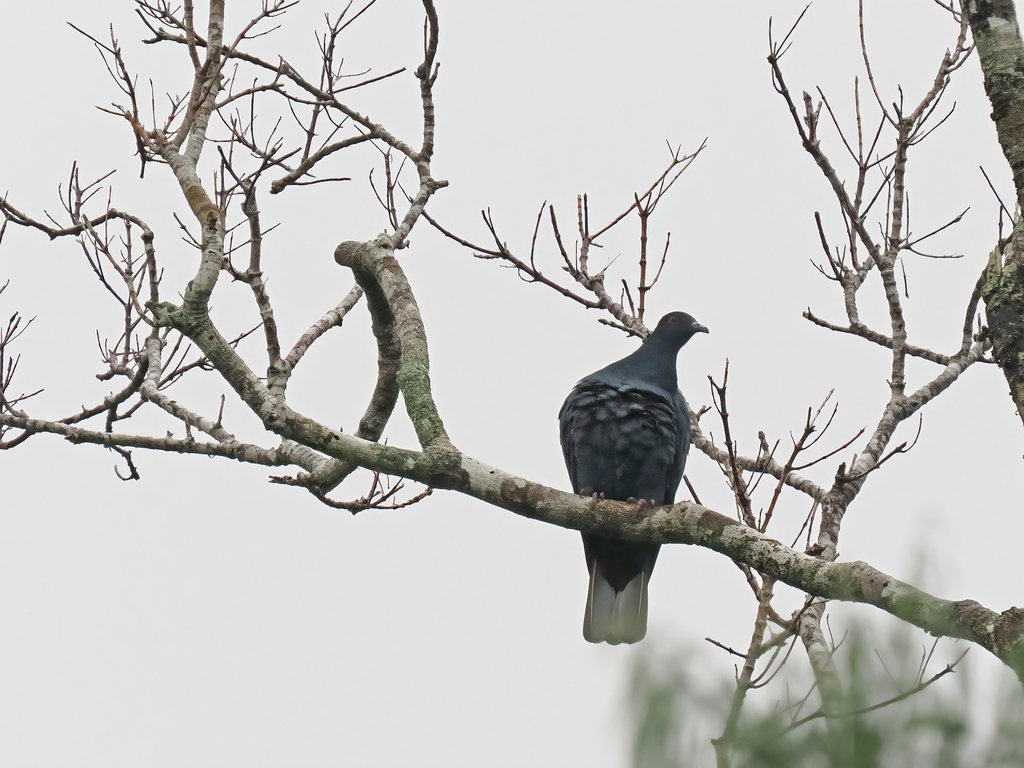
The black imperial pigeon (Ducula melanochroa), also known as the Bismarck imperial pigeon, is a species of bird in the pigeon family, Columbidae.
- Kingdom
- Animalia
- Phylum
- Chordata
- Class
- Aves
- Order
- Columbiformes
- Family
- Columbidae
- Genus
- Ducula
- Species
- Ducula melanochroa
Description
The black imperial pigeon (Ducula melanochroa), also known as the Bismarck imperial pigeon, is a species of bird in the pigeon family, Columbidae. First described by English zoologist Philip Sclater in 1878, it is endemic to the Bismarck Archipelago, where it mainly inhabits rainforest and cloud forest in mountain areas above 500 m (1,600 ft). It is a large, heavily built imperial pigeon, with a length of 38–43 cm (15–17 in) and a weight of 661–665 g (23.3–23.5 oz). Adults are almost entirely black, except for the dark chestnut undertail coverts, the silvery-grey underside of the tail, and a pale grey scaly pattern on the wings and back. Both sexes look alike. Juveniles differ from adults in having paler undertail coverts. The species feeds on fruit in the canopy, usually alone or in small flocks of up to 20 birds, though flocks of up to 40 birds have been found on fig trees. The only known nest was found on a mossy tree in January 1994 and had a single white egg. The pigeon is generally common in mountainous regions and is listed as being of least concern on the IUCN Red List due to its sufficiently large range and lack of sufficient decline in its populations.
Gallery
Ajouter des photos
Partagez vos photos de cette espèce (jusqu'à 20 à la fois) : elles sont vérifiées automatiquement, puis publiées.
Répartition
Occurrences observées (données GBIF). Les zones hors aire d'origine peuvent indiquer une présence introduite ou invasive.
Sources et crédits
Informations provenant de plusieurs sources vérifiées. Dernière mise à jour : .
Crédits photos (4)
- Photo : @peterodekerken · CC BY-NC 4.0 · via iNaturalist
- Photo : Norma Malinowski (@bogwalker) · CC BY 4.0 · via iNaturalist
- Photo : Nik Borrow (@nikborrow) · CC BY-NC 4.0 · via iNaturalist
- Photo : @peterodekerken · CC BY-NC 4.0 · via iNaturalist
Mentions de licence
Texte disponible sous licence CC BY-SA 4.0. Il adapte notamment Wikipedia (CC BY-SA) : Black imperial pigeon (Wikipédia, auteurs dans l’historique de l’article).
- Taxonomie : GBIF Backbone Taxonomy (CC BY 4.0)
- Carte : occurrences GBIF, fond © contributeurs OpenStreetMap (ODbL)
- Statut de conservation : Liste rouge de l'UICN, via Wikidata (CC0)
Détail : Sources et licences.
Discussion (0)
Aucun message pour l’instant. Lancez la discussion sur cette fiche (sources, précisions, débats éditoriaux).
Connectez-vous pour participer à la discussion.