
Northern Pintail
Anas acuta
The pintail or northern pintail (Anas acuta) is a duck species with wide geographic distribution that breeds in the northern areas of Europe and across the Palearctic and North America.
- Kingdom
- Animalia
- Phylum
- Chordata
- Class
- Aves
- Order
- Anseriformes
- Family
- Anatidae
- Genus
- Anas
- Species
- Anas acuta
Description
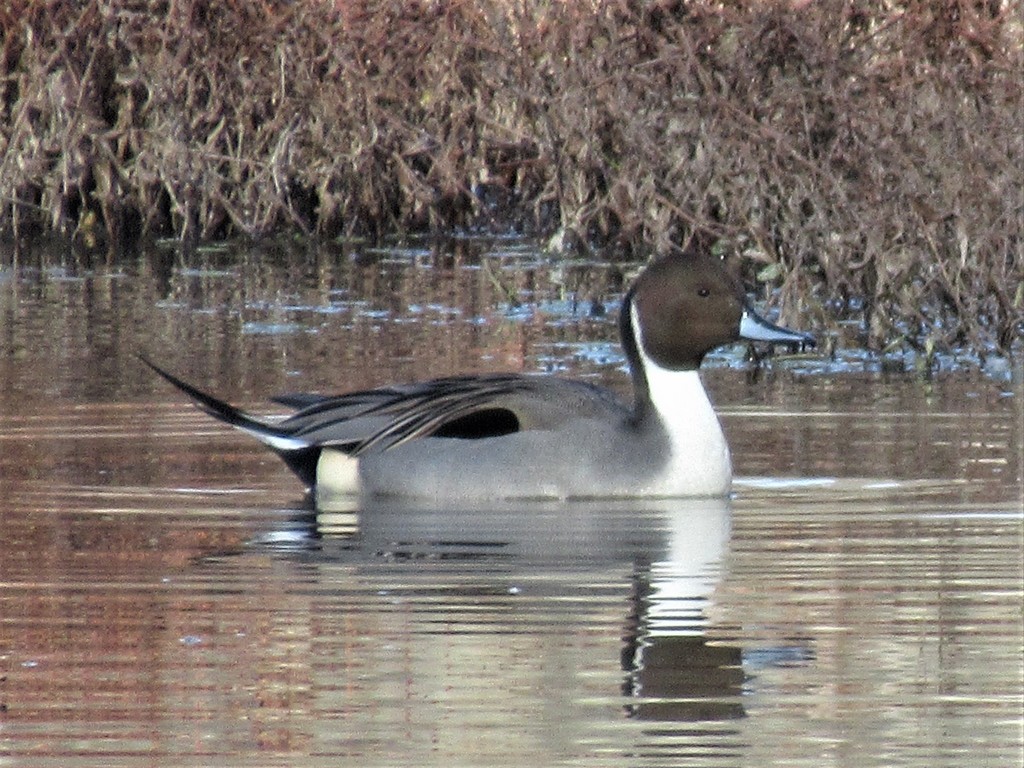
The pintail or northern pintail (Anas acuta) is a duck species with wide geographic distribution that breeds in the northern areas of Europe and across the Palearctic and North America. It is migratory and winters south of its breeding range as far as the equator. Unusually for a bird with such a large range, it has no geographical subspecies, although the possibly conspecific duck Eaton's pintail is considered to be a separate species. The Northern Pintail is a large duck, and the long central tail feathers of the male give the species its English and scientific names. Both sexes have blue-grey bills and grey legs and feet. The drake is more striking, with a thin white stripe running from the back of its chocolate-coloured head down its neck to its mostly white underparts. The drake also has attractive grey, brown, and black markings on its back and sides. The hen's plumage is more subtle and subdued, with drab brown feathers similar to those of other female dabbling ducks. Hens make a rough quacking sound and the drakes a flute-like whistle. The Northern Pintail is a bird of open wetlands that nests on the ground, often some distance from water. It feeds by dabbling for plant food, adding small invertebrates to its diet during the nesting season. It is highly gregarious when not breeding, forming large mixed flocks with other duck species. This duck's population is affected by predators, parasites and avian diseases. Human activities, such as agriculture, hunting and fishing, have also had a significant impact on numbers. Despite this, the species is not globally threatened due to its large range and abundance.
Gallery
Ajouter des photos
Partagez vos photos de cette espèce (jusqu'à 20 à la fois) : elles sont vérifiées automatiquement, puis publiées.
Répartition
Occurrences observées (données GBIF). Les zones hors aire d'origine peuvent indiquer une présence introduite ou invasive.
Sources et crédits
Informations provenant de plusieurs sources vérifiées. Dernière mise à jour : .
Crédits photos (8)
- Photo : Carol Mullen (@zhelicarol) · CC BY-NC 4.0 · via iNaturalist
- Photo : Carrie E. (@carriechelle) · CC BY-NC 4.0 · via iNaturalist
- Photo : Timur Kalininsky (@timur_kalininsky) · CC BY 4.0 · via iNaturalist
- Photo : Lauren (@quacker_barrel) · CC BY-NC 4.0 · via iNaturalist
- Photo : P Holroyd (@pholroyd) · CC BY 4.0 · via iNaturalist
- Photo : @zgy · CC BY-NC 4.0 · via iNaturalist
- Photo : Ken Finger (@kaf213) · CC BY-NC 4.0 · via iNaturalist
- Photo : Liam Huber (@liamhuber) · CC BY-NC 4.0 · via iNaturalist
Mentions de licence
Texte disponible sous licence CC BY-SA 4.0. Il adapte notamment Wikipedia (CC BY-SA) : Northern pintail (Wikipédia, auteurs dans l’historique de l’article).
- Taxonomie : GBIF Backbone Taxonomy (CC BY 4.0)
- Carte : occurrences GBIF, fond © contributeurs OpenStreetMap (ODbL)
- Statut de conservation : Liste rouge de l'UICN, via Wikidata (CC0)
Détail : Sources et licences.
Discussion (0)
Aucun message pour l’instant. Lancez la discussion sur cette fiche (sources, précisions, débats éditoriaux).
Connectez-vous pour participer à la discussion.