
Blue-and-black Tanager
Tangara vassorii
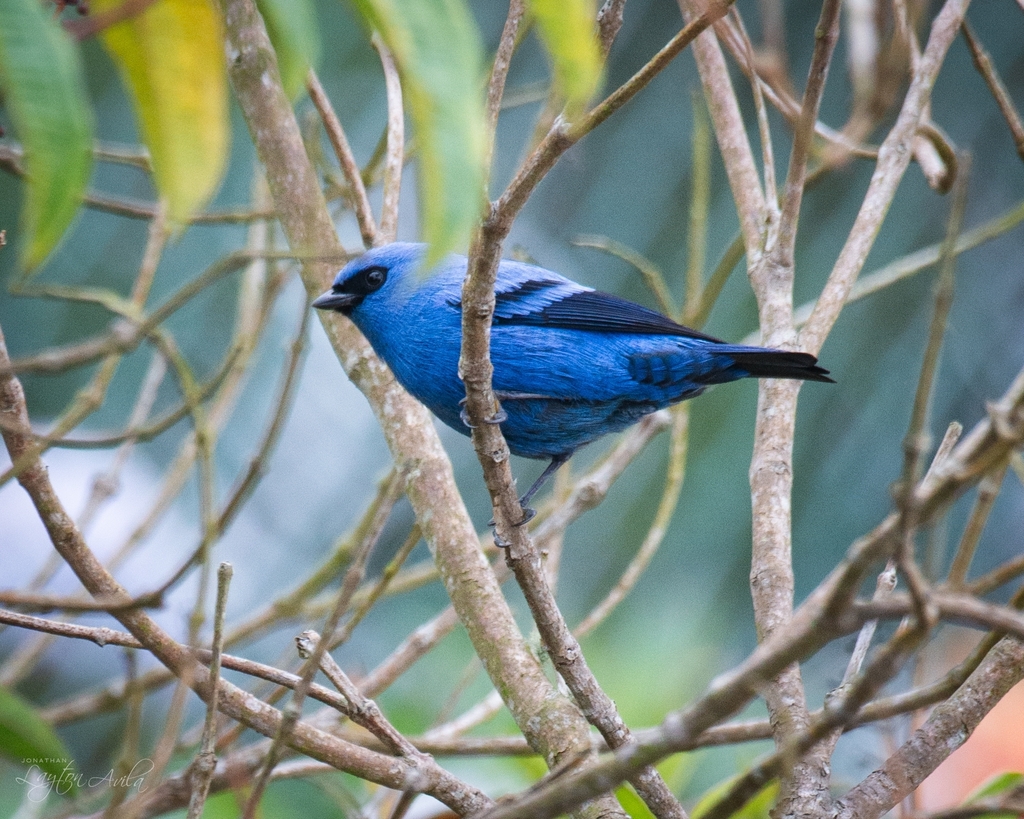
The blue-and-black tanager (Tangara vassorii) is a species of bird in the tanager family Thraupidae.
- Kingdom
- Animalia
- Phylum
- Chordata
- Class
- Aves
- Order
- Passeriformes
- Family
- Thraupidae
- Genus
- Tangara
- Species
- Tangara vassorii
Description
The blue-and-black tanager (Tangara vassorii) is a species of bird in the tanager family Thraupidae. It is found in the Andes of Bolivia, Colombia, Ecuador, Peru and Venezuela, where it inhabits montane evergreen forest, dwarf forest, and secondary forest at elevations of 1,500–3,500 m (4,900–11,500 ft). It inhabits the highest altitude of any Tangara species, and is the only species from the genus that is found near the tree line. Adults are 13 cm (5.1 in) long and weigh 18 g (0.63 oz) on average, and are mostly blue with black masks, wings, and tails. The species shows slight sexual dimorphism, with females being slightly duller than males. The blue-and-black tanager feeds on fruit and arthropods, with the most favored fruit being Miconia. It forages in mixed-species flocks in pairs or groups of 3–6 individuals, especially with Iridosornis or Anisognathus. It breeds from February to August, making cup nests out of moss and rootlets. Begging young have been reported in January, while fledglings have been reported in May. The blue-and-black tanager is listed as being of least concern by the International Union for Conservation of Nature (IUCN) on the IUCN Red List due to its large range, relative commonness, and lack of significant population declines, but is threatened by habitat destruction.
Gallery
Ajouter des photos
Partagez vos photos de cette espèce (jusqu'à 20 à la fois) : elles sont vérifiées automatiquement, puis publiées.
Répartition
Occurrences observées (données GBIF). Les zones hors aire d'origine peuvent indiquer une présence introduite ou invasive.
Sources et crédits
Informations provenant de plusieurs sources vérifiées. Dernière mise à jour : .
Crédits photos (8)
- Photo : Jonathan Layton Avila (@jonathanlaytonavila) · CC BY-NC 4.0 · via iNaturalist
- Photo : Sebastián Berrío (@sebastianberrio) · CC BY-NC 4.0 · via iNaturalist
- Photo : Mateo Giraldo Tamayo (@mateogiraldot) · CC BY-NC 4.0 · via iNaturalist
- Photo : Esteban Poveda (@quilicotriste) · CC BY 4.0 · via iNaturalist
- Photo : Rob Westerduijn (@rob-westerduijn) · CC BY-NC 4.0 · via iNaturalist
- Photo : Luis Yupa (@luisyupa) · CC BY-NC 4.0 · via iNaturalist
- Photo : Floro Ortiz Contreras (@floroortizcontreras) · CC BY 4.0 · via iNaturalist
- Photo : Ferney de Jesús Saez Solano (@ferney_de_jesus) · CC BY-NC 4.0 · via iNaturalist
Mentions de licence
Texte disponible sous licence CC BY-SA 4.0. Il adapte notamment Wikipedia (CC BY-SA) : Blue-and-black tanager (Wikipédia, auteurs dans l’historique de l’article).
- Taxonomie : GBIF Backbone Taxonomy (CC BY 4.0)
- Carte : occurrences GBIF, fond © contributeurs OpenStreetMap (ODbL)
- Statut de conservation : Liste rouge de l'UICN, via Wikidata (CC0)
Détail : Sources et licences.
Discussion (0)
Aucun message pour l’instant. Lancez la discussion sur cette fiche (sources, précisions, débats éditoriaux).
Connectez-vous pour participer à la discussion.